About the numbers. Adoption programs set their own fees and rules, and they change them. Every fee and process step below was read on the program's own website on 24 October 2026 (AEDT), and the source list shows the page and date. Where a program doesn't publish a fee, we say so and mark it "TBC" rather than guess. Always confirm with the program before you apply. For purchase prices and yearly running costs, we link to our cost guides instead of repeating them.
Adopting a horse is not like adopting a dog. Most horse "adoptions" in Australia are really careful, conditional placements: you apply, you're checked, you sign a contract, and the horse often stays legally tied to the group that placed it. The rules differ between a rescue charity, a racing industry retraining program and a national park brumby scheme. This guide explains each pathway, what the published conditions are, and how to work out honestly whether a particular horse is right for you.
The quick answer
To adopt a horse in Australia, apply to a rescue or rehoming program, or buy through a racing industry retrainer. Expect references, a look at your property, a meeting with the horse and a written contract. Published fees we found on 24 October 2026 were $1,000 for horses at RSPCA NSW (some listings $500) [21][44], $150–$1,000 at RSPCA Victoria [23] and $125 (unstarted) or $400 (started) for Standardbreds through the Standardbred Association Queensland, plus a membership [17]. The Australian Brumby Alliance says NSW National Parks charges no fee for Kosciuszko brumbies, but applications must be for a minimum of five horses [20][42]. Ex-racehorses usually go through a retrainer who sets the price; the racing bodies don't publish one [3][9][11].
The fee is the smallest part. Your property needs a Property Identification Code (PIC) or equivalent registration in most states (see the state rules), and the running costs begin on day one. See what a horse costs per year and what it costs to buy one before you apply.
What adopting a horse means in Australia
There is no national adoption scheme and no single register of horses needing homes. In practice you'll meet four models:
- Charity adoption. A rescue or RSPCA branch controls the horse, assesses you and charges a fee. Many keep a return clause [24][25][27].
- Lease first, own later. The Standardbred Association Queensland uses a 12-month free lease [17], Elysian Fields a lease of up to six months [26], and Project Hope Horse Welfare Victoria leases rather than adopts out [28].
- Industry retraining and rehoming. Racing bodies accredit retrainers and rehomers who sell or place ex-racehorses. The racing body generally doesn't set the price [3][9][11].
- Government rehoming. Park authorities give approved rehomers wild horses from national parks [18][19].
Ask who owns the horse today, who owns it in 12 months and what happens if you can't keep it.
Which type of horse suits you
Four kinds of horse come up most often. Each suits a different person.
| Horse type | Often suits | Watch for |
|---|---|---|
| Ex-racehorse (Thoroughbred or Standardbred) | Riders with some experience and time to retrain. Standardbreds are often placed unstarted [17]. | Months of letdown and retraining. Some Team Thoroughbred NSW horses are only offered to riders who can show competency [7]. |
| Brumby (wild horse) | Experienced handlers with strong yards and a plan for a horse that has never been handled [18][19]. | Wild-caught horses are not a first horse. Park programs want proof of skills and facilities [19]. |
| Retired or companion horse | Anyone who wants a paddock friend, or an older horse for gentle riding or no riding | Dental, joint and weight needs rise with age. See horse teeth and age and weighing a horse without scales |
| Rescue horse | Adopters with a safe property who can accept an unknown history | Some rescue horses are "not for beginners" and groups will decline a mismatch [24] |
Be honest with yourself and the rescue. Save A Horse Australia says beginners who apply for horses listed as not for beginners won't be considered [24]. That's not gatekeeping, it's how a good match gets made.
Are you ready to adopt a horse
Almost every program asks the same things.
- Land or agistment. You need safe fencing, shade, shelter, water and feed. Some groups accept agistment if it offers all of these [27]. See agistment costs, the agistment agreement checklist and our agistment directory.
- A companion. Horses are herd animals. Save A Horse Australia prefers homes with other horses [24], and All4hoovesWA's contract requires a companion [25].
- Experience. Save A Horse Australia wants two industry referees who aren't relatives, such as a vet, farrier, coach or agistment owner [24].
- Money and time. You pay all vet, farrier, feed and dental bills [27]. All4hoovesWA's contract writes in hoof care every four to six weeks, worming every six to eight weeks or as needed, and dental care every 12 months [25]. Test your budget with the horse cost calculator, and see our worming and vaccination schedules.
- Support. Line up a vet, farrier and coach before the horse arrives: equine vets, farriers, equine dentists, trainers and coaches or find a provider.
How to adopt an ex-racehorse in Australia
Many racehorses make good riding horses with the right retraining. The process is mostly a private sale or placement, supported by racing industry programs. Each state's racing body runs its own scheme, so what's available depends on where the horse raced.
What the Racing Australia rules mean for you
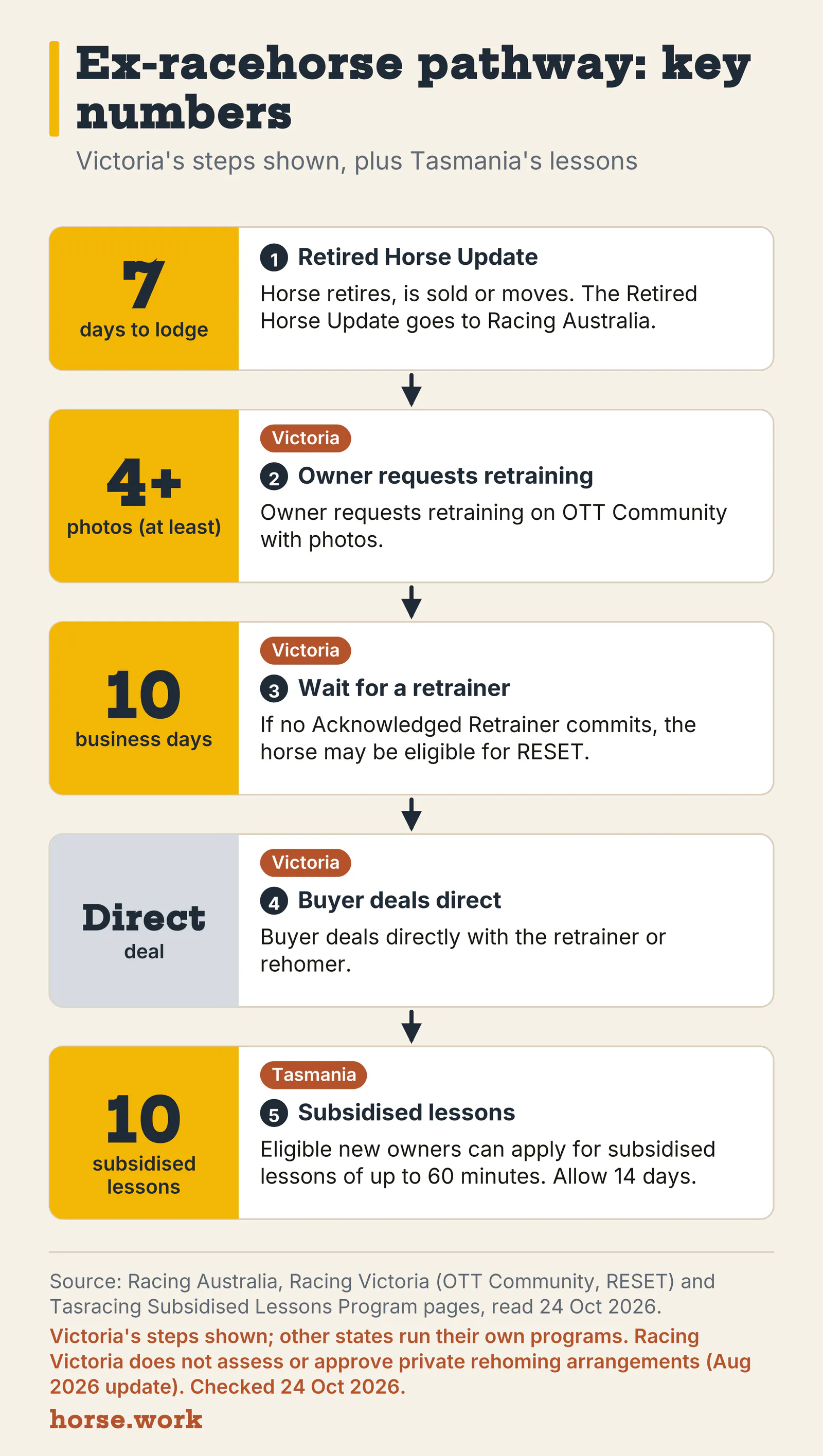
Racing Australia's traceability rules require that, within 7 days, a Retired Horse Update is lodged online through myhorseracing.horse (or on paper) when a horse registered with Racing Australia that has retired from racing is given away, sold, moves location, retires from its current career or dies [1]. The retirement notification form refers to Australian Rules of Racing AR 290 and AR 297 and lists the possible destinations, including direct to an equestrian pursuit, assisted rehoming by the racing regulator, a non-equestrian pursuit, Thoroughbred breeding, auction and private sale [2]. Horses away for veterinary treatment for up to 30 days, or at an auction for up to 7 days, don't need an update [1].
What this means for an adopter: the owner or trainer should handle the retirement paperwork, and a good seller will tell you they've done it. It's reasonable to ask. Team Thoroughbred NSW also advises new owners to lodge a Retired Horse Status Update, and its "Re-homing a Racehorse" form documents the change of ownership [41]. Racing NSW and Equestrian Australia have a five-year partnership to build a retired-horse traceability platform, but on 30 September 2026 it was still planned rather than live [38]. The rules sit in Part 14 of the Australian Rules of Racing, as at 1 October 2026 [39].
Victoria: Racing Victoria Off The Track
Racing Victoria's Off The Track (OTT) Community runs the main Victorian pathway. For an owner retiring a horse, the steps are: register on the OTT Community, use OTT Search, choose Request Retraining and upload at least four photos. Once approved, the horse's profile goes to the Acknowledged Retrainer network. If no retrainer commits within 10 business days, the horse may be eligible for the RESET program (checked 24 Oct 2026) [3]. Buyers deal with the retrainer or rehomer directly, and the OTT Community's programs page helps you find a provider near you [5]. No adopter fee is published, so treat the price as set by the seller (TBC).
Two things worth knowing, both from Racing Victoria's own pages:
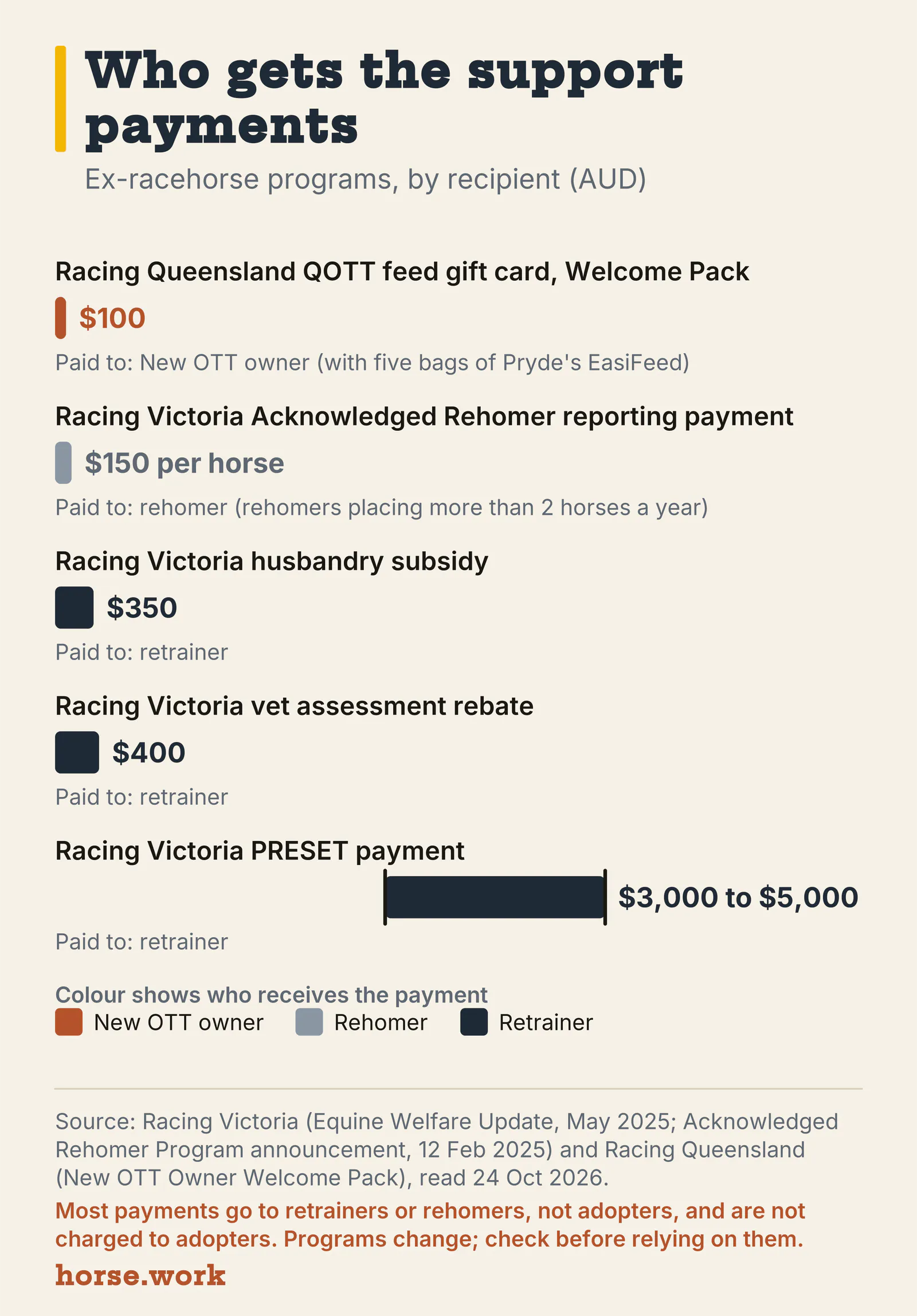
- Acknowledged Rehomers must screen you. Since February 2025, rehomers placing more than two OTT Thoroughbreds a year receive a one-off $150 reporting payment per horse, paid to the rehomer and not charged to the adopter. They must screen prospective owners on experience, retraining experience and where the horse will be kept. Racing Victoria doesn't require a ridden assessment from rehomers [4].
- Racing Victoria does not vet private deals. Its August 2026 update says RV "does not assess or approve private rehoming arrangements" once a horse leaves an industry participant's care [5]. Do your own checks.
Support for new owners: the August 2026 update reports 94 subsidised education clinics for OTT owners and riders in the 2025–26 financial year, with more than 1,400 subsidies redeemed to date [5]. Racing Victoria's May 2025 update lists payments to retrainers, not adopters: a $350 husbandry subsidy, a $400 veterinary assessment rebate and PRESET payments of $3,000–$5,000 per horse [6].
New South Wales: Team Thoroughbred NSW
Team Thoroughbred NSW (TTNSW) is Racing NSW's program for retired racehorses. Owners can surrender a horse for free, and unsuitable horses stay in care [8]. For buyers, the process runs through a Potential Buyer expression of interest, which asks for evidence of riding competency before a test ride or sale. Beginners are told the horses aren't suitable. The form defines Novice as over 60 lesson hours and Intermediate as over 200 lesson hours plus competing [7][43]. TTNSW says horses are "priced to suit all budgets"; the price isn't published (TBC) [7]. Its surrender steps refer to rehoming attempts under Local Rule 114 [40].
Queensland: QOTT
Racing Queensland's Queensland Off The Track (QOTT) lists Acknowledged Retrainers. Buyers contact a retrainer directly, and QOTT accepts no responsibility for the arrangement [9]. New OTT owners can claim a Welcome Pack with a $100 feed gift card (when you buy five 20 kg or 25 kg bags of Pryde's EasiFeed), one pack per horse per lifetime, with Clubhouse membership required [10]. Prices aren't published (TBC).
Western Australia, South Australia and Tasmania
- WA. Off The Track WA runs a buy-and-sell page. Ads are posted by independent parties unless marked as OTTWA Retraining Program horses [14].
- SA. Thorough Care SA's Thorough Care Pack is offered to Thoroughbreds that apply within three months of retirement and meet the South Australian domicile or racing criteria; terms and conditions apply [13].
- Tasmania. Off The Track Tasmania doesn't own or sell horses. You negotiate with the owner or trainer, or an Acknowledged Retrainer [11]. New owners of eligible horses retired less than 12 months can apply for 10 subsidised lessons of up to 60 minutes with approved coaches; allow 14 days for processing [12].
Retired Standardbreds
Harness racing has its own programs. HRV Hero's formal pathway runs through nomination, a pre-acceptance vet check, a waitlist, an allocated retrainer and owner transport [16]. Separately, its Direct Off The Track page lists horses placed by their racing connections, which may be unbroken. These aren't Hero program horses, so the sale agreement is between buyer and seller [15]. In Queensland, the SAQ Horse Placement Program has re-homed almost 1,300 Standardbreds since 2002 [17]. Fees and conditions are in the table below.
How to rehome a brumby
"Brumby" can mean a wild horse removed from a national park or a domestic horse of brumby type. Park programs are tightly controlled.
NSW (Kosciuszko National Park). Only NSW NPWS-approved rehomers receive horses, and approval lasts up to 12 months [18]. Applications must be for at least five horses [20][42]. The Australian Brumby Alliance says you have 48 hours to collect once horses are available [20], and that there is no fee, but you must provide transport and cover all ongoing costs [20][42]. If you want fewer than five, contact an approved rehomer; the NPWS page named Clearview Brumby Rescue (Thangool, Qld), Rosewood Hills Brumby Rescue (Rosewood, NSW), Mountain Brumby Sanctuary (Cooma, NSW) and Umbango South (Humula, NSW) on 24 October 2026 [18]. The NPWS wild horse team is on 1300 361 967 [18].
Victoria (Parks Victoria). You submit an Expression of Interest. You must be 18 or over, have no offences under the Prevention of Cruelty to Animals Act 1986, have suitable containment and agree to a site inspection. Parks Victoria transports horses within five hours of the trap site and traps only when recipients are secured [19].
Wild-caught brumbies are not for first-time owners. The Australian Brumby Alliance's rehoming page, which reproduces Parks Victoria guidance, says the horses "are wild animals" and applicants must be prepared to train and care for them [20]. You'll need round yards, handling skill, strong fencing and a coach.
Retired and companion horses
Many adoptable horses are simply older, or retired from work. They can be wonderful, but they need a clear-eyed plan.
- Ask what "sound" means. A horse may suit gentle riding, or be a paddock companion only. Say what you want and ask the group to be specific.
- Plan for age. Older horses may need dental work and weight management. See horse teeth and age, weighing a horse without scales and hay nets and slow feeders, and check supplement evidence with your vet before buying anything.
- Know the emergencies. Learn the signs of colic and the risks of spring laminitis before the horse arrives.
- Companions still cost. Save A Horse Australia's form says horses can't just be left in a paddock to eat grass, and that includes paddock companions that aren't ridden [24].
- Pairs. RSPCA Victoria lists discounted pricing for bonded pairs [23], and Save A Horse Australia gives preference to adopters who will take more than one [24].
Adopting a rescue horse
Rescue horses come through RSPCAs, charities, sanctuaries and community groups. The process is similar across them.
- Enquire or apply. RSPCA Victoria asks for an application through the horse's profile or an email to its barn or horse team [23]. All4hoovesWA starts with an expression of interest form [25].
- Background and property checks. All4hoovesWA does background and welfare checks [25]. The Winged Horse requires a site inspection and three references, preferably including an equine vet [27]. Elysian Fields wants professional references and a virtual or live property check [26]. Save A Horse Australia asks for two industry referees, photos of your pasture, water, shade and fencing, and a riding video for a ridden horse [24].
- Meet the horse. All4hoovesWA says everyone needs an in-person viewing [25].
- Sign the contract and pay the fee. All4hoovesWA sends forms and fee details after the viewing [25].
- Collect the horse. You usually pay for transport [24]. Use our float hire vs buying guide, the transport cost calculator and horse transport directory, and read floating a horse long distance.
For RSPCA NSW, bring photo identification showing your name and current address [22]. RSPCA NSW horse listings also say you will need a PIC number to adopt [44]. RSPCA NSW says its horses have had comprehensive health and behavioural checks and that adoption fees help recover a portion of those costs [22].
Distance matters: Save A Horse Australia adopts to Queensland and NSW residents within about four to five hours of its Beaudesert sanctuary, and considers others case by case [24]. Browse our horse rescue directory to find groups near you. Horse Rescue Australia describes bespoke matching and says it always takes a horse back [29].
Published fees and conditions (checked 24 October 2026)
| Program | Published fee | Key conditions |
|---|---|---|
| RSPCA NSW | $1,000 (horses) [21]; some listings show $500 [44] | Photo ID with name and current address [22]; PIC number (stated on individual horse listings) [44] |
| RSPCA Victoria | $150–$1,000 for horses [23] | Apply via the horse's profile or email [23] |
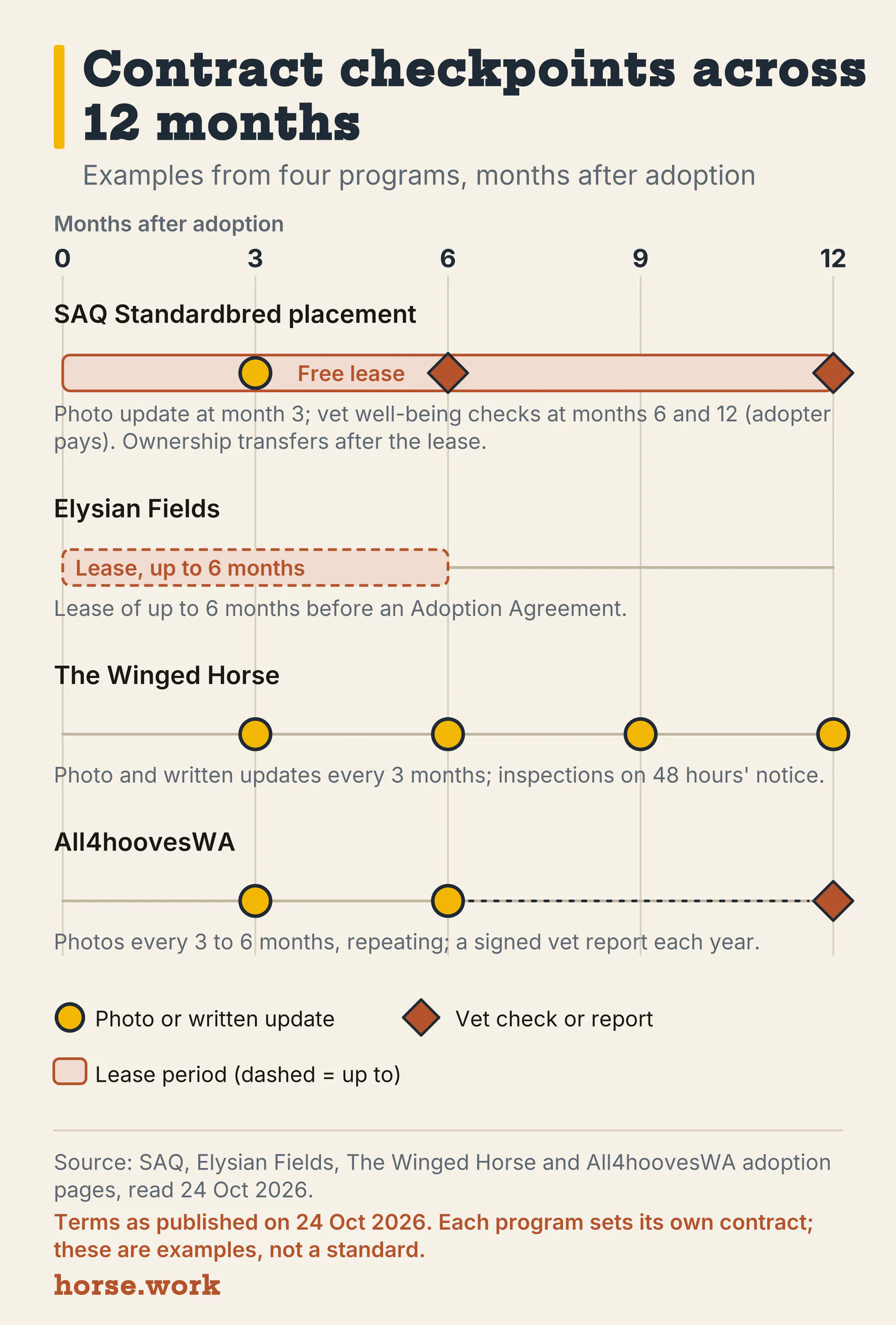
| Standardbred Association Queensland | $125 unstarted, $400 started, plus SAQ membership for at least two years (membership fee TBC) [17] | 12-month free lease. Never raced again. Three-month update with photos, then vet checks at 6 and 12 months at adopter's cost. Ownership can transfer on completion if conditions are met [17] |
| NSW NPWS (Kosciuszko brumbies) | No fee, per the Australian Brumby Alliance. Adopter pays transport and costs [20][42] | Minimum five horses [20][42], or use an approved rehomer; approval lasts up to 12 months [18] |
| Parks Victoria (feral horses) | TBC | EOI, 18+, containment, site inspection [19] |
| Save A Horse Australia | TBC | Two industry referees, property photos, no breeding, no sale, must return to the group [24] |
| All4hoovesWA (WA) | Given after approval (TBC) | Companion required, yearly vet report, photos every 3–6 months, no breeding, must return [25] |
| Elysian Fields | TBC | Lease up to 6 months before adoption agreement [26] |
| The Winged Horse (Vic) | TBC | Three references, site inspection, never sold, return to the group, updates every three months [27] |
| Project Hope Horse Welfare Victoria (PHHWV) | TBC (a lease program, Victoria only) | Membership, annual updates, mares will not be bred from [28] |
| Ex-racehorses (RV, QOTT, Tasracing, TTNSW, Thorough Care SA) | Not published. Set by the seller or retrainer (TBC) [3][7][9][11] | Varies by retrainer |
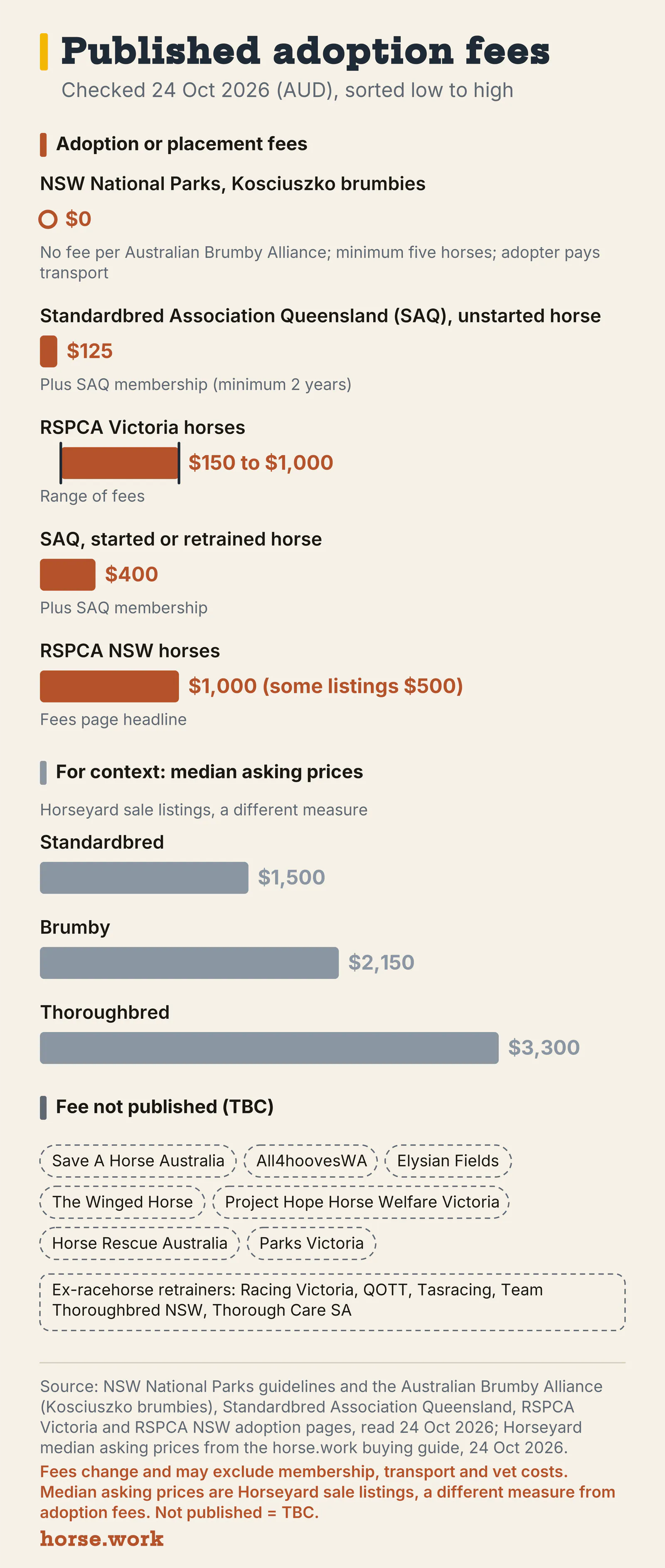
For comparison, Horseyard median asking prices on 24 October 2026 were $1,500 for Standardbreds, $2,150 for brumbies and $3,300 for Thoroughbreds (see our buying guide). Those are asking prices for sale listings, not adoption fees, so don't treat them as like for like.
What the contract will ask of you
Rescue contracts exist to protect the horse. Common terms:
- No breeding and no sale. Save A Horse Australia says the horse can't be bred, sold or given away [24]. The Winged Horse says the horse will never be sold [27].
- A return clause. If you can't keep the horse, it goes back. All4hoovesWA says dumping a sick horse isn't acceptable and you stay liable for vet costs [25].
- Updates and inspections. The Winged Horse may inspect with 48 hours' notice and asks for photo and written updates every three months [27]. All4hoovesWA asks for a yearly vet report [25]. SAQ asks for a three-month update with photos, then vet well-being checks at six and 12 months [17].
- A trial period. SAQ's 12-month lease is the longest we found [17].
Read every clause. If a group can't explain who owns the horse, walk away.
Pre-adoption vet check and health questions
A rescue's vet check is not your check. If the horse matters to you, book your own vet before you commit. The University of Sydney's Equine Centre Camden describes a pre-purchase examination as an assessment of health and soundness at the time of examination only. Depending on the intended use it can include a clinical exam, gait assessment, X-rays, ultrasound, blood tests and endoscopy, and it doesn't guarantee future health [37]. X-rays aren't part of every exam [37].
Tell your vet what you plan to do with the horse and ask for a written summary. See equine vets and the pre-purchase section of our buying guide for costs. Ask the group for the horse's history: injuries, behaviour, vaccinations, worming, farrier and dental records. Team Thoroughbred NSW, for example, asks surrendering owners for dental float, 2-in-1 and worming records [40]. If you live in a Hendra area, read our Hendra virus guide and ask your vet about vaccination.
Behaviour matters as much as soundness. Ask how the horse handles being caught, tied, led, floated, shod and left alone. Visit more than once, and have an experienced coach watch you handle it if you can.
PIC, microchips and ownership transfer by state
Property registration is the legal step most adopters miss. Rules are state-based. Here's what the official pages said on 24 October 2026.
| State | Requirement | Cost and notes |
|---|---|---|
| Victoria | A PIC is required for properties where horses are kept [30] | No cost to apply, receive or update. Allow seven business days. If you advertise or give away livestock online or in print, the ad must include the PIC. A PIC is not required if the sale is through a livestock agent and the agent's name and contact details have been included [30] |
| NSW | Any property with livestock, including horses kept as pets or agisted, needs a PIC [31] | Fee TBC. Apply through Local Land Services on 1300 795 299 [31] |
| Queensland | You must register as a biosecurity entity if you own or keep one or more horses, even if agisted [32] | See our buying guide for fees. The page was last updated 20 March 2023 [32] |
| Western Australia | All horse owners must be registered and have a PIC. Horses must carry your registered brand or an approved identifier before 18 months (6 months in the South West Land Division) or before moving [33] | Penalties up to $20,000. Approved identifiers can include breed society systems, microchip or tattoo [33] |
| South Australia | PIC required for one or more horses [34] | $108 every 2 years. Allow 8–10 weeks. Fines up to $10,000 [34] |
| Tasmania, ACT, NT | TBC | Not verified for this guide. Check with the state agriculture department |
Microchips and transfer of ownership
In Victoria, microchipping a horse isn't compulsory, but only an authorised veterinary implanter may legally do it. The implanter sends details to a licensed animal registry. When ownership changes, the new owner completes a change of ownership form with that registry, and the Victorian guidance recommends keeping evidence of the transfer [35]. We haven't verified microchip rules in other states (TBC). Ask the group what identification the horse has, whether it's registered and how to transfer ownership. Our buying guide covers registry and association transfer fees.
If you adopt an ex-racehorse, the retirement update is separate and sits with the racing industry [1]. Make sure both the racing record and any microchip registry are correct.
What adoption really costs afterwards
The adoption fee is a small slice. Once the horse arrives, the yearly bills begin: feed, farrier, dental, vet, worming, insurance, and agistment if you don't own land. Our horse cost per year guide shows the line items, and the horse cost calculator builds your budget. See also farrier pricing and the feed calculator.
Budget also for:
- Gear that fits. Use our rug size chart and saddlery directory.
- Lessons. Ex-racehorses and unhandled brumbies benefit from a coach. Browse riding schools and clubs and associations.
- Insurance. Read horse insurance in Australia and the insurance and finance directory. Ask the insurer early how it values a horse you paid little for.
- Seasonal risks. See summer horse care and Queensland itch.
Avoiding scams and dodgy rescues
Scamwatch warns that buying and selling scams use unbelievably low prices, fake websites and unusual payment methods. For pets, it advises you to view the animal in person, ask for a video call, verify the seller and treat very cheap offers as a likely scam. Don't pay for a big-ticket item before inspecting it [36].
For horses, the red flags are:
- A "free" or cheap horse you can't visit, or any deposit for a horse you haven't met.
- Pressure to pay quickly, or to pay by unusual methods, or into an account that doesn't match the person or group [36].
- No ABN, contact details or terms on the website [36].
- No contract, vet records or history, or a refusal to let your vet look at the horse.
- No checks on you. Real rescues ask questions. A group that hands over a horse without references or a property check is a warning sign.
Check a charity's ABN on ABN Lookup (business.gov.au), and search its name with "scam" or "review" [36]. If you've been scammed, call your bank first, then report it to Scamwatch [36].
Rehoming your own horse responsibly
If you need to rehome a horse, start early and plan the horse's future, not just a quick sale.
- Be honest about health, behaviour and training. A mismatched home is how horses end up back in the system.
- Use the right channel. For ex-racehorses, use your state's program: OTT Community in Victoria [3], Team Thoroughbred NSW [8], QOTT in Queensland [9] or Off The Track Tasmania [11]. For other horses, a reputable rescue or breed association may help.
- Screen buyers with references and a written agreement, and consider a return clause.
- Keep the paperwork right. Update the PIC, any microchip registry and racing or breed records. In Victoria, an ad that offers livestock for sale or free must include the PIC. A PIC is not required if the sale is through a livestock agent and the agent's name and contact details have been included [30].
Frequently asked questions
Can anyone adopt a horse in Australia? Not automatically. Most groups ask for references, a property check and an interview, and some decline beginners for certain horses [24][7]. State rules also require your property to be registered (see the state table).
How much does it cost to adopt a horse in Australia? Published fees we found were $1,000 at RSPCA NSW (some listings $500) [21][44], $150–$1,000 at RSPCA Victoria [23] and $125–$400 plus membership through SAQ [17]. Many groups don't publish a fee (TBC). The ongoing costs are far larger. See what a horse costs per year.
Is an ex-racehorse a good first horse? Usually not. They often need months of retraining, and Team Thoroughbred NSW tells beginners its horses aren't suitable [7]. A Standardbred placed through a program may be calmer, but SAQ notes that most of its horses haven't been broken to saddle [17].
Can I adopt a brumby? Yes, but not casually. NSW NPWS applications must be for a minimum of five horses [20][42], or you can contact an approved rehomer [18]. Parks Victoria requires an Expression of Interest and a site inspection [19].
Do I need a PIC to adopt a horse? In Victoria, NSW, Queensland, WA and SA, the official pages say horses need property registration or a PIC [30][31][32][33][34]. Check your own state's rules.
What if the adoption doesn't work out? Contact the group straight away. Most contracts require the horse to be returned [24][25][27]. Under SAQ's lease, you contact its Horse Welfare Officer [17].
Does this cover New Zealand? No. We haven't sourced New Zealand programs for this article, so check NZ rescues directly.
Can I adopt a horse from a council pound? We haven't verified any council horse rehoming program. Ask your local council.
Finding providers: use find a provider to locate vets, farriers, dentists, coaches and transporters near where your new horse will live.