Not veterinary advice. Laminitis is an emergency. If you think your horse or pony has it, call your vet now. This article is general information to help you spot it early and prevent it; it doesn't replace an examination.
Every spring, vets in southern Australia and New Zealand see the same pattern: rain, a flush of green grass, and a fat pony that suddenly won't walk. The RSPCA puts it plainly: "Spring is when most episodes of laminitis due to over-feeding occur" [1].
Laminitis can be managed but not cured, and once a horse has had an episode it's more likely to have another [1]. So the most useful thing an owner can do is prevention, and spotting it in the first hours.
What laminitis actually is
Inside the hoof, the coffin (pedal) bone is held to the hoof wall by soft, interlocking tissue called the laminae. Laminitis (also called founder) is inflammation of those laminae. The damage causes severe pain and can let the coffin bone become unstable; in bad cases it rotates or separates from the hoof wall [1]. Agriculture Victoria notes that in some cases the damage is untreatable and the horse has to be put down [2].
Who is most at risk
- Fat ponies and their crosses are the most predisposed [1]. Agriculture Victoria lists obesity, too much green pasture and grain as common causes, and says ponies are "particularly susceptible" [2].
- Horses that have had laminitis before. Look for hoof rings or slipper-shaped feet, signs that there are fewer healthy laminae left [1].
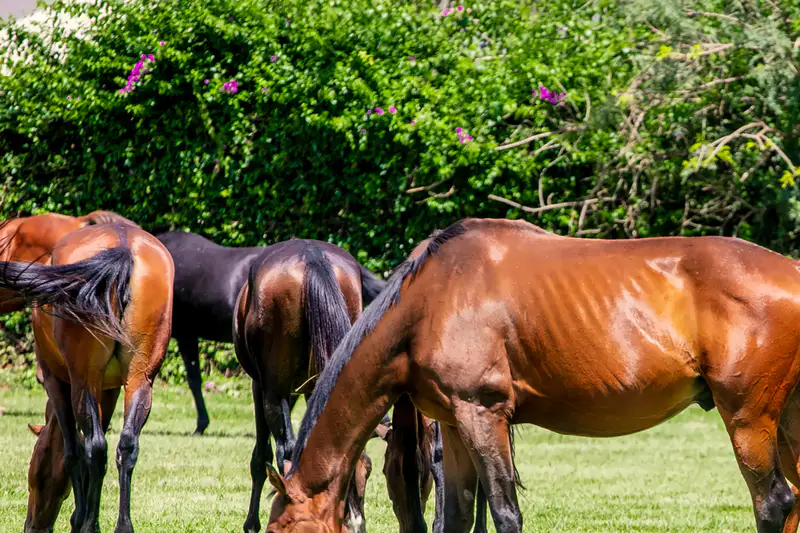
- Easy keepers carrying extra condition. On Agriculture Victoria's 0–5 scale, a score of 4 ("fat") shows a slight crest and a gutter along the back; 5 ("very fat") has a marked crest and folds of fat [4]. If your horse looks like that going into spring, it's high risk.
Other causes the RSPCA lists include breaking into the feed shed (grain overload), a retained placenta after foaling, serious infections, overloading one leg because of lameness in the other, and concussion from hard work or over-enthusiastic trimming [1].
Why spring grass is the trigger
The RSPCA explains that the soluble carbohydrate content of grasses and clovers increases after rain in spring; when eaten, this causes metabolic changes that alter blood flow to the laminae [1]. Australian research for AgriFutures (Watts and Pollitt, 2010) explains that environmental conditions can trigger up to three-fold increases in the sugar, starch and fructan content of pasture and hay, together called non-structural carbohydrates (NSC), and sets out pasture strategies for reducing the risk [5].
Early signs: what to look for
From the RSPCA's list of acute signs [1]:
- reluctance to move, and a "sawhorse" stance: rocking back to take weight off the front feet
- lying down more than usual
- difficulty picking up one front foot, because standing on the other one hurts
- warm hooves and coronary band
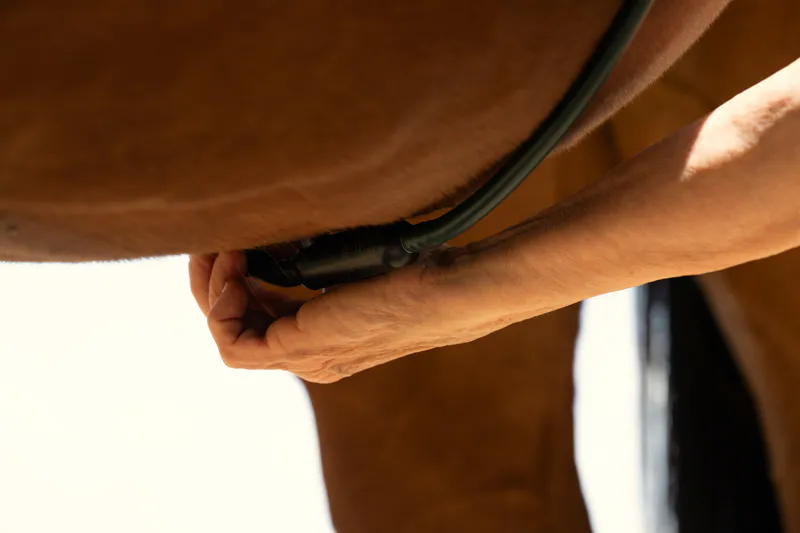
- strong, bounding digital pulses at the back of the fetlock (ask your vet to show you how to feel these before you need to)
- pain over the toe when hoof testers are used.
Both front feet are usually worse than the hinds, but all four can be affected [1]. Agriculture Victoria adds standing in water for long periods to the list of reasons to call a vet [2].
Chronic signs of past episodes include rings on the hoof wall, a dished or slipper shape with long toes, and a bulge in the sole if the bone has rotated [1].
What to do straight away
- Call your vet. The RSPCA says to seek veterinary attention immediately; X-rays are often used to see whether the bone has moved [1].
- Remove the cause. If over-feeding is the likely trigger, get the horse off the grass or away from the feed now [1].
- Until your vet advises otherwise, feed hay only [1].
- Keep the horse still, on soft footing. The RSPCA recommends deep shavings, or a sand yard picked out twice a day, and no exercise in the early stages because it may cause further rotation [1].
- Keep a companion in sight. Horses confined for treatment still need company [1].
Pain relief and anti-inflammatories are the cornerstone of treatment, but dose and drug are your vet's call, not ours [1]. Your farrier and vet should work together on trimming or shoeing [1].
Prevention: a practical spring plan
1. Know your horse's weight and condition, and track it. Use a weight tape or our horse weight calculator, which uses Agriculture Victoria's girth-and-length formula [4], and condition score every couple of weeks through spring. A change you can measure is easier to act on than "he looks a bit round".
2. Restrict access to lush pasture, especially in wet spring months [1]. Options owners use:
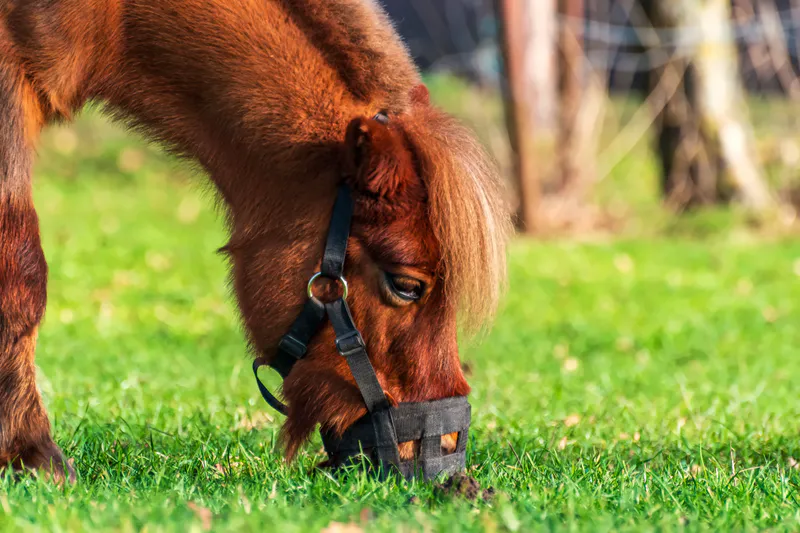
- a grazing muzzle, which lets the horse graze slowly while limiting intake
- a "sacrifice" area or dry lot with hay instead of pasture, an approach the AgriFutures report discusses for high-risk animals [5]
- shorter turnout times, with time in a yard on hay.
3. Change feed slowly. Agriculture Victoria advises introducing feed changes over 3 to 5 days, because a sudden change can cause colic or laminitis [3].
4. Watch the grain. Agriculture Victoria says concentrates should make up a maximum of 30% of the diet and be introduced gradually [3]. Lock the feed shed.
5. Don't trust a "laminitis-safe" label on its own. The RSPCA warns that many feeds promoted as safe for laminitic horses aren't appropriate if the horse is also getting other high-carbohydrate feed [1]. Ask your vet or an equine nutritionist to look at the whole diet. Our feed calculator gives you a starting budget to take to them.
6. Keep feet in good order. Regular trimming is part of prevention [1]. Agriculture Victoria suggests a farrier every 6–8 weeks for most horses [2]; the care planner can remind you.
7. Plan for weight loss before spring, not during it. A horse that comes out of winter in moderate condition is much easier to manage than one that's already fat when the grass arrives.
NZ owners
The same principles apply in New Zealand, where spring growth on improved pastures can be rapid. The sources in this article are Australian; talk to your vet about local pasture types and timing.
Frequently asked questions
Is founder the same as laminitis? Yes. The RSPCA notes that laminitis is also termed founder [1].
Can laminitis be cured? The RSPCA says it can be managed but not cured, which is why prevention matters so much [1].
Can a mare get laminitis after foaling? Yes. A retained placenta is one cause. The RSPCA says to call your vet immediately if you suspect a mare hasn't passed the placenta, warning that 12 hours later can be too late [1].
Is it only ponies? No. Fat ponies and their crosses are most at risk, but any horse with one of the causes above can be affected [1].
Quick checklist for this spring
- Condition score and weight recorded now
- Digital pulse: you know where it is and what normal feels like
- Grazing muzzle or dry lot ready for high-risk horses
- Feed shed secured
- Farrier booked
- Vet's number saved, including after-hours
If your horse shows the sawhorse stance, warm feet or bounding pulses, don't wait to see if it improves. Ring the vet.