Colic is an emergency. If you think your horse has colic, call your vet now. This article helps you recognise the signs and give your vet useful information. It can't tell you what's wrong with your horse, and it doesn't replace an examination. Don't give any medication unless your vet tells you to.
"Colic" isn't one disease. It's the word for abdominal pain, and that pain can come from many different problems in the gut [4]. Agriculture Victoria warns colic can be very painful and can have very serious consequences, including death [1]. Some cases settle quickly; others need surgery. From the outside, early on, they can look the same.
That's why every equine source we checked says the same thing: if you suspect colic, get your vet involved straight away.
The signs of colic
Agriculture Victoria lists these signs and says to seek urgent veterinary attention if you see them [1]:
- lying down or rolling frequently
- teeth grinding
- restlessness
- repeatedly kicking
- looking at their flanks or sides.
The MSD Veterinary Manual adds pawing repeatedly with a front foot, curling the upper lip and arching the neck, raising a hind leg or kicking at the belly, sweating, stretching out as if to urinate, straining to pass manure, a swollen belly, loss of appetite, depression and fewer droppings than usual [5]. It's uncommon for one horse to show all of these [5].
The quiet signs that are easy to miss
World Horse Welfare points out that early colic can be subtle: lying down more, eating less, or passing fewer droppings than normal [4]. A horse found muddier than usual, or with fresh grazes on its head or the bony parts of its body, may have been rolling violently overnight [4].
The RSPCA's list of signs of an unwell horse includes standing with the head low, not joining in with the herd, tucked-up flanks, unexplained sweating, and looking at the flanks, pawing or repeatedly getting up and down and rolling, which it describes as signs of abdominal pain [6]. Its advice is simple: if you think there's a problem and you don't know what it is, call a vet [6].
Red flags: when it's urgent
The University of Sydney's veterinary hospital lists urgent signs of colic [2]:
- violent or persistent rolling
- sweating, trembling or signs of severe pain
- symptoms getting rapidly worse over a short period
- no improvement after pain relief
- sudden onset of severe pain in the last few hours.
These need urgent veterinary attention, which may mean an emergency call-out or going straight to an equine hospital for investigation and possibly surgery [2].
It lists milder or ongoing signs as pawing, flank-watching or lying down more than usual, a reduced appetite or less manure, and mild pain that comes and goes [2]. Those still need a vet. If they've been coming and going for weeks or months, ask your vet about a work-up for chronic colic [2].
World Horse Welfare adds an important warning: although how bad the signs look usually matches how serious the problem is, that isn't always the case, so any colic should be treated as potentially serious [4].
What to do while you wait for the vet
1. Ring the vet first. Your vet can advise over the phone and help decide whether an emergency visit is needed [4]. The RSPCA recommends knowing a good horse vet and having their number in your mobile [6].
2. Keep yourself safe. Horses in severe pain can be dangerous to handle [4]. Don't put yourself at risk to do any of the steps below.
3. Take the feed away, leave the water. Vets typically advise continued access to water but not feed [4]. One Australian equine practice suggests a small yard with fresh water and no feed [3].
4. Make the space safe. A well-bedded stable with anything the horse could hurt itself on removed is often easiest; a horse found in the paddock is often best brought in, especially at night, because colic needs constant watching [4].
5. Walking: only if your vet advises it. Advice varies here. World Horse Welfare says limited hand walking should only be done on your vet's recommendation and never to the point the horse is tired [4]. Southwest Equine suggests walking a horse that's actively colicking can help move gas and stop it rolling [3]. Ask your vet when you call, and don't force a horse that won't walk.
6. Don't give medication. World Horse Welfare says not to medicate, because it can make it harder for the vet to decide whether the horse needs referral to a hospital [4]. Southwest Equine adds that giving one drug beforehand can limit what your vet can use, and can mask pain so the horse is harder to assess [3]. Leave all drugs and doses to your vet.
7. Think ahead about hospital. Some colics can't be managed at home. If referral is an option for you, have a plan for transporting your horse safely [3]. Have a trusted horse transporter in your phone, or know where your float keys are. World Horse Welfare notes that hospital treatment isn't always an option, for example if the horse is too sick to travel or the cost is more than you can pay or your insurance limit, and suggests talking your worries through with your vet [4].
What to note for your vet
Your vet will want to know how long the colic has been going, how fast it's getting worse, how severe the pain is, whether the horse has passed manure, and how it responded to any treatment [5]. They'll also ask about the horse's worming history, when its teeth were last done, any changes to feed or water, any history of crib-biting, and whether it was resting or working when the colic started [5]. Age matters too, because some conditions are more common at certain ages [5].
Jot this down, or keep it in your phone, while you wait:
- Time you first noticed signs, and what they were
- Changes since then: better, worse, the same
- Manure: when it was last passed, how many piles, and what it looked like (very hard, loose, big or small) [3]
- Eating and drinking: when it last ate, and whether it's drinking
- Recent changes: new hay, new hard feed, a new paddock, weeds in the paddock, recent worming [3]
- Recent travel or a change in routine
- Worming dates, last dental visit and vaccinations
- Any medication the horse has had in the past few days
- Past colic episodes
- Vital signs, if you can take them safely (see below)
A printed horse health record keeps worming, dental and vaccination dates in one place, so you're not searching for them in a panic.
Know your horse's normal before an emergency
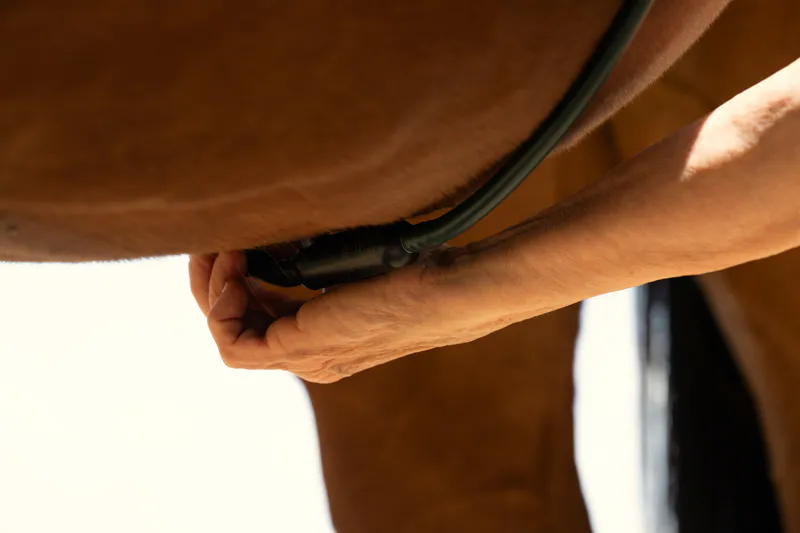
Several sources stress knowing what's normal for your horse: its usual appetite, droppings and behaviour [3][4][6]. Southwest Equine Veterinary Group lists normal adult values as a heart rate of 32–40 beats per minute, a breathing rate of 8–20 breaths per minute, and a temperature of 36.9–38.5 °C [3]. Individual horses vary, so record your own horse's figures at rest on a calm day.
Monitoring vital signs alongside behaviour such as pawing or rolling helps your vet see how long the problem has been going and whether it's getting worse [3]. Ask your vet to show you how to take a temperature, pulse and breathing rate safely, and never do it if the horse is thrashing or you could be hurt.
Lowering the risk of colic
The cause of a colic episode is often never found, but some factors raise the risk. World Horse Welfare's prevention list includes [4]:
- keeping the diet forage-based (grass, hay or haylage)
- making diet changes gradually
- keeping concentrates to a minimum and splitting them into several small feeds
- making sure clean water is always available
- following a vet-led worm control program
- regular dental checks
- watching carefully for colic after travel, especially if water was withheld.
Agriculture Victoria advises introducing feed changes over 3 to 5 days, because a sudden change can cause colic or laminitis, and keeping grain to no more than 30% of the diet [7]. It also warns that grass clippings and many food scraps are not suitable feed and can make a horse ill [1], and suggests avoiding feeding on the ground [7]. The MSD manual notes that sand can build up in the gut and cause a blockage where pasture is short and horses are fed on the ground [5].
Our feed calculator helps you plan a forage-based ration, the care planner keeps worming and dental visits on track, and our guides to worming and long-distance floating cover two of the risk factors above.
New Zealand owners
The signs and first steps are the same on both sides of the Tasman. Several sources here are Australian, so ask your vet about local after-hours arrangements and the nearest equine hospital. You can find an equine vet in New Zealand in our directory.
Frequently asked questions
Is it OK to let a colicking horse roll? Ask your vet when you call; they'll advise based on what they hear. Southwest Equine suggests walking a horse that's actively colicking, partly to stop it rolling [3]. Whatever you do, your own safety comes first [4].
My horse seems better. Do I still need the vet? Southwest Equine says it's always best to get your vet to come and see the horse, because prompt treatment can stop something simple snowballing [3]. At the very least, ring and describe what you saw.
Can colic be mistaken for something else? Yes. World Horse Welfare notes that other conditions, including laminitis, can sometimes be mistaken for colic, which is another reason to get a vet's assessment [4]. See our laminitis guide.
If your horse is rolling, sweating or getting worse, stop reading and call your vet.