Not veterinary advice. If your horse is unwell before or after a trip, talk to your vet. Transport rules differ between states and between Australia and New Zealand, so check the rules that apply to your journey.
In Australia, "a long way to the show" can mean two or three days on the road. An equine vet writing for Equestrian Queensland describes a 15-hour trip from Queensland to Sydney as a two-day job, and Melbourne as a 24-hour trip often done over three days [3]. Long trips are where most travel problems happen, and nearly all of them come down to planning.
The rules: how long a horse can go without water
Under the Australian Animal Welfare Standards and Guidelines for the Land Transport of Livestock, which Agriculture Victoria notes are adopted into Victorian law and apply to horses [1], there are maximum times livestock can go without water. Once a horse reaches that limit, it must be spelled (rested) and given water, food and the chance to rest [2].
The Queensland code lists these limits for horses [2]:
| Class of horse | Maximum time off water | Minimum spell |
|---|---|---|
| Any other horse | 24 hours | 12 hours |
| Under 6 months old | 12 hours | 12 hours |
| Lactating, travelling with dependent young | 12 hours | 12 hours |
| 30–43 weeks pregnant | 12 hours | 12 hours |
| More than 43 weeks pregnant | 4 hours | 24 hours |
These are legal maximums, not targets. A horse that has technically complied but stood for 24 hours without a drink is not a horse that arrives ready to compete. Check your own state's rules before you travel.
The Queensland code also says livestock aren't fit to travel if, among other things, they can't bear weight on all legs, gave birth in the previous 72 hours, are severely emaciated or visibly dehydrated, or are blind in both eyes [2].
The practical rule: stop every 3–4 hours
The equine vet's advice for Equestrian Queensland is that any float trip over four hours carries increased risk of stress and travel-related illness, and that horses should get a break every three to four hours, even if it's only pulling over to offer water. For trips longer than six hours, plan at least one stop where the horse comes off the float to stretch its neck down and eat [3].
Why the head-down break matters: horses are built to spend much of the day grazing with their heads low. Chewing and a lowered head help drain mucus from the airways. Tied up high for hours, they can't clear it, and that's linked to respiratory problems after travel [3].
Agriculture Victoria's checking schedule for long trips is to check your horse after 30 minutes, then every 4 hours [1].
Plan the route around the horse
- Map the stops before you go: every 3–4 hours, with at least one unloading stop on trips over six hours [3]. Our float trip planner works out stops and fuel costs for you.
- Book overnight stabling for multi-day trips. Showgrounds, equestrian centres and horse-friendly accommodation along the main interstate routes often take overnight horses. Ring ahead.
- Check interstate requirements. Some events and states have health declaration, vaccination or tick-clearance requirements. Equestrian Queensland, for example, publishes horse health declarations for events.
- Avoid the heat of the day in summer if you can.
- Carry enough water, and water from home if your horse is fussy. Agriculture Victoria says a horse may drink 25–45 litres a day in hot weather [4].
Set up the float or truck
From Agriculture Victoria [1]:
- The vehicle must be strong and secure; a rigid roof over the full length is desirable.
- Internal surfaces smooth, with no protruding nails or clips.
- Non-slip floors and ramps, with foot battens if needed.
- Enough head room for each horse to stand naturally, and space for air to circulate.
- Partitions at least 600 mm high and at least 600 mm off the floor when carrying more than one horse.
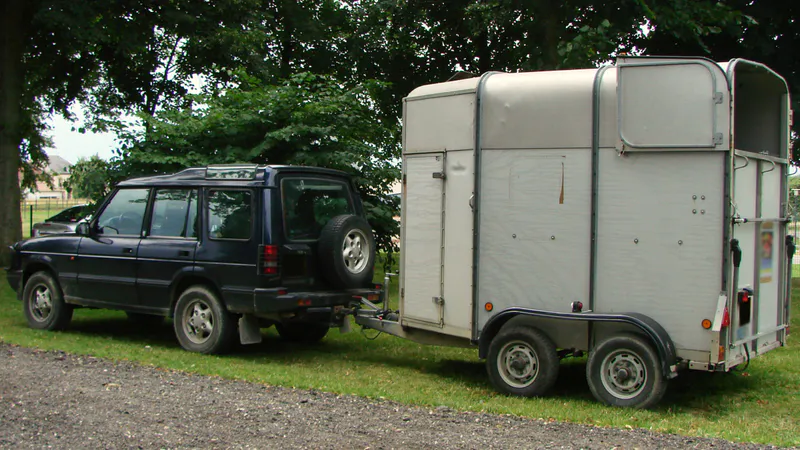
- In a two-horse float, a single horse goes on the driver's side, with the centre partition removed for better balance. With two horses, put the heavier one on the driver's side.
- Make sure exhaust fumes aren't getting into the horse area, and keep it clean and dry.
- Fit rugs, boots, bandages or hoods correctly before loading.
Loading and unloading
Agriculture Victoria is blunt: no sticks, pipes, straps or anything else to beat horses, and no dogs or electric prods [1]. If loading is a struggle at home, it'll be worse on a roadside at night, so practise until it's boring before a big trip.
On arrival [1]:
- enter the vehicle quietly and untie the horse before lowering the ramp
- let it walk off at its own pace
- unload as soon as you arrive, and offer feed, water and a comfortable place to rest
- if it's stiff, walk it gently until it loosens up.
Watch for travel sickness afterwards
Respiratory illness after a long trip (often called shipping fever or travel sickness) is the big worry. The Equestrian Queensland vet article stresses planning to reduce the risk [3]. Practical steps many vets recommend:
- Take your horse's temperature before you leave, so you know its normal, and again on arrival and for a few days afterwards.
- Watch for dullness, going off feed or water, coughing, nasal discharge, fast or laboured breathing.
- Call a vet early if your horse has a temperature or seems off after a long trip. Don't wait for it to get worse.
Record trips, temperatures and any treatments in your horse health record.
Before you leave: a quick check
- Is the horse fit to travel? Go through the Queensland code's list above [2]. If in doubt, ask your vet.
- Heavily pregnant mares: under the Queensland code, mares over 43 weeks pregnant can go only 4 hours without water and need a 24-hour spell [2]. Talk to your vet before moving a mare that close to foaling.
- Foals under 6 months and mares travelling with foals have a 12-hour limit [2].
- Check the float or truck: floor, ramp, partitions, lights, brakes and tyres.
- Know your horse's normal: temperature, how much it usually drinks, and what its manure normally looks like.
- Tell someone your route and expected arrival times.
Pack list for a long trip
- Water containers and buckets (plus water from home)
- Hay nets for each leg of the trip
- Thermometer
- First aid kit and your vet's number, plus vets along the route
- Spare halter and lead rope
- Health records, vaccination certificate and any required declarations
- Torch, tools, spare tyre and jack that fit the float
- Booked overnight stabling details
Using a professional transporter
For interstate moves, many owners use a professional horse transporter. Ask how often they stop and water, whether horses are unloaded on long legs, how they handle overnight spells, and what insurance they carry. Compare transporters in the horse.work horse transport directory.
Frequently asked questions
How far can I float a horse in one day? There's no single answer; it depends on the horse, the weather and the legal time-off-water limits [2]. The Equestrian Queensland vet article describes a 15-hour trip from Queensland to Sydney as a two-day trip, and a 24-hour trip to Melbourne as often done over three days [3]. Splitting long trips with an overnight stop is common practice.
Should I tie my horse's head up for the whole trip? Horses need regular chances to lower their heads to help clear their airways. That's why the vet article recommends breaks every three to four hours and unloading on trips over six hours [3].
Do I need to unload at every stop? Not always. On short stops you can offer water on the float, but on longer trips plan at least one stop where the horse comes off to stretch and eat [3].
New Zealand
Distances are shorter in New Zealand, but the same principles apply on long trips and on the Cook Strait ferry. NZ owners should check MPI and their transporter's requirements.