Check the rules where you live. Towing laws differ between Australian states and territories and New Zealand, and they change. This guide summarises official guidance from NSW, Queensland, Victoria and NZ Transport Agency Waka Kotahi as published in October 2026. Always check your vehicle's handbook, the trailer's plate, and your local transport authority before you tow. We don't quote float prices because they vary too much to be useful; get your own quotes.
Sooner or later most horse owners need to move a horse: to the vet, a clinic, a new paddock or out of a fire's path. You can hire a float, buy one, borrow one, or pay a professional transporter. Each suits different people, and the "right" answer depends more on how often you travel and what you tow with than on the price of the float.
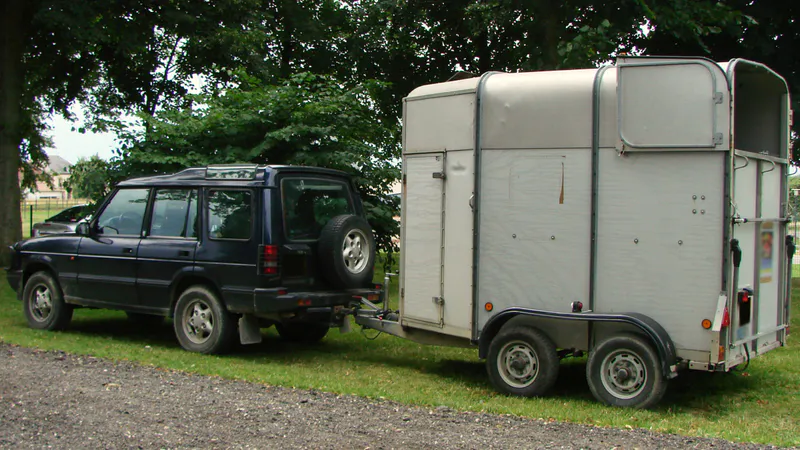
Whichever you choose, the same towing rules apply when you're behind the wheel. We'll start there, because if your vehicle or licence can't legally tow a loaded float, the hire-or-buy question is already answered.
First: can you legally tow a loaded float?
Your vehicle's limits
In NSW, the loaded mass of a trailer must not exceed the lowest of [1]:
- the rated capacity of the towbar and tow coupling
- the vehicle's maximum towing capacity
- the trailer's maximum carrying capacity
- the rated carrying capacity of the tyres.
Queensland's rules work the same way, and they spell out that for a horse float the load includes the weight of the horses, tack and feed [2]. Horses are heavy, and two of them plus gear add up fast. Our weight calculator estimates a horse's weight from a tape measure, and our guide on weighing a horse without scales explains the methods.
If you're unsure of the combined weight of the float and its load, Queensland suggests having it weighed at a public weighbridge [2].
Older vehicles. If the manufacturer hasn't specified a towing capacity, NSW sets it at one and a half times the unladen mass of the tow vehicle if the trailer has working brakes [1]. Queensland gives the same 1.5× guide for vehicles made before 1 January 1992, or a maximum of 750 kg if the trailer has no brakes [2].
Brakes and safety chains
NSW's braking requirements by gross trailer mass (GTM) [1]:
| Gross trailer mass | Brakes required |
|---|---|
| Up to 750 kg | None required (if fitted, they must comply) |
| 751–2,000 kg | Efficient brakes on both wheels of at least one axle |
| 2,001–4,500 kg | Efficient brakes on all wheels |
Trailers with a GTM over 2.0 tonnes must also have an automatic breakaway system in case the trailer comes off the vehicle [1]. Trailers under 2,500 kg loaded need at least one safety chain; over 2,500 kg, two chains, crossed over [1].
Your licence
Licence conditions can stop you towing even if the vehicle can:
- NSW: learner drivers aren't allowed to tow, and P1 car licence holders can only tow small trailers of up to 250 kg unloaded weight [1]. That rules out a horse float for most P1 drivers.
- Victoria: learners must not tow a trailer. P1 drivers can't tow unless it's for work at their employer's request, solely for agricultural or similar use, or with a full-licence driver sitting beside them [3].
- New Zealand: on a class 1 learner or restricted car licence, the combined weight of the vehicle, trailer and load must not exceed 4,500 kg; on a full licence, 6,000 kg [4].
Other states and territories have their own rules, so check with your licensing authority.
On the road
- Speed. In NSW, a vehicle or combination with a GVM or GCM over 4.5 tonnes must not exceed 100 km/h, whatever the posted limit [1]. In New Zealand, the maximum legal speed for a light vehicle towing a trailer on the open road is 90 km/h [4].
- Length. In NSW, the vehicle-and-trailer combination including its load must not be more than 19 m [1].
- Following distance. NZTA advises increasing your following gap from 2 seconds to 4 seconds when towing [4].
- Towballs. New Zealand has two towball sizes, 1 7/8" and 50 mm. NZTA warns that mismatched sizes can cause the trailer to disconnect [4]. Check the float's coupling matches your ball.
Loading the float safely
For balance, NSW advises keeping loads low and close to the axles, with about 60% of the total weight forward of the centre of the axle(s), and about 5–10% of the trailer-plus-load mass carried on the coupling [1].
Agriculture Victoria's advice for horse floats includes [5]:
- a strong, secure vehicle, ideally with a rigid roof over the full length
- smooth internal surfaces with no protruding nails or clips
- a non-slip floor and ramp
- partitions at least 600 mm high and at least 600 mm off the floor when carrying more than one horse
- a single horse on the driver's side of a two-horse float, with the centre partition removed for better balance
- with two horses, the heavier horse on the driver's side.
On longer trips, check your horse after 30 minutes and then every 4 hours, and when you arrive, untie the horse before lowering the ramp [5]. Our long-distance floating guide covers rest stops and travel stress.
Hiring a float: what suits and what to check
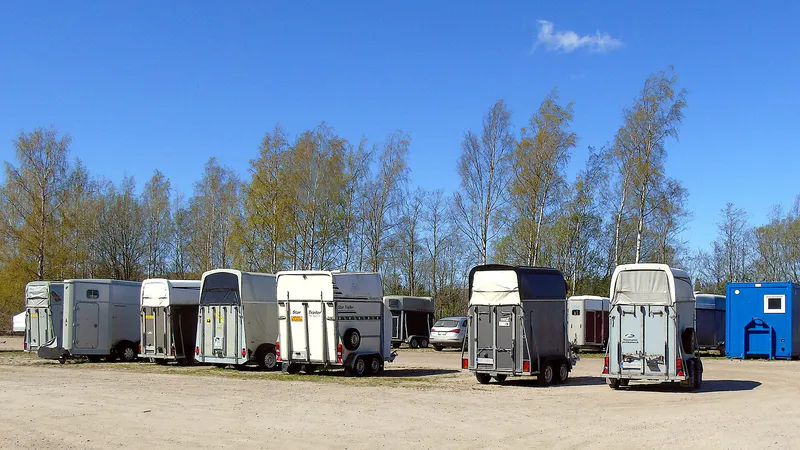
Hiring can make sense if you travel occasionally, have nowhere to store a float, or want to try towing before committing. On the other hand, you're working with an unfamiliar float each time, and availability can be tight when everyone's heading to the same event.
Before you sign a hire agreement, check:
- The float's plate: its tare and maximum loaded mass, and that your vehicle's towing capacity covers the loaded weight [1][2]
- Registration: the trailer must be registered and roadworthy (Queensland) [2]
- Brakes and breakaway system suit the float's weight [1]
- Coupling size matches your towball (NZ) [4]
- Floor and ramp: non-slip, solid, no soft spots [5]
- Partitions and fittings: no sharp edges or protruding clips [5]
- Lights and safety chains work and connect properly [1]
- Insurance: what the hire company covers, your excess, and whether your own policy applies
- Your licence allows you to tow it [1][3][4]
NSW's pre-trip checklist reminds you to make sure all lights work and safety chains are properly connected before every trip [1].
Buying a float: what suits and what to check
Buying suits people who travel often, need to move quickly in an emergency, and have a suitable tow vehicle and somewhere to keep the float. You get to know your float, and your horse gets to know it too. But you take on the ongoing costs: registration, maintenance, tyres, insurance and storage.
If you're buying, especially second-hand:
- Paperwork. In Queensland, light trailers with an aggregate trailer mass (ATM) of 751–4,500 kg need a current safety certificate when sold or transferred while registered [2].
- New trailers. In Queensland, all new trailers have needed to fully meet the relevant Australian Design Rules since 1 July 2023 [2].
- ATM vs your towing capacity. You may tow a trailer with an ATM above your vehicle's rated towing capacity in Queensland, provided the trailer isn't loaded beyond that towing capacity [2]. That leaves little margin with horses on board, so plan around the loaded weight.
- Brakes, breakaway and chains meet the rules for the float's weight [1].
- Condition: floor, ramp springs, partitions, roof, tyres, lights and coupling. Get an independent inspection if you're not sure what to look for.
- Storage and access: somewhere secure, and easy to hitch up in a hurry.
Put the ongoing costs into our horse cost calculator alongside feed, farrier and agistment, so you can see the yearly figure.
Or let someone else drive
A professional transporter can be the simplest option if you don't have a suitable vehicle, travel rarely, or are moving a horse a long way. Ask how they clean between loads, how often they stop, and what insurance they carry. Our horse transport directory lists transporters across Australia and New Zealand, and the transport cost calculator estimates a float trip's cost by distance, so you can compare that with hiring.
How to decide
| Question | Leans towards hiring or a transporter | Leans towards buying |
|---|---|---|
| How often do you travel? | A few times a year | Most weeks |
| Do you need to move quickly in an emergency? | Lower risk area, other options lined up | Fire or flood-prone area; see our bushfire plan |
| Is your vehicle rated to tow a loaded float? | No, or only just | Yes, with margin |
| Does your licence allow it? | Learner, P1 or restricted | Full licence |
| Do you have storage? | No | Yes, secure and accessible |
| Are you confident towing and reversing? | Not yet | Yes |
Frequently asked questions
Can I tow a horse float on my P plates? It depends on your state and licence stage. In NSW, P1 drivers can only tow trailers up to 250 kg unloaded [1]. In Victoria, P1 drivers can tow only in limited circumstances, such as with a full-licence driver beside them [3]. Check your own state's rules.
Do I need brakes on a horse float? Add up the float's tare, your horse's weight and your gear. In NSW, brakes are required on any trailer over 750 kg GTM [1], and horses are heavy, so check the numbers rather than guessing.
How do I know what my float weighs loaded? Add the horses, tack and feed to the float's tare, or have the loaded float weighed at a public weighbridge [2].
Hire, buy or book a transporter: whichever you choose, check the numbers on the plates and your licence before your horse steps on the ramp.