Every horse is different. This is general information about feeding equipment. If your horse is overweight, has a medical condition, or you're restricting its feed, work out a plan with your vet or a qualified equine nutritionist.
Hay is often the biggest feed bill a horse owner has, and a fair chunk of it can end up trampled into the mud. At the same time, many horses finish their hay in a few hours and then stand around with nothing to chew. Hay nets and slow feeders promise to fix both problems.
Most of the useful research on this comes from the University of Minnesota's equine extension team, which has run controlled trials on hay nets and bale feeders. Their conditions (US hay, US winters) aren't identical to ours, but the principles carry over.
Why slow the meal down?
The University of Minnesota notes that horses evolved to eat small, frequent forage meals, often spending more than 14.5 hours a day grazing [1]. Many owners try to copy that with free-choice hay, but that often leads to obesity because the horses simply eat too much [1].
Agriculture Victoria recommends feeding twice a day, says small frequent feeds are better than one big feed, and advises that at least 70% of a horse's diet should be roughage such as hay, pasture or chaff [5]. Slowing a hay meal down is one way to keep a horse chewing for longer without feeding more.
What the hay net trial found
The Minnesota team fed eight adult horses in individual stalls, comparing hay fed off the ground with three nets [1]:
- large openings of 6 inches (about 15 cm)
- medium openings of 1.75 inches (about 4.4 cm)
- small openings of 1 inch (about 2.5 cm).
Horses had access to their hay for two 4-hour periods a day, with grass hay fed at 1% of bodyweight per meal [1]. The results [1]:
| Feeding method | Eating rate (lb/hour) | Approx. kg/hour* | Share of the meal eaten in 4 hours |
|---|---|---|---|
| Off the ground | 3.3 | 1.5 | 95% |
| Large-holed net (6 in) | 2.9 | 1.3 | 95% |
| Medium-holed net (1.75 in) | 2.4 | 1.1 | 89% |
| Small-holed net (1 in) | 1.9 | 0.9 | 72% |
*Converted by us from the published pounds per hour and rounded.
In a second study, horses took just over 5 hours to finish a meal from the medium net and 6.5 hours from the small net, compared with about 3.2–3.4 hours off the ground or from the large net [1].
What that means: the large net barely slowed horses down. Medium and small nets made a real difference. The researchers estimate that feeding twice daily from small or medium nets in a stall could let horses forage for 10 to 13 hours a day, which better mimics natural grazing [1].
The catches
- It takes time to adjust. Horses usually needed 4 to 5 feedings to get used to eating from the nets [1].
- Not for every horse. The researchers say small and medium nets aren't practical for all horses [1].
- Watch they're getting enough. In the trial, horses on the small net ate only 72% of their meal in the 4-hour window [1]. If your horse can't finish its hay in the time available, it may be eating less than you think. Monitor its weight and condition. Our weight calculator can help you track changes.
Feeders and waste
Waste is the other big reason to use a net or feeder. The University of Minnesota says hay waste during storage and feeding can add up to more than 40%, depending on conditions [2].
Small square bales
In a trial of small square-bale feeders in outdoor dirt paddocks, the slat feeder had the lowest hay waste at 1%, while feeding with no feeder wasted the most at 13% [2]. All the feeders put a physical barrier between horses and the hay, which limited trampling and soiling [2]. No injuries occurred from any of the feeders during the trial [2].
Round bales
For round bales, every feeder tested reduced waste. Waste with a feeder ranged from 5% to 33%, compared with 57% without one [3]. Feeders that restricted access to the hay wasted less (5–11%) than those allowing greater access (13–33%), because horses can push their whole head into open designs, pull hay out and drop it [3].
The study also found horses ate more with a feeder: 2.0–2.4% of bodyweight, against 1.3% without one, and the herds without a feeder lost weight, likely because more hay was spoiled [3].
A warning about nets on round bales: as the bale is eaten, it can collapse, and horses may then stand on the remaining hay and soil it. The researchers suggest using a net together with another feeder to avoid this [3].
Hanging a hay net safely
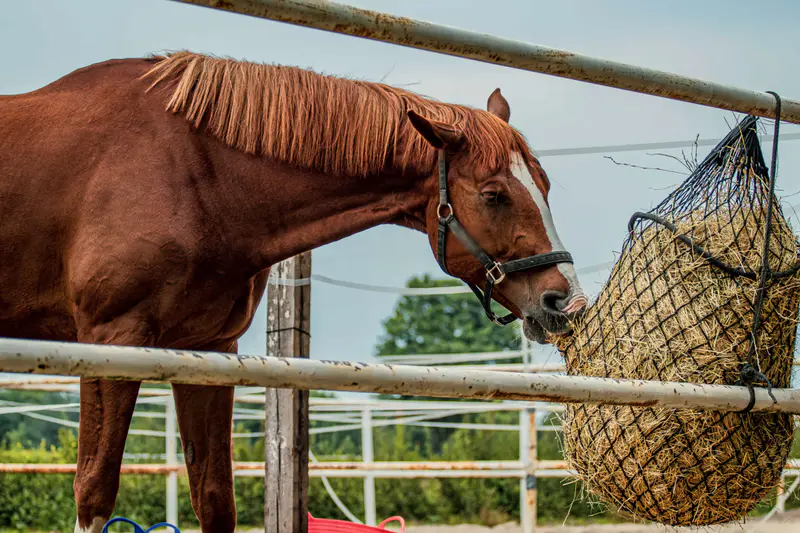
The British Horse Society says unlimited forage at ground level is ideal, but may not suit horses whose intake needs restricting, for example to lose weight [4]. If you use hay nets, the BHS advises fixing them at the horse's head height so they don't hang low once empty, which could increase the risk of a hoof getting caught [4].
Practical checks:
- Hang the net at head height, and check where it hangs when empty, not just when full [4]
- Use a secure fixing point; pick fittings that suit your stable or yard
- Check nets daily for broken cords and holes
- Introduce small-holed nets gradually, over several feeds [1]
Ground feeding, worms and sand
Agriculture Victoria advises avoiding feeding on the ground, because it can increase the ingestion of worm larvae [5]. The MSD Veterinary Manual notes that sand can build up in the gut and cause a blockage where pasture is sparse and horses are fed on the ground [6]. A feeder or net can help on sandy or bare paddocks. See also our worming schedule guide and our guide to the signs of colic.
Feeding several horses
If you're feeding a group, Agriculture Victoria says to make sure there's enough space for every horse to get to the food, and that no horse is missing out [5]. Spreading nets or feeders well apart makes it harder for one horse to guard them all.
Choosing a net or feeder
| If your priority is... | Consider... | Watch for... |
|---|---|---|
| Longer eating time in a stable or yard | Small or medium-holed nets [1] | Adjustment period; make sure the horse eats enough |
| Cutting waste with small squares outdoors | A slat-style feeder had the least waste in trials [2] | Making sure horses can still eat their full ration in the time between feeds [2] |
| Cutting waste with round bales | A restrictive feeder design [3] | Nets alone can collapse onto the bale [3] |
| A horse that needs weight loss | Slow-feed nets, with a vet or nutritionist plan | Weight checks; don't cut forage drastically without advice |
Our feed store directory lists local suppliers, and saddleries often stock nets. Hay is easier to budget once you know how much your horse needs: use our feed calculator, and add the cost to the horse cost calculator.
Frequently asked questions
Do slow-feed hay nets really work? In the Minnesota trial, small and medium nets slowed eating and stretched meals out to around 5–6.5 hours. Large nets made little difference [1].
What hole size should I use? The trial nets that made a real difference had openings of 1.75 inches (about 4.4 cm) or 1 inch (about 2.5 cm) [1]. Start with a larger size if your horse is new to nets.
Is a hay net safe in the paddock? Hang it at head height so it doesn't drop low when empty [4], check it daily, and think about using a feeder instead for round bales [3].
Quick checklist
- Know how much hay your horse needs each day
- Choose a net hole size or feeder that fits your goal
- Hang nets at head height, checked when empty
- Introduce slow-feed nets over several feeds
- Enough feeding points for every horse in the group
- Monitor weight and condition after any change