General information only. This guide is for people who run a farriery business. It does not set "standard" prices, and it is not tax, legal or accounting advice. Check the ATO (Australia) or Inland Revenue (New Zealand) rules that apply to you, and talk to your accountant or bookkeeper before you change how you charge GST or set invoices.
If you price by copying a mate's board, or by guessing what owners will wear, you will either leave money on the table or quietly lose money every visit. A better approach is to build every fee from what it actually costs you to turn up, then put the fee sheet in writing so clients know what they are buying.
This article is written for farriers setting rates — not for owners shopping for a cheap trim. Owners looking for providers can start in the farriers directory (including New Zealand).
Start with your real cost of a working day
Before you invent a "trim price", write down what a full working day costs you. The national Certificate IV in Farriery (ACM40818) treats farriery as a trade that includes micro-business skills: organising finances and complying with taxation and insurance requirements sit in the core units alongside hoof care [1]. Use that same discipline when you price.
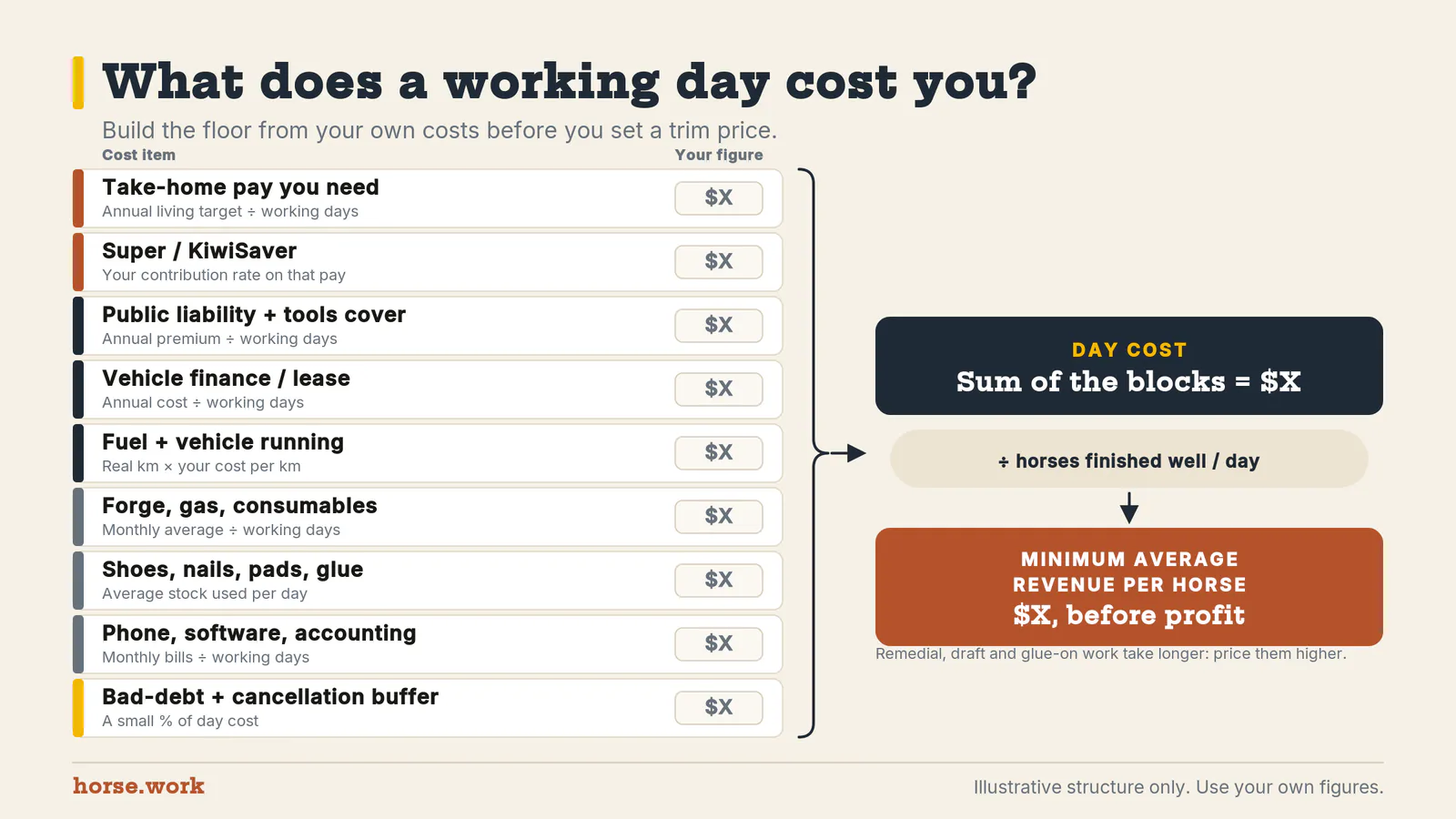
A simple day-cost worksheet:
| Cost item | How to estimate it | Your figure |
|---|---|---|
| Take-home pay you need | Annual living target ÷ working days you can actually shoe | |
| Super / KiwiSaver / retirement | Your own contribution rate on that pay | |
| Public liability and tools cover | Annual premium ÷ working days | |
| Vehicle finance / lease | Annual cost ÷ working days | |
| Fuel and vehicle running | Your real km × your cost per km | |
| Forge, gas, consumables | Monthly average ÷ working days | |
| Shoes, nails, pads, glue | Stock you use that day (average) | |
| Phone, software, accounting | Monthly bills ÷ working days | |
| Bad-debt and cancellation buffer | A small % of day cost | |
| Day cost | Sum of the above |
Then divide the day cost by the number of horses you can finish well in a day — not the number you once rushed through. That gives you a minimum average revenue per horse before profit. Remounts, draft horses, glue-ons and remedial work take longer; they need a higher line item, not the same average.
Do not publish a national "average farrier fee" from memory. Peer prices only help after you have your own cost floor. Look at named, dated public price lists from colleagues in your region if they publish them, ask peers what their structure looks like (call-out, travel, GST), and track your own books for a month before you rewrite the board.
Separate the job types on the fee sheet
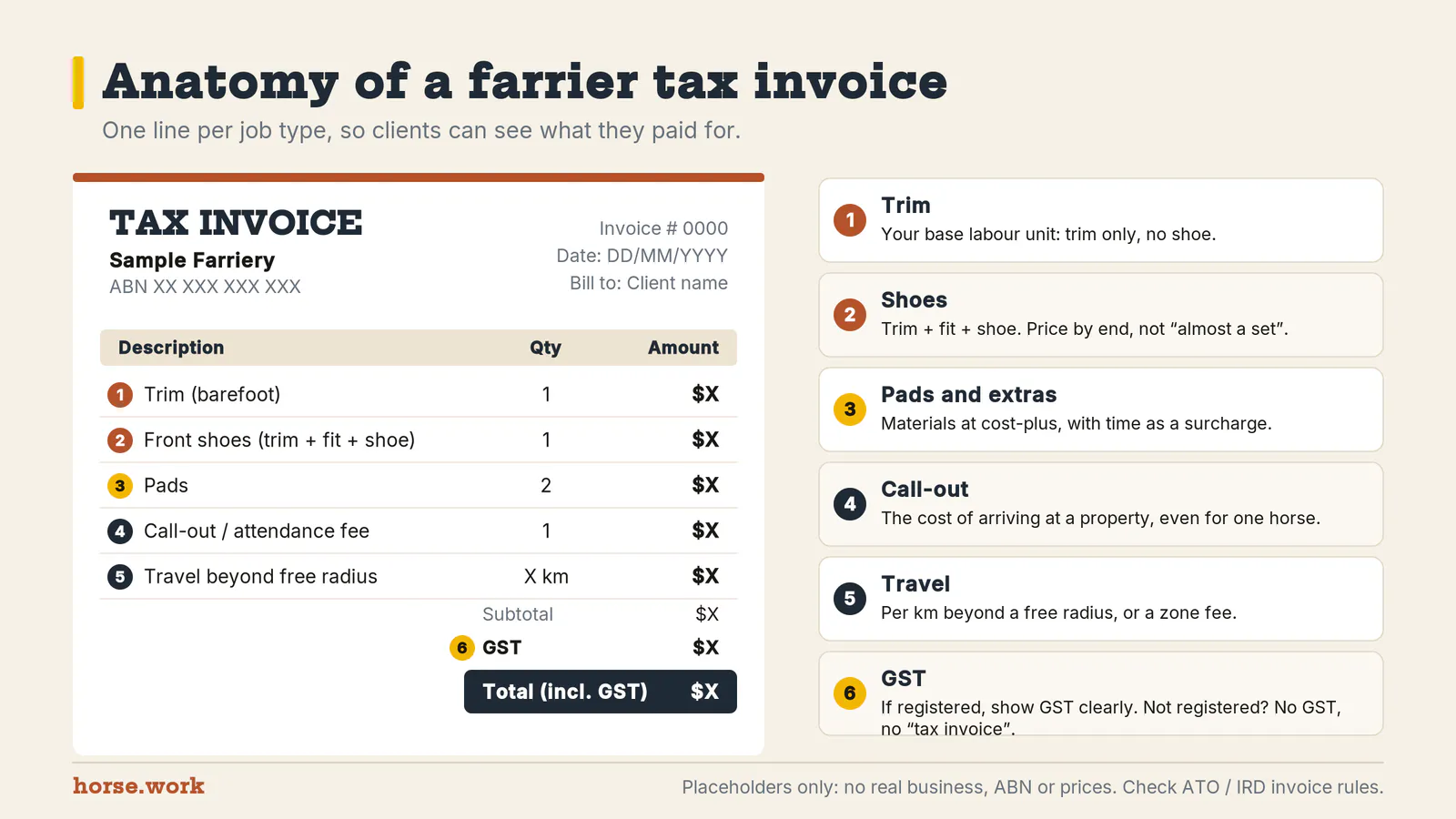
Clients understand clearer invoices when each job type has its own line. A practical fee sheet usually separates:
| Line item | What it covers | Pricing tip |
|---|---|---|
| Trim (barefoot) | Trim only, no shoe | Your base labour unit |
| Front shoes / hind shoes / full set | Trim + fit + shoe | Price by end, not "almost a set" |
| Reset / remove and replace | Same shoes back on | Often priced as a % of a new set — decide and publish it |
| Pads, packing, stud holes | Materials + time | Materials at cost-plus, time as a surcharge |
| Glue-on / composite | Kit + longer visit | Longer slot on the diary |
| Remedial / vet-directed | Extra assessment and fitting | Quote after seeing the horse or the vet plan |
| Draft / heavy horse | Extra labour and materials | Separate column, not a quiet surcharge at the truck |
| Stallion / difficult horse | Extra handler time and risk | State the conditions (handler present, stocks, etc.) |
| After hours / weekend | Premium for diary disruption | Fixed premium or % uplift |
Agriculture Victoria's code for horse hire establishments expects hooves that are worked on roads or hard ground to be shod, and for horses to be regularly trimmed or shod by a farrier, preferably every 6 to 8 weeks [5]. That interval is a welfare and diary planning fact, not a price. It does tell you how many visits a school horse or busy riding horse is likely to need in a year when you model your own cash flow.
Travel, call-out and minimums
Mobile farriery dies on thin margins when travel is "included". Separate:
- Call-out / attendance fee — the cost of arriving at a property, even for one horse.
- Travel — per kilometre beyond a free radius, or a zone fee for named areas.
- Minimum visit — for example, the call-out plus the equivalent of two trims, so a single-horse property still covers the day cost.
- Yard or clinic day — a lower per-horse rate when several horses are held for you in one place.
Publish the free radius and the per-km or zone fee on the same sheet as the trim price. When clients ask you to "just swing by", you can point to the sheet instead of negotiating from scratch every time.
Shared call-outs are worth offering: one travel fee split across the horses on the property. Your bill splitter is a handy link to send owners who share a horse or a paddock bill.
GST in Australia and New Zealand
Australia. You must register for GST when your GST turnover reaches $75,000 (or when you expect to reach it), and you have 21 days to register once you are required to [2]. If you are registered and make a taxable sale over $82.50 (including GST), you must give a tax invoice; if a customer asks for one at any amount, you have 28 days to provide it [3]. A tax invoice needs the words "tax invoice", your business name, ABN, date, a description of what you sold (quantity and price), and the GST amount (or a clear "Total price includes GST" statement where that applies); sales of $1,000 or more also need the buyer's identity or ABN [3].
State prices GST-inclusive on the public fee sheet if you are registered, and show GST clearly on the tax invoice. If you are not registered, do not use the words "tax invoice" and do not add GST to the price [3]. The ABN invoice checker helps you and your clients check that ABNs look right before money changes hands.
New Zealand. Inland Revenue requires GST registration when turnover from a taxable activity was at least $60,000 in the last 12 months, or you expect it will be at least $60,000 in the next 12 months — or when you add GST to your prices [4]. Once registered, you charge GST, file returns and keep records [4]. Keep AU and NZ fee sheets separate if you work both sides of the Tasman; do not mix GST rates or invoice rules.
This is not a substitute for advice from a registered tax agent. Thresholds and invoice rules change — check the ATO and Inland Revenue pages linked in the sources before you redesign templates.
How to quote without undercutting yourself
A clean quote process saves arguments later:
- Confirm the job in writing — trim, set, reset, materials, which feet.
- Confirm the site conditions — undercover work area, horse held, handler available, stocks if needed.
- State travel — free radius or kilometres from your base.
- State payment terms — cash / card / bank transfer on the day, deposit for new clients, card surcharge if you use one and are allowed to.
- State cancellation — for example, the call-out if they cancel inside 24 hours after you have left base.
- Valid-for date — materials and fuel move; quotes should expire.
For remedial or vet-directed work, quote after you have seen the horse or the written plan. A low "guess" quote that blows out mid-shoe is how you lose both money and the client.
When to raise prices
Raise prices when your cost sheet says the old board no longer covers the day, not when you feel guilty after a wet winter. Common triggers:
- Fuel, shoes or insurance jumped and stayed up.
- You are booked solid for weeks and still not hitting your take-home target.
- Remount and remedial work has grown and is subsidising basic trims.
- You have added qualifications, continuing education or specialised kit that lengthens the visit.
Give existing clients notice in writing (email or SMS with the new sheet). Apply the new board to new clients immediately. Grandfathering forever quietly trains your best clients to underpay you.
Packaging and retention (without race-to-the-bottom discounts)
Useful packages that protect margin:
- Property day rate — a fixed fee for a half or full day on one property with a horse cap.
- School or racing stable contract — scheduled visits, invoice weekly or monthly, clear horse list.
- Reminder cycle — book the next visit before you leave; six-to-eight-week planning matches how many hire-establishment codes expect regular farriery [5].
Avoid open-ended "mates rates" that never expire. If you discount, put an end date on it.
Qualifications and how you present them
In Australia, ACM40818 Certificate IV in Farriery is the current trade qualification on the national register; it includes at least 120 hours of work placement and micro-business finance and compliance units [1]. New Zealand farriers organise through the NZ Farriers Association; check current training and membership pathways on their site before you claim a title [6]. Put the qualification you actually hold on the invoice footer and on your horse.work farrier listing — do not invent letters.
Cash flow habits that keep the truck fuelled
- Invoice the same day, while the work is fresh.
- Take payment before you leave when you can.
- Reconcile weekly, not at BAS or GST return time.
- Keep a materials log so shoe and pad costs do not vanish into "misc".
- Review the fee sheet every six months against the day-cost worksheet.
Owners who want a yearly horse budget can use the horse cost calculator and care planner; you can point them there instead of inventing averages for them.
Frequently asked questions
Should I publish prices online? Yes, if you can keep them current. A clear fee sheet filters tyre-kickers and reduces haggling. Mark it with the date updated.
Do I have to match the cheapest farrier nearby? No. Match your cost floor and the quality of the work. Clients who only buy on price churn.
Can I charge GST if I am under the threshold? In Australia, registration below the threshold is optional, but if you register you must charge GST and meet tax-invoice rules [2][3]. In New Zealand, adding GST to prices is itself a reason you must register [4]. Ask your accountant before you opt in.
What about NZ clients while I am based in Australia (or the reverse)? Treat cross-border work as a separate compliance question with your accountant. Do not assume one country's invoice template works in the other.
Fee-sheet checklist
- Day-cost worksheet updated in the last six months
- Separate lines for trim, shoeing, materials, remedial, after hours
- Call-out, travel radius and minimum visit written down
- GST position checked (ATO or Inland Revenue)
- Tax invoice / invoice template matches that position
- Cancellation and payment terms on every quote
- Next visit booked before you leave the property
- Listing current on horse.work farriers
Price from your costs, write it down, and raise the board when the numbers say so — not when a Facebook thread says so.