General information only. This guide is for people who run a mobile equine service — farriery, dentistry, physiotherapy, veterinary visits and similar trades. It is not marketing, privacy, tax or professional-conduct advice. Check your professional board, the ATO and current Australian rules on commercial electronic messages before you automate promotions.
Mobile equine businesses do not need a billboard. They need a diary that clusters visits by suburb, a way for the next client to find them, and a reputation that travels from one yard to the next. Hype posts help less than a clear Google profile and a text that says you are running late by twenty minutes.
Decide what you sell in one sentence
Write a positioning line you can say at the float ramp:
- "Mobile farrier covering the Mornington Peninsula, booked six to eight weeks ahead."
- "Equine dentist working with your vet for sedated dentistry across the Hunter."
- "AHPRA-registered physiotherapist with postgraduate animal training, referral-friendly."
Be accurate. Animal physiotherapy and animal chiropractic sit in specific professional frameworks; the Physiotherapy Board of Australia publishes an FAQ on animal practice for registered physiotherapists [5]. Do not claim titles or scopes you do not hold. Put the real credentials on your invoices and directory listings.
Point clients to the right directory category: farriers, equine vets, equine dentists, equine physios.
Route planning is marketing
Empty kilometres are a silent discount. Treat the route as a product:
| Habit | How it helps clients | How it helps you |
|---|---|---|
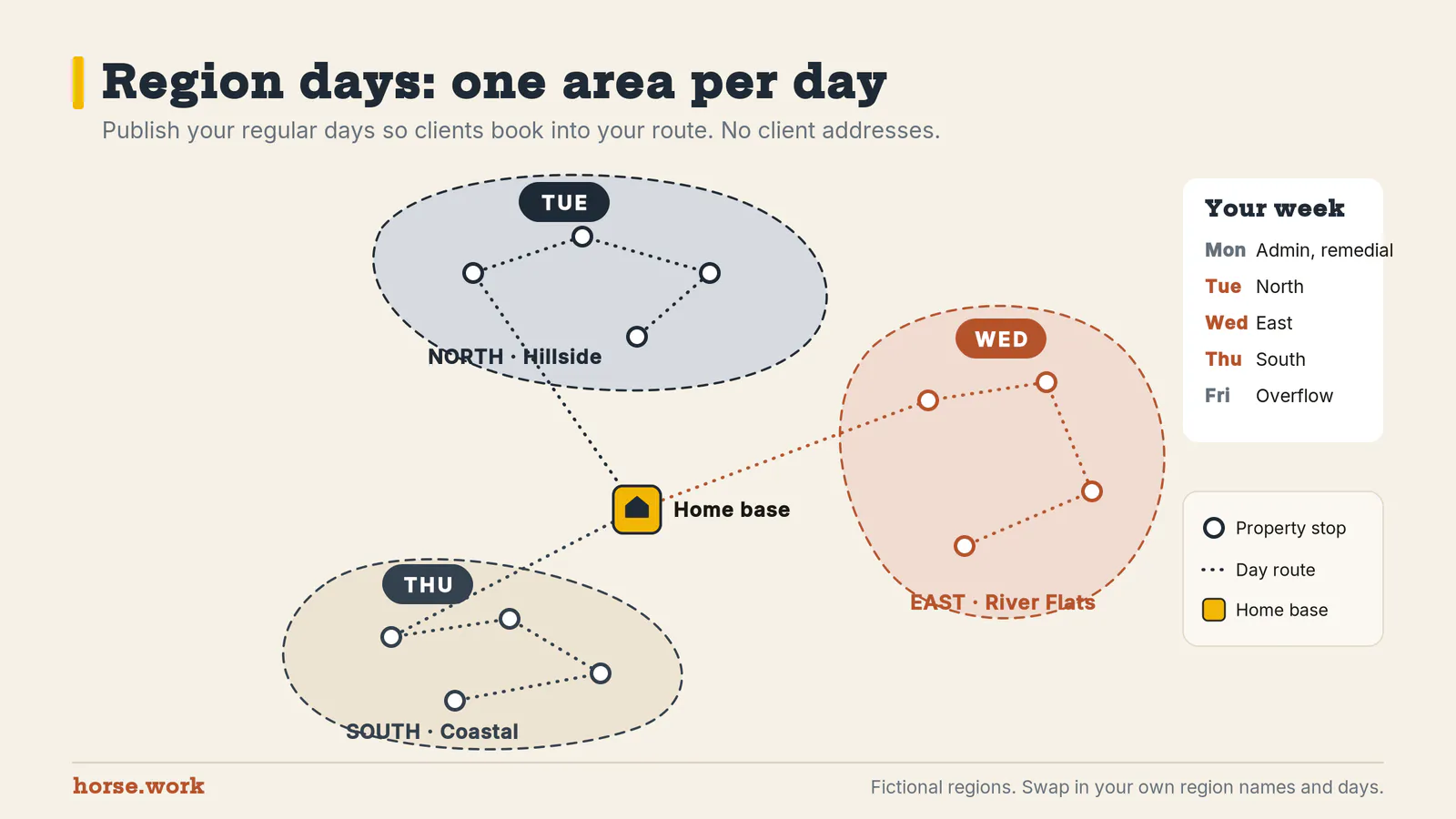
| Suburb or region days | "She's on the south side Tuesdays" | Less fuel, more horses per day |
| Property days | Neighbours book the same visit | Shared call-out / travel |
| Published lead times | Clients stop expecting same-week miracles | Fewer angry messages |
| Buffer slots | Emergencies without wrecking the day | Better reviews |
| Seasonal maps | Wet-weather yards, summer early starts | Fewer cancelled visits |
Send a simple map graphic (no client addresses) showing your regular days. Brand Designer can turn a region list into a clean chart; until then, a plain table on your site is enough.
When several horses share a property visit, point owners at the bill splitter so the travel fee split does not become your problem.
Reminders without turning into spam
Transactional reminders ("your farrier visit is tomorrow at 10am") keep no-shows down. Promotional messages ("20% off this month — book now!") are a different category under Australian commercial electronic messaging rules. ACMA publishes guidance on consent, identification and unsubscribe requirements for marketing email and SMS; because those pages were not reliably reachable while this draft was written, check the current ACMA guidance yourself before you automate any promotional content, and keep marketing lists separate from appointment reminders.
Practical habits that stay on the safe side of both manners and the law:
- Collect mobile numbers and emails for appointment purposes at booking, and ask separately if they want occasional service updates.
- Always identify your business name in the message.
- Make it easy to opt out of marketing (not of essential appointment changes).
- Do not buy contact lists for cold SMS blasts.
- Keep a written record of how each marketing consent was given.
If in doubt, use the phone for new outreach and reserve SMS for clients who already book you.
Local SEO that matches how yards search
Most new clients type a trade + a place: "equine dentist Bendigo", "mobile horse physio Geelong". Your job is to be findable and believable.
Website (even a one-pager):
- Service + region in the title
- What you do / do not do
- Service area and typical lead time
- How to book (form, phone, SMS)
- Credentials and insurance statement (without inventing cover)
- Link to your horse.work profile
Google Business Profile:
Google allows service-area businesses that travel to customers; use one profile, hide a residential address if you have no storefront, set a realistic service area, and keep the business name free of keyword stuffing [1]. Choose the fewest categories that describe the core business [1]. Put hours that match how you actually take calls — many mobile trades are "by appointment", which Google's guidelines note as a case where hours may not fit neatly [1].
NAP consistency: Name, phone and primary URL should match across Google, horse.work, Facebook and your invoice footer.
Get listed where horse people already look
Claim or create your profile on horse.work for providers — the live page is titled for listing or claiming a horse business [6]. Keep categories honest:
| Trade | Directory to prioritise |
|---|---|
| Farrier | /services/farriers/ |
| Vet | /services/equine-vets/ |
| Dentist | /services/equine-dentists/ |
| Physio / bodywork | /services/equine-physios/ |
| Related marketing help | /services/marketing/ |
Complete every field: service area, booking method, qualifications, whether you work with vets for sedation, and whether you cover weekends. Empty profiles do not convert.
Use find a provider yourself to see how you appear next to peers.
Referral loops that do not rely on luck
Write the ask into the end of the visit:
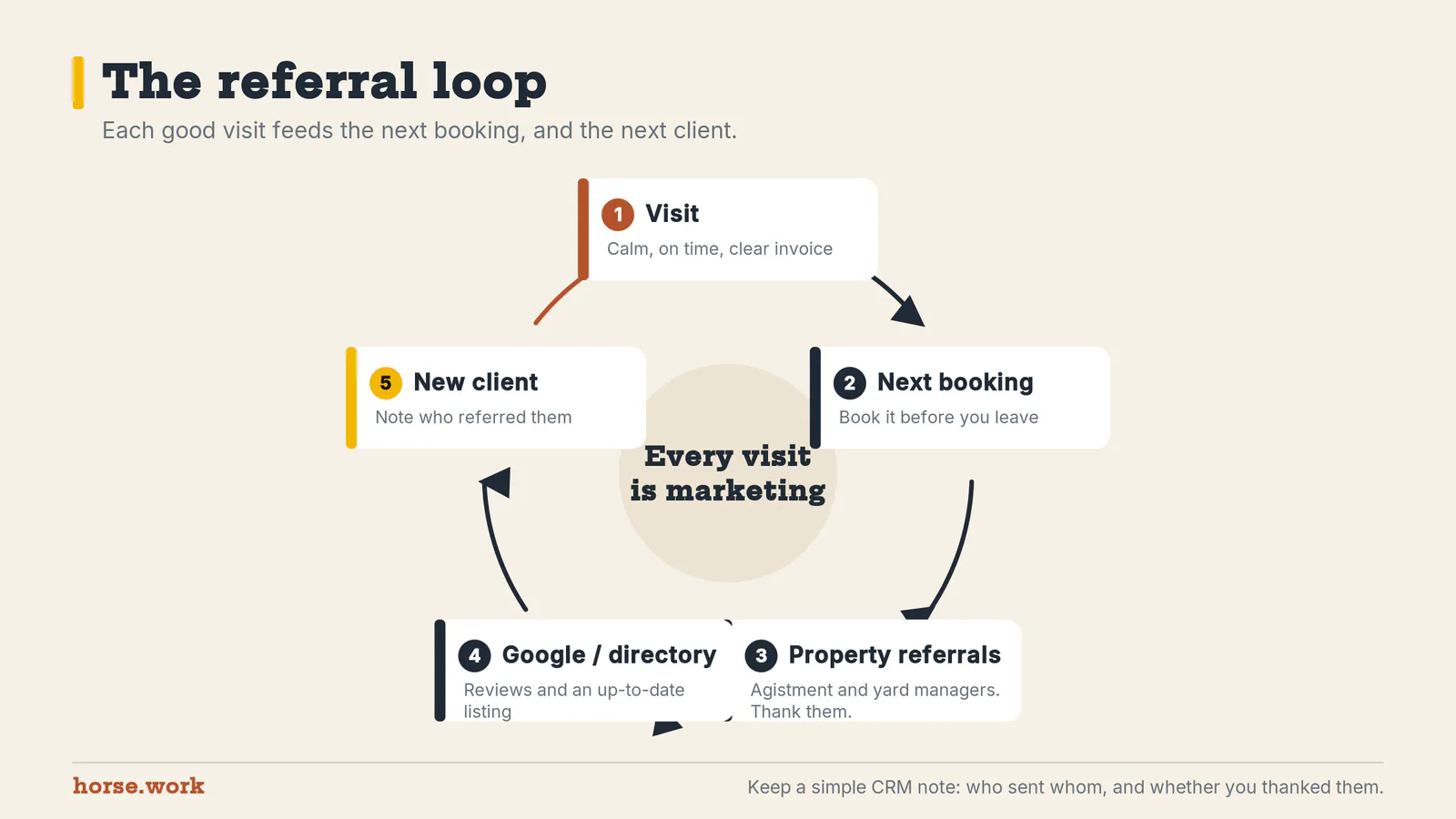
- Confirm the next booking before you leave.
- Ask who else on the property or road needs the same service.
- Leave three business cards or a QR to your booking page with the property manager.
- Thank referrers with something you can afford (priority booking slot, not an open-ended discount).
Build reciprocal relationships:
- Farriers ↔ dentists ↔ physios ↔ vets (stay inside legal scopes)
- Agistment managers who hold horses for you
- Saddle fitters and coaches who see problems early
Put referral partners in a simple CRM note: who sent whom, and whether you thanked them.
Social media without the hype
Useful posts:
- "North-west run next Thursday — two slots left" (real availability)
- Before/after hoof or bodywork photos with owner permission and no clinical overclaim
- "What to have ready for the visit" checklists
- Seasonal reminders (spring pasture, wet yards, show prep) that send people to book, not to argue in comments
Avoid:
- Invented "average prices for Australia"
- Guarantees of soundness or competition results
- Tagging clients without consent
- Argument threads about other practitioners
One calm reel of a tidy set-up at a yard beats ten shouting ads.
Pricing presentation and invoices
Publish a fee structure (call-out, travel, base procedure, extras) even if final quotes vary — see also how to price farrier work for a cost-based approach you can adapt. If you are GST-registered in Australia, follow tax-invoice rules and the $75,000 registration threshold guidance from the ATO and business.gov.au [2][3]. Sole traders and employers should also check which insurances they need with a broker; business.gov.au summarises common types including public liability and workers compensation [4].
Clear invoices are marketing. Confused invoices create chargebacks and one-star reviews. Use the ABN invoice checker when you onboard business clients.
Working with other professionals (without stealing their clients)
Mobile trades grow fastest when they play nicely with the rest of the yard:
- Vets. Dentists and physios who need sedation or a lameness work-up should have a short written protocol for who books the vet, who invoices what, and who owns the clinical record. Never imply you replace veterinary diagnosis.
- Farriers and physios. Share observations (with owner permission) rather than blaming the other trade in front of the client.
- Agistment staff. Pay or tip holding fees if that is the local norm; leave the yard tidier than you found it; text ETAs.
- Coaches. A coach who trusts your scheduling will put you in front of whole squads.
If you disagree with another practitioner, take it offline. Public pile-ons destroy referral loops faster than any ad can rebuild them.
What not to promise in ads
Skip claims you cannot defend on a wet Tuesday:
- Guaranteed soundness, competition placings or "fix free" outcomes
- National average prices
- Same-week availability if you are booked six weeks out
- Scope of practice you are not legally allowed to perform
Honest scarcity ("next open Peninsula day is in three weeks") converts better than fake urgency.
Measure what matters
Track monthly:
| Metric | Why |
|---|---|
| Enquiry → booked visit rate | Are you answering fast enough? |
| No-show / late cancel rate | Are reminders working? |
| Horses per kilometre | Is routing improving? |
| Reviews this month | Are you asking? |
| Referrals named | Is the loop alive? |
| Directory profile views / calls | Is horse.work worth the claim? |
If a channel never produces a booking after three months of honest effort, stop feeding it.
30-day operator sprint
Week 1: Fix Google Business Profile and horse.work listing; photograph the truck/kit (no client faces).
Week 2: Publish region days and a fee-structure page; set reminder templates.
Week 3: Visit or call five agistment or training yards with cards and a one-pager.
Week 4: Ask every completed client for a review; book their next visit; note one referral partner to thank.
Checklist
- One-sentence offer that matches your credentials [5]
- Region-day route published
- Appointment reminders separate from marketing messages
- Google Business Profile set as a service-area business where appropriate [1]
- horse.work listing claimed and complete [6]
- Referral ask built into the end of every visit
- Invoice and GST position tidy [2][3]
- Insurance conversation with a broker completed [4]
Show up on the same day each fortnight, communicate early when you are late, and make it easy for the next yard down the road to find you. That is most of the marketing.