Marketing a mobile horse business is about routes and repeat bookings. We cover that in marketing a mobile equine business. Marketing a horse care business that clients bring their horses to is different. You're selling a place, a routine and trust, and you usually have a fixed number of spots to fill.
This guide is for agistment properties, livery and full-care yards, spelling and rehab facilities, and horse sitters who care for horses on the client's property or their own. It covers what horse owners look for, how to present vacancies and prices, and the rules on reviews, contracts and privacy that apply in Australia. Where we mention law or platform rules, we link the official source. They are general information, not legal advice.
Know what owners are actually choosing
Moving a horse to a new property is a big decision. Owners are trusting you with an animal they love and often a lot of money. Before they ring, most want to know:
| Owner question | What your marketing should show |
|---|---|
| Is there room, and when? | Current vacancies, type of spot, start date |
| What does it cost, and what's included? | A clear price and inclusions list |
| Will my horse be safe and well cared for? | Fencing, shelter, water, feed, who checks the horses and how often |
| What are the rules? | Contract, notice period, arena hours, visitors, float parking |
| Is it close enough? | Suburb or district, travel time from nearby towns |
| Can I trust you? | Honest reviews, ABN, insurance, how long you've been operating |
If your listing answers these, you'll get fewer time-wasting enquiries and more serious ones.
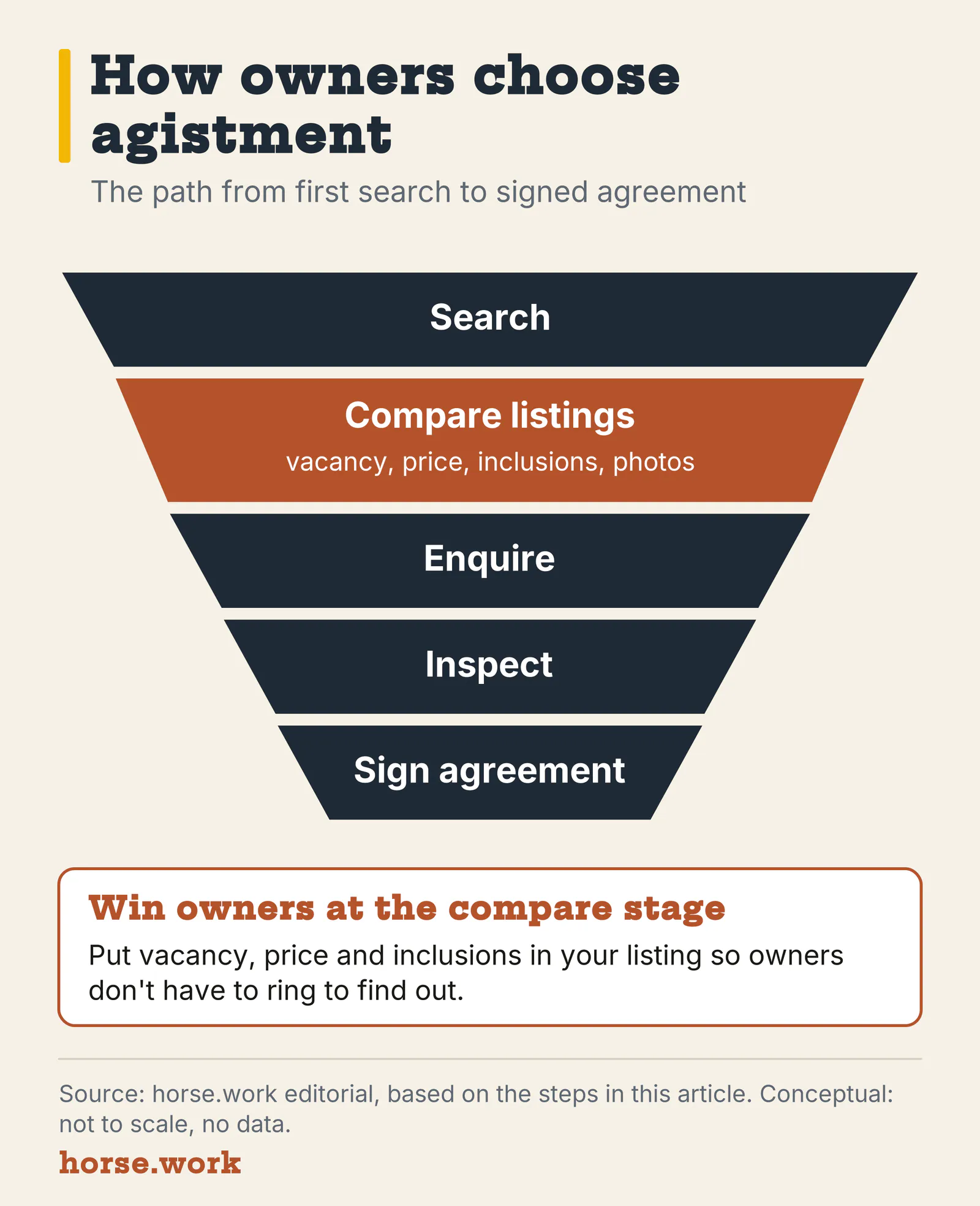
Treat vacancies as your headline
A horse care business sells capacity. Unlike a farrier, you can't fit in one more client at the end of the day. Make the vacancy itself the news.
- Be specific. "1 x individual paddock with shelter, available from 1 December" beats "Agistment available".
- Say what kind of spot it is. Paddock, group paddock, stable and yard, full care, part care, spelling, rehab, or a horse-sitting booking.
- Update it the day it changes. Nothing frustrates owners more than ringing about a spot that went three weeks ago.
- Keep a waiting list. When spots are full, take names and contact the list first when one opens up.
- Name any restrictions honestly. For example, no stallions, mares only in a paddock, or a maximum height or weight for a rehab treadmill.
A vacancy post template
Vacancy: individual paddock, [district] Available from: [date] Suits: [type of horse] Includes: [water, shelter, hay rules, checks per day] Facilities: [arena, float parking, tack room] Price: [$ per week, what's included, what's extra] Contract and notice period: [summary, with full terms on request] Contact: [name, phone, best time]
Write your own details in; never post a price or inclusion you aren't sure of.
Photos that sell a property
Owners will judge your property from its photos before they visit. Good photos are honest and specific.
| Show | Why it matters |
|---|---|
| Fencing up close | Owners check fence type and condition first |
| Shelters, stables and yards | Shows protection from heat, wind and rain |
| Water points and troughs | Proves reliable water |
| Paddock cover in the current season | Sets honest expectations about pasture |
| Arena, round yard, wash bay, float parking | The facilities owners use day to day |
| The feed room and hay storage | Signals organisation and hygiene |
| A wide shot of the property | Gives a sense of size and layout |
Take photos in good light, keep them current, and caption them ("Individual paddocks with post-and-rail fencing, October 2026"). Don't use stock photos as if they show your property, and don't use photos from a lusher season without saying so.
Ask permission before posting photos of clients' horses, and avoid showing people's faces or car number plates without consent.
Be upfront about price and inclusions
Agistment prices aren't consistent across the industry, and owners know it. They'll compare. Being clear about your price and what it covers builds trust and screens out the wrong clients.
- Give a weekly or monthly price per horse, plus a clear list of what's included and what costs extra.
- Separate optional extras such as rugging, feeding hard feed, holding for the farrier, or worming.
- Say how and when you charge for hay in dry times, so it's not a surprise.
- Issue proper invoices, with your ABN where it applies. You can check an ABN with our ABN and invoice checker.
Owners are likely to use our agistment comparison tool and horse cost calculator to compare you with others. Our guide to agistment costs and comparing quotes explains how they'll weigh it up. If several owners share a paddock or a service, the bill splitter can help.
Fair contracts are a marketing asset
A clear written agreement protects both sides and reassures owners. Our agistment agreement checklist covers what to include.
If you use the same agreement for every client (a standard form contract), note the Australian rules on unfair contract terms. According to the ACCC [4]:
- Since 9 November 2023, it has been illegal to propose, use or rely on an unfair term in a standard form contract with a consumer or a small business.
- A small business, for these rules, has fewer than 100 employees or an annual turnover under $10 million.
- A term may be unfair if it causes a significant imbalance in the parties' rights, isn't reasonably necessary to protect the business's legitimate interests, and would cause detriment if relied on.
- The ACCC's examples include terms that let only one party end the contract, penalise only one party, or change the terms of the contract.
- Transparency matters: terms should be in plain language, clearly presented and not hidden.
- Terms setting the upfront price aren't assessed for unfairness.
- Only a court can decide whether a term is unfair. If it does, the term is void.
In practice, that means a balanced notice period that applies to both of you, clear fees for extras, and no "we can change anything at any time" clauses. Get advice if you're unsure.
Reviews: ask honestly, never buy them
Reviews matter to owners choosing who to trust with their horse. They're also an area where the rules are strict.
The ACCC says [3]:
- Fake reviews are illegal.
- Reviews by family, friends or staff that don't disclose the relationship can mislead customers.
- Businesses must not suppress or hide negative reviews.
- Any incentive offered for a review must be offered regardless of whether the review is positive or negative, and the incentive should be disclosed.
- The ACCC's case studies include Federal Court penalties of $600,000 against Service Seeking, which let businesses draft their own reviews, and $2.9 million against HealthEngine, which held back negative reviews and edited others.
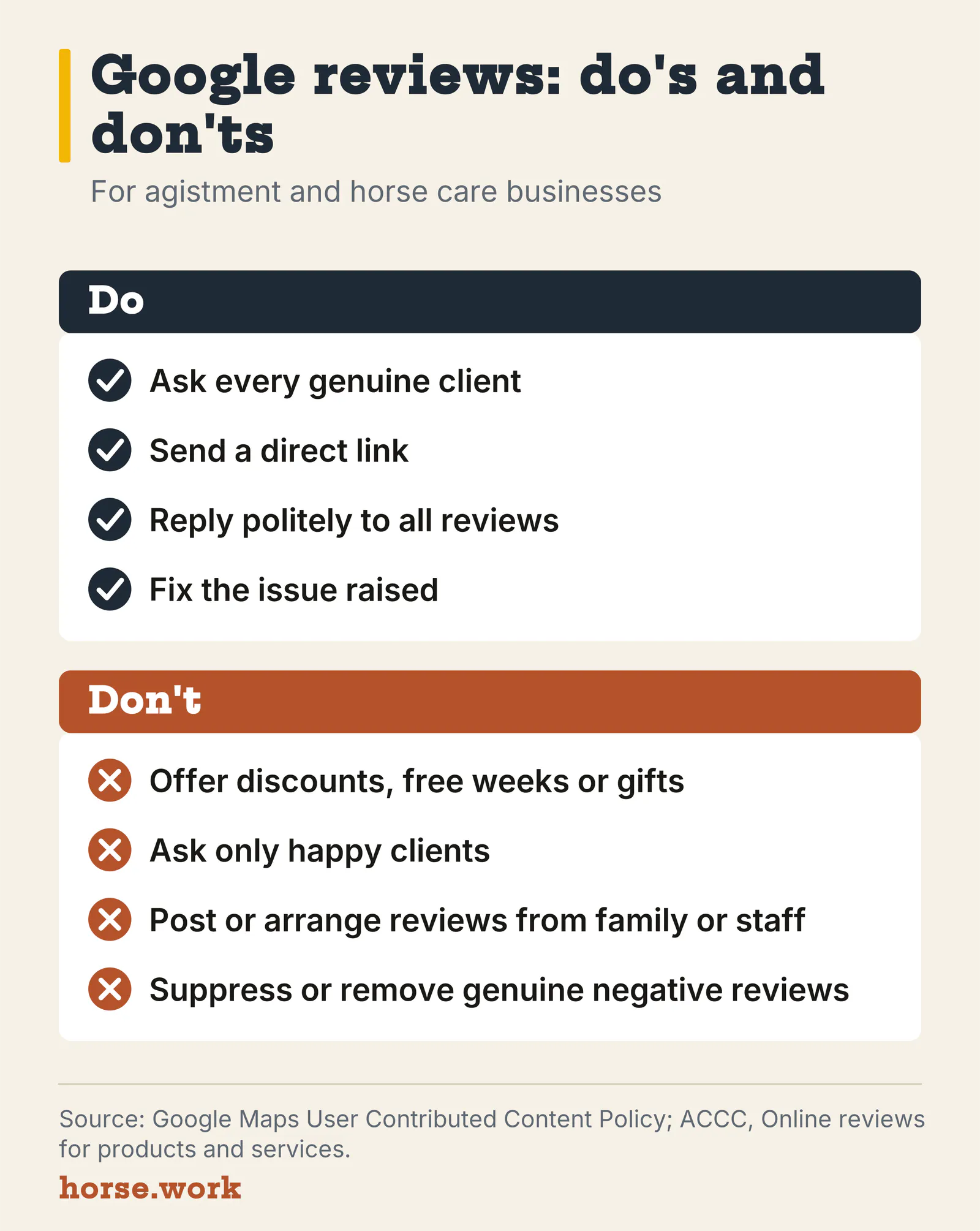
Google's Maps policy, which applies to Google reviews, is stricter [2]:
- Businesses must not offer incentives such as payment, discounts or free goods or services for reviews.
- Businesses must not discourage negative reviews or ask only happy customers for reviews.
- No reviews from people with a conflict of interest, such as owners or staff.
- Businesses can ask genuine customers to leave a review, as long as there's no incentive and no pressure.
| Do | Don't |
|---|---|
| Ask every client, at a natural point such as the end of a spelling stay | Ask only clients you know are happy |
| Send a direct link to your review page | Offer a free week, discount or gift for a review |
| Reply politely to every review, including negative ones | Argue publicly or reveal a client's private details |
| Fix the problem a negative review raises | Ask friends or family to post reviews |
| Report genuine negative reviews just because you don't like them |
Set up your Google Business Profile properly
Owners searching "agistment near me" will often see Google Maps results first. Google's guidelines say [1]:
- Use your real business name. The name on your sign, stationery and branding. Don't add keywords or locations to it.
- Pick the fewest, most specific categories. Choose categories that describe your core business.
- Hide your home address if clients don't visit. A service-area business, such as a horse sitter who travels to clients, should have one profile, hide a residential address and set a service area. Google says the service area shouldn't extend more than about 2 hours' drive from where the business is based.
- Only list hours if clients can visit then. Businesses that work by appointment only aren't supposed to list opening hours.
- Keep the description clean. Google doesn't allow prices, promotions or links in the business description.
If clients do visit your property, such as an agistment centre or livery yard, you can show the address. Think about privacy and security before you do, and make sure the pin is at the front gate, not the house.
Get listed on horse.work
Horse owners use horse.work to find services by type and location. Listing is a simple way to appear where owners are already searching.
- Add your business through for providers.
- Choose the right category, for example agistment, with state pages such as Victoria, New South Wales and New Zealand.
- Use the same business name, phone number and location as on Google, so owners don't get confused.
- Add vacancies, photos, inclusions and prices where you can.
If you'd rather get help with the website, photos or ads, look in the marketing services directory.
Partnerships and referrals
Horse care businesses do well when local professionals know and trust them.
- Farriers, vets and physios see a lot of horses and hear when an owner needs a new place. Make it easy for them to recommend you by being reliable when they visit.
- Transporters often know who's moving to the area. Find one in the horse transport directory.
- Rehab and spelling clients often come via vets. Explain clearly what level of care you can and can't provide, and never claim to provide veterinary care unless a vet is involved.
- Insurance. Clients may ask about your public liability and care, custody and control cover. An insurance provider can explain the options.
Client privacy
You'll collect names, phone numbers, emergency contacts and vet details. According to the OAIC, most small businesses with an annual turnover of $3 million or less aren't covered by the Privacy Act 1988, but some are, regardless of turnover [5]. Check the OAIC's small business checklist to see where you stand. Whatever the legal position, keep client details secure, only share them when needed for the horse's care, and ask before posting about a client's horse.
A 4-week plan to fill your next vacancy
| Week | Do this |
|---|---|
| 1 | Write your inclusions list and price; check your agreement against the agistment agreement checklist |
| 2 | Take fresh photos; update your horse.work listing and Google Business Profile |
| 3 | Post the vacancy with the template above; tell your waiting list, farrier and vet |
| 4 | Ask recent clients for honest reviews; reply to every enquiry within a day |
Checklist
- Vacancies listed with type, start date and price
- Inclusions and extras written down
- Current, captioned photos of fencing, shelter, water and facilities
- Standard agreement reviewed for one-sided terms
- Google Business Profile follows Google's name, category and description rules
- Review requests sent to all genuine clients, with no incentives
- horse.work listing up to date
- Client contact details stored securely