General information only. This guide is for people who run a horse transport business. It is not legal, biosecurity, insurance or tax advice. Interstate and welfare rules change — always check the official page for every state you leave, enter or transit before you accept a load.
Most transport work is won before the truck leaves the yard: a clear quote, a client who trusts you will not surprise them with paperwork at the border, and a trainer or agistment manager who recommends you because the last horse arrived calm and on time.
This article is for operators. If you want something to send owners who are planning a DIY trip, link them to floating a horse long distance and the transport cost calculator. Owners searching for a carrier can find you through the horse transport directory (and New Zealand).
Quote like a professional, not a mate
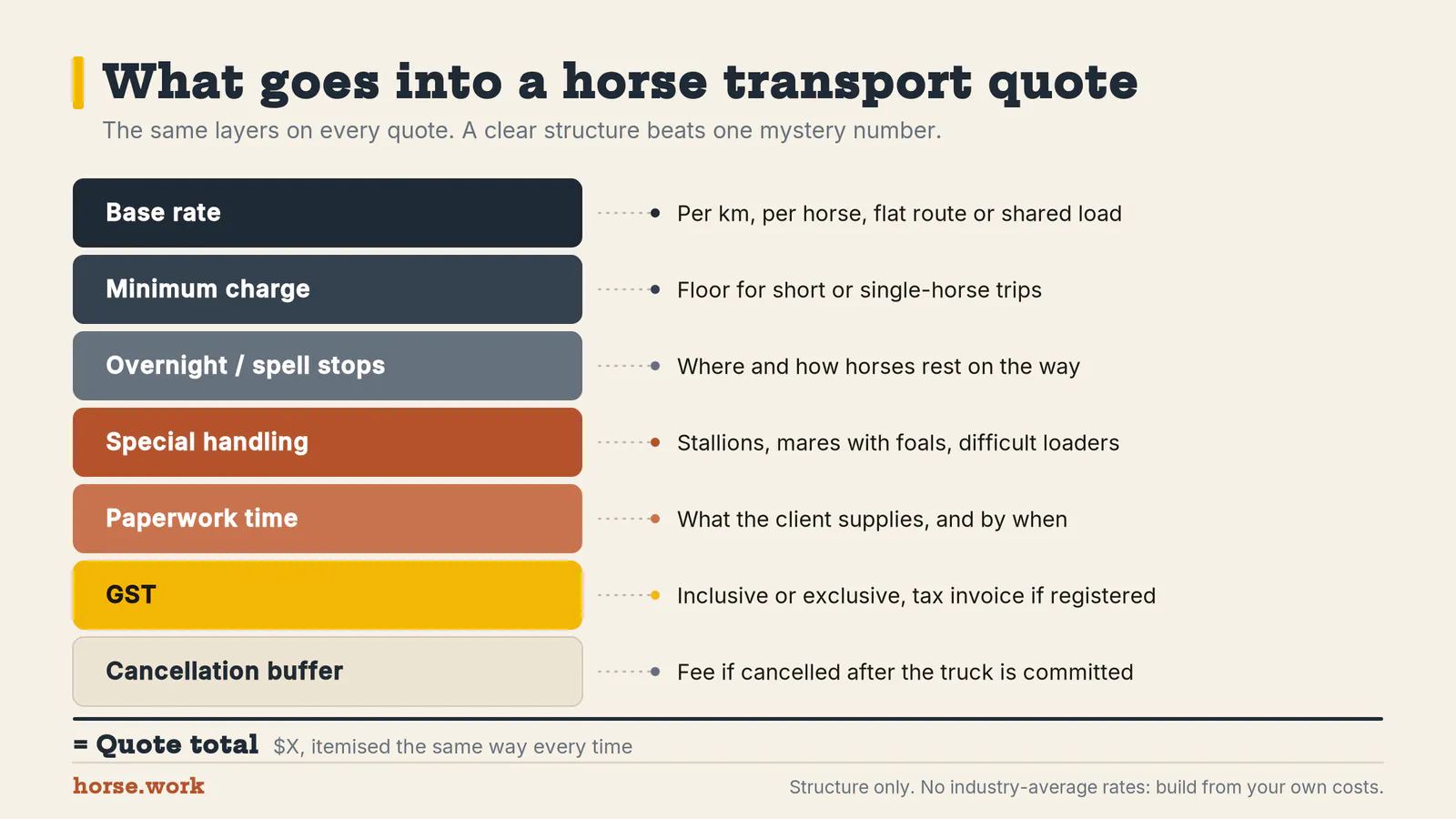
A quote that leaves out the hard parts creates the worst reviews. Break every quote into the same parts each time:
| Quote component | What to state | Why it wins work |
|---|---|---|
| Pickup and drop-off | Exact addresses, access notes, loading facilities | Prevents "you didn't say it was a steep driveway" |
| Distance or route | Planned route and approximate km | Lets the client sanity-check with the calculator |
| Base rate | Per km, per horse, flat route, or shared load | Clear structure beats a single mystery number |
| Minimum charge | Minimum fee for short or single-horse trips | Protects you on small jobs |
| Overnight / spell stops | Where and how horses are rested | Shows welfare planning |
| Return leg | Empty running or backloading policy | Explains price differences |
| Special handling | Stallions, mares with foals, difficult loaders, sedation under vet instruction | Avoids conflict at the ramp |
| Paperwork | What the client must supply and by when | Avoids border delays |
| GST | GST-inclusive or exclusive, tax invoice if registered | Trust and compliance [7] |
| Cancellation | Fee if cancelled after you have committed the truck | Protects your diary |
Do not invent "industry average per km" rates in your marketing. Use your own costs (fuel, finance, driver time, tolls, insurance, wear) and publish your structure. Encourage clients to run the transport cost calculator with their expected rate so they understand distance-driven pricing before they call.
Welfare standards your clients increasingly ask about
The Australian Animal Welfare Standards and Guidelines for Land Transport of Livestock apply to horses among other species, and set out a chain of responsibility that starts with the owner or their agent and runs through transport operators to the final receiver [1]. States and territories implemented them in different ways and on different dates; in Western Australia, current regulations implement the standards for cattle and sheep, with other classes still under consideration [1]. A review of horses under the land transport standards is underway [1].
Practical takeaway for marketing: say you plan journeys to meet the welfare standards and state rules that apply on the route — then actually do it. Ask the client about the horse's fitness to travel, recent illness, pregnancy or foal at foot, and whether a vet has advised against the trip.
As a short-form checklist, Victoria's horse hire establishment code (written for hire yards but useful in conversations with riding schools that hire you) recommends transporting in the shortest practicable time, penning separately where possible, not transporting more than 8 hours unless horses are healthy and preconditioned, special limits for heavily pregnant and early-lactation mares, not moving mares within 7 days of foaling except to vet treatment, separating incompatible classes, and not transporting lame or sick horses except to or from veterinary treatment [4]. It also lists vehicle expectations: non-slip floors, secure latches, ventilation, protection from temperature extremes and regular inspection [4].
New Zealand operators should follow MPI animal welfare codes and transport guidance rather than Australian rules [8].
Interstate paperwork: know what to flag
You are not the client's biosecurity officer, but you lose work if you discover a missing document at the checkpoint. Build a pre-trip checklist and send it with every interstate quote.
Queensland tick zones. Queensland separates a tick-infested zone and a tick-free zone. Horses are classed as low-risk livestock. When moving from the tick-infested zone to the tick-free zone, livestock must be tick-free and inspected by the owner, an experienced person or an accredited certifier; you do not need a biosecurity certificate, but a movement record must accompany the livestock, with a declaration stating how the risk minimisation requirements were met, and any prescribed NLIS requirements must be met [2]. Queensland also tells movers to check requirements for every state they move to or transit through [2].
Western Australia entry. All livestock entering WA must meet published import conditions, which take the form of species-specific LB1 health certificates [3]. Parts 1 and 2 plus supporting documents should be emailed to the relevant Quarantine WA entry inspection point at least three days before arrival, and the original signed certificate must travel with the livestock [3]. WA changed liver fluke import conditions for horses on 1 December 2025; some horses receive an LB14 Inspector's Direction Notice with post-entry requirements, and a permit may be needed to move them off the destination property until those are done [3]. Fees apply for inspection and related services [3].
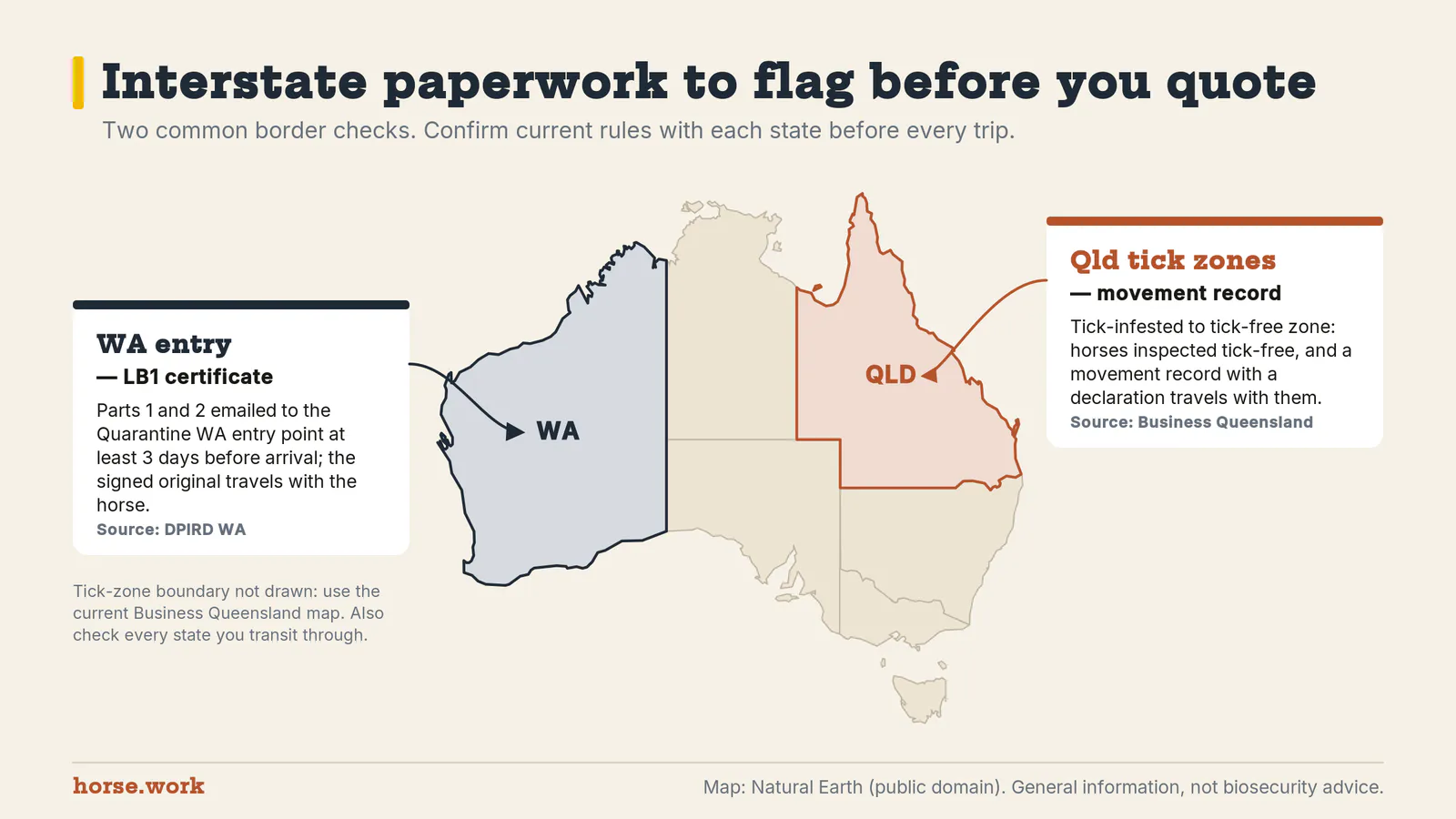
| Route type | What to ask the client before you quote | Official starting point |
|---|---|---|
| Within Qld across tick zones | Tick-free inspection, movement record with declaration | Business Queensland [2] |
| Into or through other states | Destination and transit state entry rules | State pages linked from Business Queensland [2] |
| Into WA | LB1 certificate, lead time to QWA, post-entry conditions | DPIRD WA [3] |
| Any long haul | Fitness to travel, spell plan, water and feed plan | Land transport standards [1] |
Keep a one-page "interstate prep" PDF on your site. Clients forward it to their vet and agistment manager, and you look organised.
Partnerships that bring repeat loads
The best transport clients often come through someone else's yard.
Agistment properties. Offer a regular run (for example, monthly shuttle to a vet hospital, sale or show). Give the property a clear sheet with your rates and booking contact. Listing in the agistment directory is one way to meet property owners who need a reliable carrier.
Trainers and coaches. Seasonal show and competition calendars create predictable demand. Agree a block booking with deposits.
Studs and breeders. Mare and foal moves need extra care and planning; price specialised handling honestly.
Vets and farriers. Clinics sometimes need a carrier for referrals. Provide a short insurance and contact sheet they can hand to clients.
Partnership rules of thumb:
- Write down referral arrangements; avoid secret kickbacks.
- Do not over-promise capacity at peak show weekends.
- Send a post-trip text or photo of arrival (with client permission) so the partner looks good for recommending you.
Reviews and reputation
Ask for a review when the horse has arrived and the client is relieved — not three weeks later. Make it easy: a short link and a one-line ask. Respond to negative reviews calmly with facts and a phone number.
What clients notice and write about:
- Communication on the day (ETA updates)
- How the horse looked on arrival
- Clean vehicle and correct gear
- Whether the final invoice matched the quote
Google Business Profile for mobile operators
Google's guidelines say a business that travels to customers can have a service-area Business Profile; if you run from home with no storefront signage, hide the street address and set a service area instead [5]. Use one profile per business, keep the name consistent with your real-world branding, choose the fewest categories that describe your core business, and avoid stuffing taglines or keywords into the business name [5]. Service areas generally should not extend beyond roughly two hours' driving from where the business is based, though larger areas may suit some businesses [5].
Checklist:
- Real business name only (no "Best Horse Transport Melbourne Cheap" stuffing)
- Service area set; home address hidden if you have no customer-facing yard
- Phone number under your control
- Photos of clean vehicles and safe loading (no clients' horses without permission)
- Reply to every review
- Post updates for regular runs (for example, monthly south-east run) without prices in the description field if Google's description rules restrict promotional pricing [5]
Pair Google with an accurate horse.work transport listing. Directories and Maps work together when the name, phone and service area match.
Insurance and invoices that build trust
business.gov.au lists goods-in-transit insurance, public liability and workers compensation (if you employ drivers) among common business covers, and suggests getting professional advice on what you need by law [6]. Ask your broker specifically about animals in your care, custody and control — do not assume a general policy covers a horse injured in transit.
If you are GST registered, issue tax invoices that meet the requirements business.gov.au summarises: "tax invoice", business name, ABN, date, description, quantity and price, GST amount, and buyer identity or ABN for sales over $1,000 [7]. The ABN invoice checker helps clients and partners check ABNs.
Content that sells (without rehashing owner DIY guides)
Useful pages and posts for operators:
- "How we quote" (your component table, no fake averages)
- "Interstate prep checklist" (links to Qld and WA official pages)
- "What to have ready on pickup day" (headcollar, rug, documents, feed for the trip)
- "Share with your client" — link to floating a horse long distance for owners who ask about DIY care
Avoid publishing medical advice. Point fitness-to-travel questions to the client's vet.
Operator growth checklist
- Quote template with every component filled in
- Interstate checklist emailed with every cross-border quote
- Welfare and journey plan you can explain on the phone [1][4]
- Insurance reviewed for animals in transit [6]
- Tax invoice template matches GST position [7]
- Google Business Profile set up as service-area business [5]
- Review request sent within 24 hours of delivery
- At least two yard or agistment partnerships with regular runs
- horse.work listing current
Win the load with clarity, keep the client with care on the road, and let partners do some of the selling for you.