General information only. We don't publish average agistment prices, because prices vary so much by region and by what's included that an average would mislead you. This guide shows you how to compare the quotes you're actually given. For anything to do with contracts, liens or liability, get legal advice.
Ring around for agistment and you'll hear all sorts of numbers. One place is cheap but you supply the hay. Another costs more but someone rugs your horse morning and night. A third quotes by the month, a fourth by the week. Comparing those numbers directly doesn't tell you much.
As our agistment tool puts it, agistment prices only mean something once you know what's included: paddock only, full care, feed, rugging, an arena or a float park all make a big difference [1]. Here's how to get every quote into the same shape so you can compare like with like.
Step 1: Get every quote in writing, and in the same unit
Ask each property for a written price, and for a list of exactly what that price covers [1]. Then convert everything to the same unit. The simplest is weekly, because you can always convert up:
- Monthly = weekly price × 52 ÷ 12
- Yearly = weekly price × 52 [1]
Watch out for "per month" quotes that are really four weeks. Ask the property how they bill, so you're not comparing a calendar month with a four-week period.
Our agistment tool does the conversion for up to six properties side by side. It doesn't show averages, and properties without a price show "Price on request" [1]. Prices and ticks stay in your browser.
Step 2: Write down what's included
This is where quotes really differ. For each property, tick off what the price covers. Common inclusions to ask about [1]:
| Ask about | Included? | If not, who supplies it and roughly how much? |
|---|---|---|
| Paddock only (you do everything else) | ||
| Full care (someone checks, feeds and handles your horse) | ||
| Hay or other supplementary feed | ||
| Hard feed and supplements | ||
| Rugging on and off | ||
| Arena or riding area access | ||
| Float or truck parking | ||
| Holding horses for the farrier, vet or dentist | ||
| Worming or other routine care | ||
| Stable or yard use |
Fill in the last column with figures from your own suppliers, not guesses. A quote that looks cheaper may end up costing more once you add what it leaves out.
Step 3: Add the extras that sit outside the agistment fee
Even full-care agistment usually doesn't cover everything. Our tool suggests adding your own extras, such as hard feed and the farrier, if they're not included [1]. Agriculture Victoria notes the horse owner may also be liable for the costs of feed, exercising, training and caring for their horse [2].
Typical extras to price separately:
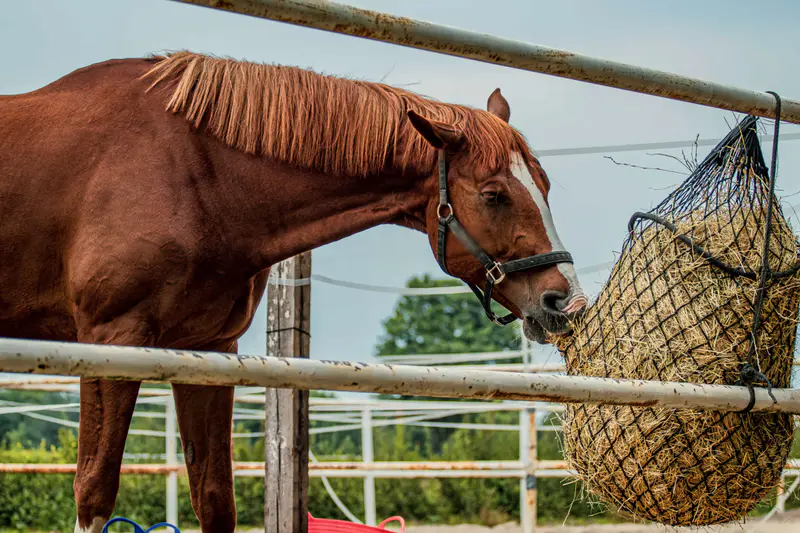
- Supplementary feed. If you supply hay or hard feed, you need a feed budget. Agriculture Victoria says horses can eat about 1.5–2% of their bodyweight in dry feed a day, and suggests using 1.7% for a feed budget; at least 70% of the diet should be roughage such as hay, pasture or chaff [4]. It also points out that feed wastage is one of the factors affecting weight gain or loss [4]. Our feed calculator can help, and you'll need your horse's weight (see how to weigh a horse without scales).
- Hooves. Agriculture Victoria says hooves need trimming every 6–8 weeks by a farrier [3].
- Teeth. At least once a year for a paddock horse, and every 3–6 months for horses under 5 or grain-fed horses [3].
- Worming. Follow the product directions and your vet's advice [3]; see our worming schedule guide.
- Vaccinations your vet recommends, which some properties require (more on that below).
- Insurance. Agriculture Victoria lists insurance for the horse, and against any damage it may cause, among the owner's normal responsibilities [2].
- Travel. Fuel and time to get to the property. Agriculture Victoria suggests asking whether the property is close enough to visit daily [3].
Price these with your own quotes from local providers. Our feed store and farrier directories are a good place to start. The horse cost calculator pulls everything into a yearly total, and our cost of owning a horse guide walks through each category.
Step 4: Compare what you're getting for the money
Price isn't everything. Agriculture Victoria's basic requirements for any horse are adequate feed, water, shelter, space and exercise, company, health care, and treatment of illness or injury [3]. When you visit (and do visit: horse.work doesn't inspect properties [1]), check:
- Fencing in good repair with no loose wire [1][3]
- Water that's clean and always available; a dam or self-filling trough is best, and anything not self-filling must be checked daily [3]
- Shelter from sun, wind and rain [3]
- Space to walk and run, and company of other horses [3]
- Who checks the horses and how often. Agriculture Victoria says at least daily [1][3]
- A Property Identification Code (PIC). Required in Victoria for properties where horses are agisted; check the rules in your state [1][3]
- Access hours and any rules about riding, visitors or floats.
Our tool's checklist covers these, and you can download it as a fillable PDF with a cost comparison page [1].
Step 5: Ask how the price can change
The quoted price is today's price. Agriculture Victoria points out that fire, flood or drought can dramatically increase the cost of pasture and feed, and lists ways landholders may use contracts to limit those losses [2]:
- allowing the agreement to end after notice if a flat fee is set
- allowing re-evaluation of costs in adverse weather
- making the owner responsible for food and water if pasture and water can no longer support the horse
- using short-term agreements that renew automatically unless either side gives notice.
None of these are unreasonable, but they change what you might pay. Ask each property:
- Has the price changed in the past, and how much notice do you give?
- What happens in a drought: who supplies hay, and who pays?
- What's the notice period for ending the agreement?
- Who pays transport if the horse has to leave? (Agriculture Victoria lists transport costs to deliver the horse to the owner as something to agree on termination [2].)
- When are fees due, and what happens if a payment is late?
Step 6: Get it in writing
Agriculture Victoria recommends a written agistment agreement, because verbal agreements rarely plan for injury, disease, non-payment or the need to move horses because of fire, flood or drought [2].
Non-payment is worth understanding before you sign. In Victoria, if there's no written agreement covering non-payment, the Impounding of Livestock Act 1994 allows a landholder to create a lien over an agisted horse when payments default, and to take steps to sell, dispose of or destroy it if payment stays outstanding [2]. Rules differ in other states and in New Zealand, so get local legal advice.
Our agistment agreement checklist walks through what to put in writing, from fees and liens to vet authority and fire plans.
Sharing agistment costs
If you share a horse, or several owners share a paddock and hay, agree in writing who pays what. The share cost calculator helps split ownership costs, and the bill splitter handles one-off bills such as a load of hay.
New Zealand owners
The comparison method is the same: written quotes, the same unit, a full list of inclusions, and your own figures for extras. The legal points in this guide (the Victorian PIC requirement and the Impounding of Livestock Act 1994) are Victorian, so check the rules that apply where you are.
Frequently asked questions
How much does agistment cost? It depends on the region and what's included [1]. Get a written price from each property and compare them with our agistment tool.
Is the cheapest quote the best value? Only if it includes the same things. Add hay, rugging, handling for the farrier and other extras before comparing.
What should every agistment property have? At minimum, safe fencing, water, shelter and feed [1][3].
Quote comparison checklist
- Written quote from each property
- All prices converted to weekly, then monthly and yearly
- Inclusions table filled in for each property
- Your own prices added for feed, farrier, dentist and other extras
- Each property visited, with fencing, water, shelter and company checked
- PIC and local rules checked
- Price-change, drought and notice terms understood
- Written agreement reviewed before your horse moves
Start by searching agistment near you, then put the quotes into the agistment tool.