About the numbers. There is no official average price for a horse in Australia. The asking prices below are summaries of live classified listings on the day we checked them (24 October 2026), and the fees come from individual providers' published price lists. Prices change, vary by region and usually exclude travel. Where we add figures together, we label the result as our estimate. Always get your own quotes.
Most people underestimate what a horse costs to buy. They budget for the horse itself, then get surprised by the vet check, the float trip home, the registration paperwork and a saddle that doesn't fit. This guide covers the upfront side: what horses are listed for, where to look, and the one-off fees you pay in the first few weeks. Yearly running costs get a short summary near the end. For the full breakdown, see our guide to what a horse costs per year.
The quick answer
On Horseyard, Australia's biggest horse classifieds site, median asking prices on 24 October 2026 ranged from about $1,500 for a Standardbred to about $12,000 for a Warmblood. Thoroughbreds had a median of $3,300 and Australian Stock Horses $5,000 [1]. Rescue and off-the-track horses can cost less: RSPCA NSW's fees page lists horse adoption at $1,000 [27]. Proven competition horses and well-bred youngstock cost far more.
On top of the purchase price, we estimate the one-off costs of getting a horse home and set up at roughly $1,100 at the lean end, about $3,600 for a typical first horse, and $7,000+ if you buy a full set of new gear, insure from day one and need X-rays. The budget table below shows how those figures are built.
Purchase prices by type of horse
What a horse costs depends mostly on its breed, age, training, soundness and record. Breed and discipline give you a useful first filter. The table below uses Horseyard's own summaries of current listings. Each figure is a median asking price for the horses on that page on the day we checked, not a sale price [1][2].
| Breed (Horseyard listings, 24 Oct 2026) | Listings | Median asking price | Cheapest–dearest listed |
|---|---|---|---|
| Standardbred | 24 | $1,500 | $300–$4,000 |
| Brumby | 8 | $2,150 | $1,000–$5,000 |
| Thoroughbred | 379 | $3,300 | $500–$11,000 |
| Arabian | 49 | $4,000 | $1,750–$8,000 |
| Ponies (general) | 22 | $4,250 | $1,000–$6,500 |
| Appaloosa | 18 | $4,400 | $1,000–$6,600 |
| Shetland | 7 | $4,500 | $3,500–$5,000 |
| Australian Stock Horse | 81 | $5,000 | $1,500–$15,000 |
| Clydesdale | 20 | $6,300 | $4,000–$12,000 |
| Riding pony | 54 | $6,500 | $1,000–$20,000 |
| Warmblood | 67 | $12,000 | $3,500–$32,000 |
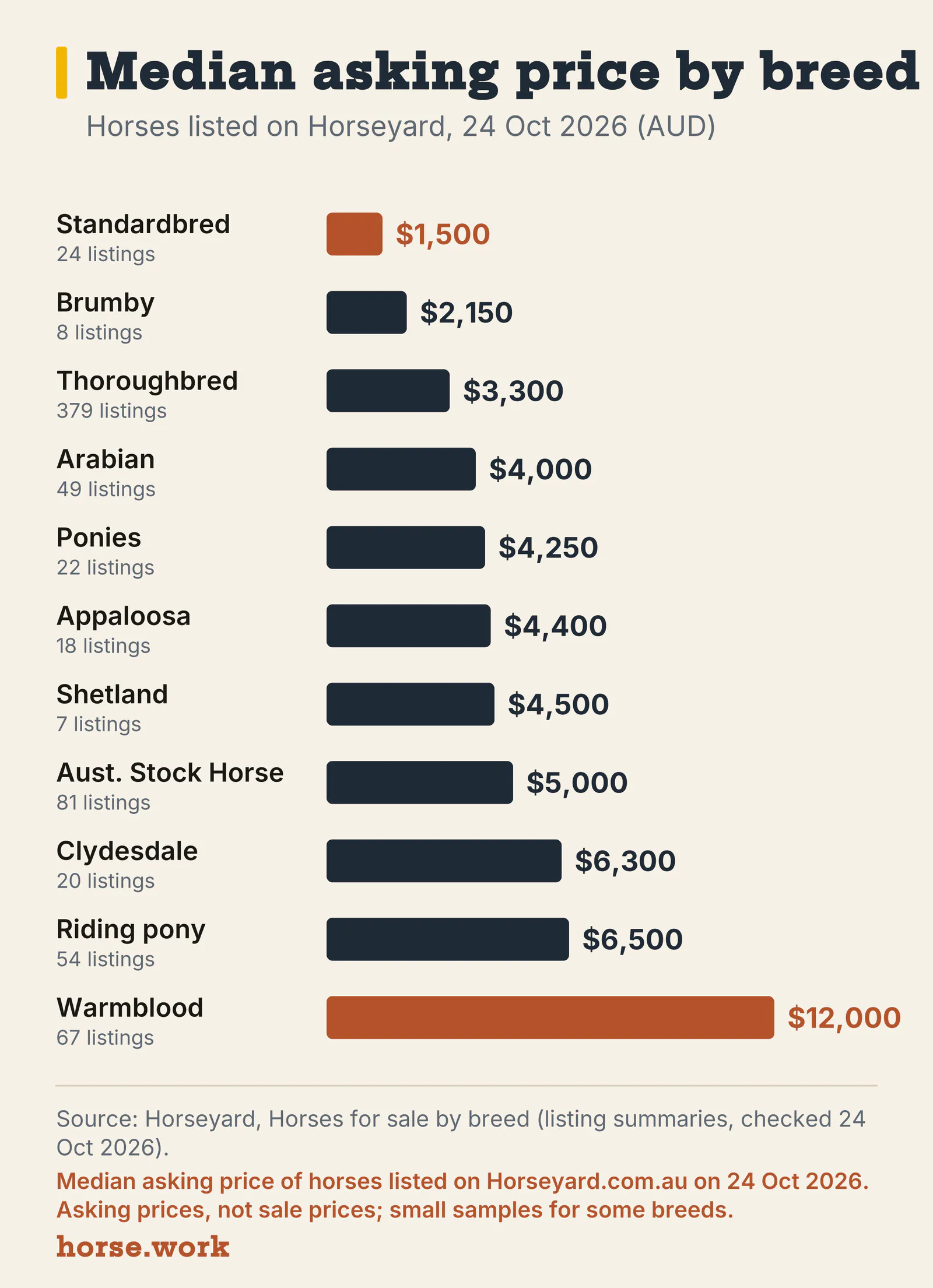
Read this with care. Some pages show only a handful of horses, and the "range" reflects whatever happened to be listed that day. Asking prices are also not what horses actually sell for. Horseyard didn't publish a median for Quarter Horses. The few prices on the first page of its Quarter Horse listings ran from about $2,000 to $12,000, so treat that as indicative only.
Breed societies sometimes publish wider ranges. The Australian Stock Horse Society's buyer's guide says ASH "regularly sell between $1,500 and $80,000". It adds that most horses at its Approved Sales sell for between $2,500 and $30,000 [3].
Prices by what you want to do
Training and job matter as much as breed. The same Horseyard summaries grouped by discipline show [2]:
| Discipline (Horseyard, 24 Oct 2026) | Listings | Median asking price | Range listed |
|---|---|---|---|
| Pleasure | 26 | $3,000 | $950–$10,000 |
| Pony club | 42 | $4,250 | $1,000–$8,800 |
| All-rounders | 251 | $4,500 | $1,500–$10,000 |
| Dressage | 224 | $9,000 | $2,000–$32,000 |
| Eventing | 70 | $10,000 | up to $30,000 |
| Showjumping | 89 | $10,000 | up to $33,000 |
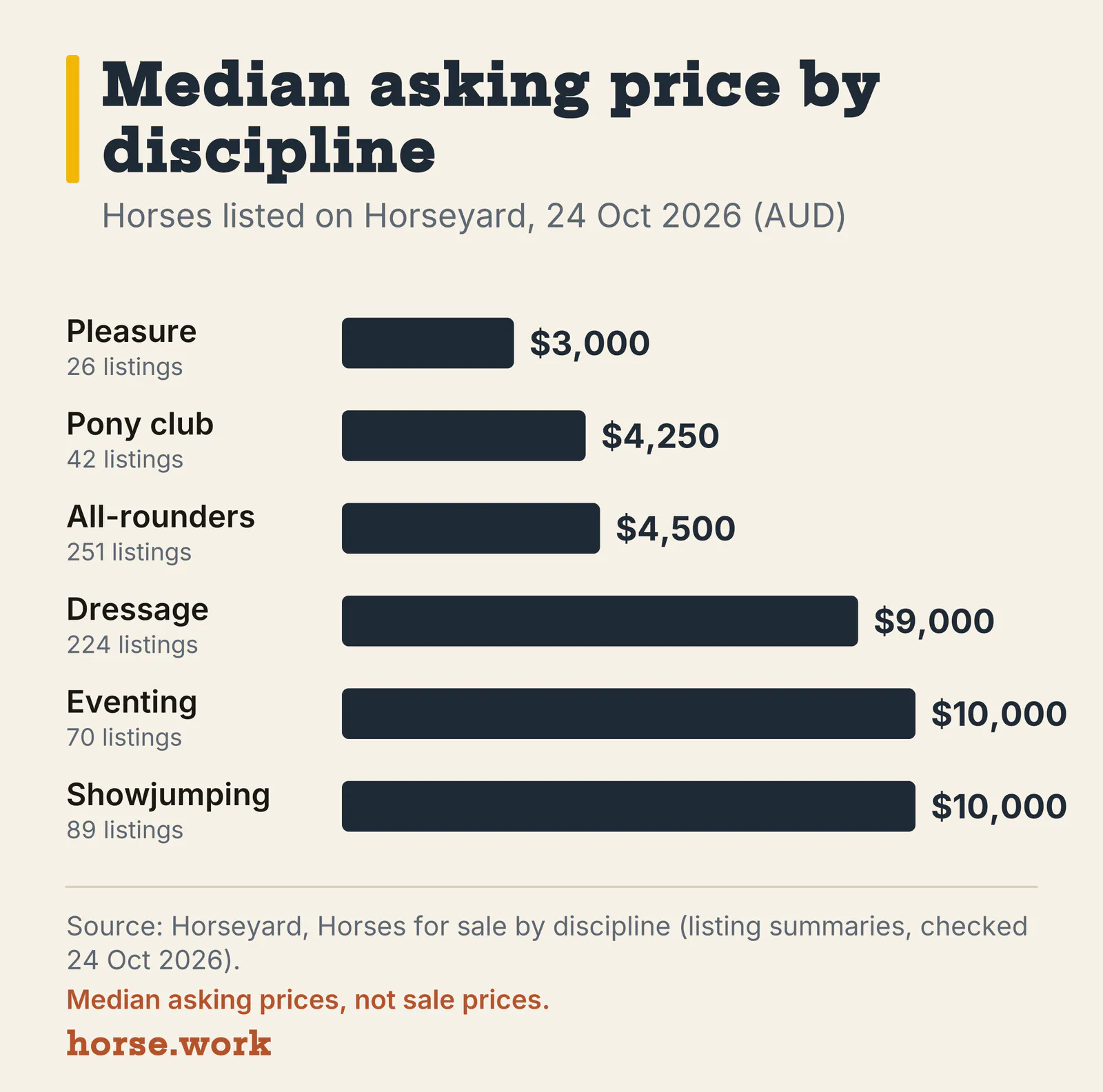
The pattern is clear. A quiet all-rounder or pony club horse is usually listed at a few thousand dollars. A horse with competition training or results costs two to three times as much.
At the very top end, the 2026 Magic Millions Gold Coast Yearling Sale sold 934 of 1,221 lots at a median of $150,000 and an average of $228,252 [7]. That's a racing investment market, not a guide to what a riding horse costs.
Rescue, adoption and off-the-track horses
These routes often cost less upfront. What matters more is that the horse comes with an honest history and some support.
- RSPCA. RSPCA NSW's fees page lists horse adoption at $1,000 (individual listings can differ; some older horses were listed at $500) [27]. Expect to bring photo ID showing your name and current address [4], and RSPCA NSW's individual horse listings say you will need a PIC number to adopt [28]. The RSPCA's health check is not a substitute for your own pre-purchase exam. Browse other groups in our horse rescue directory, or read our guide to adopting a horse in Australia.
- Retired Standardbreds. Harness Racing Victoria's HRV Hero programme rehomes Standardbreds, either through retrainers or straight from their racing connections. Listed prices are often in the $2,000–$3,500 range, and some horses are "price on enquiry" [5].
- Off-the-track Thoroughbreds. Racing Victoria's Off The Track programme points buyers to Acknowledged Retrainers and Rehomers rather than setting a price [6]. On Horseyard, the "off the track" category had 78 horses listed when we checked, but no median was published.
A horse straight off the track usually needs months of letdown and retraining. Budget for lessons or a coach from our trainers and coaches directory before you rely on it as a first horse.
Where to buy a horse in Australia
- Online classifieds (Horseyard and similar sites). These have the biggest range and the price filters above. Ask for videos, ride the horse yourself, and never pay a deposit for a horse you haven't seen in person.
- Breed society sales and registries. Approved or society sales often publish catalogues with breeding and records. The ASHS guide suggests questions to ask before you buy [3].
- Studs and breeders. These are best if you want youngstock or a particular bloodline. Find them in our studs and breeding directory.
- Riding schools and coaches. They sometimes sell schoolmasters or know of horses before they're advertised. See riding schools and clubs and associations.
- Rescue and racing rehoming programmes. See the section above.
- Auctions. Auctions are fast, but you often get limited time for a vet check or trial. Only bid if you can do your homework beforehand.
Before you hand over money
Agriculture Victoria's advice is simple. Have the horse examined by your own vet, take someone experienced with you, and arrange a trial period if you can [8]. Check the horse's age against its papers using our horse teeth age chart. Put the price, deposit, trial terms and vet-check conditions in writing, and find out what the horse has been eating, wormed with and vaccinated against.
The one-off fees of buying a horse
Pre-purchase vet exam
This is the fee people skip and later regret. Two published examples:
- Tweedie Equine Veterinary Services (VIC): five-stage pre-purchase exam from $675 on site plus call-out, or $650 in the clinic [10].
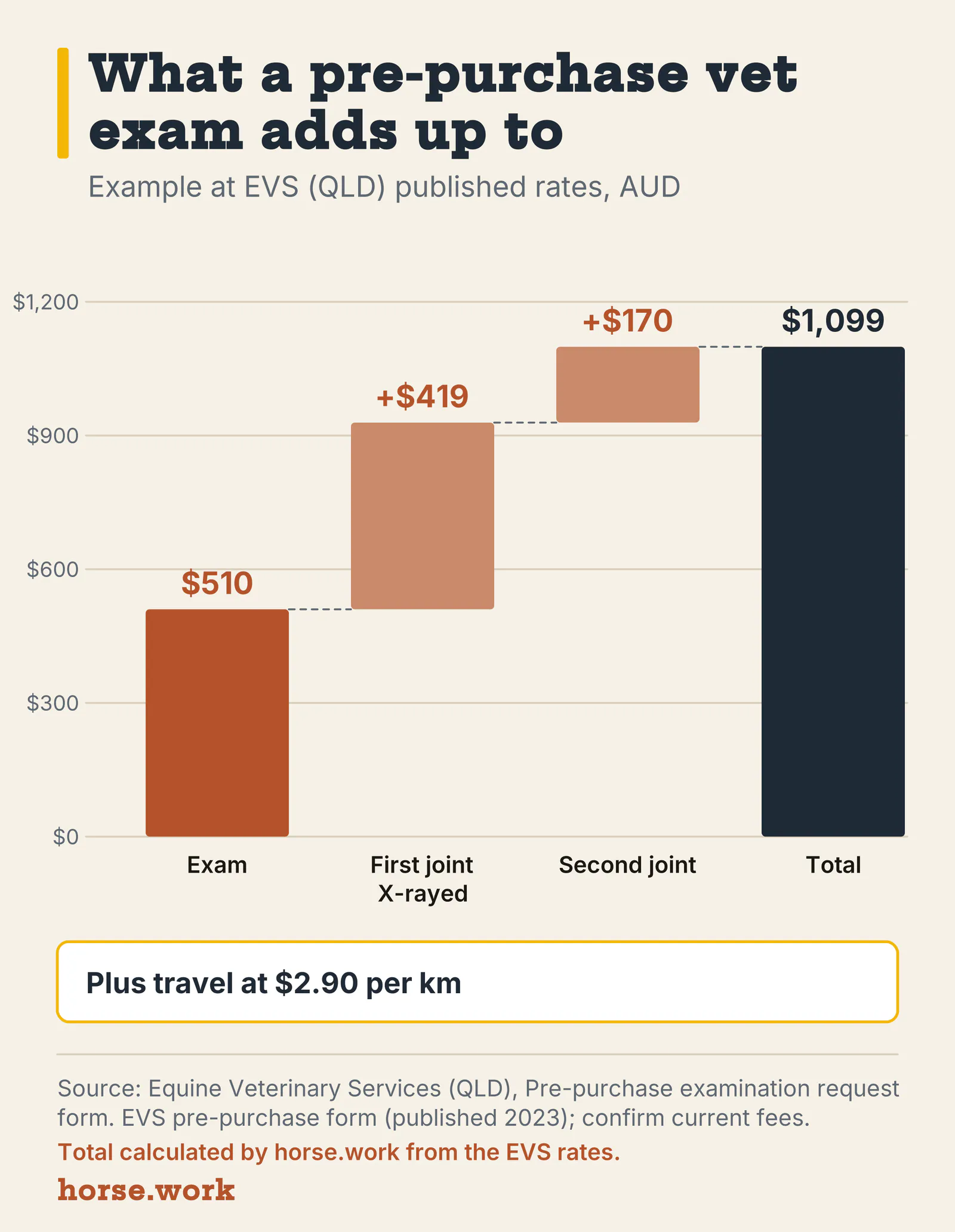
- Equine Veterinary Services (QLD): pre-purchase exam $510 plus travel at $2.90 per km. X-rays cost $419 for the first joint and $170 for each extra joint [9]. That price form was published in 2023, so confirm current fees.
A basic exam with a couple of joints X-rayed comes to about $1,100 at those QLD rates (our estimate). Sport horses often get a fuller set of X-rays, which can take the total past $2,000. Find a vet near the horse in our equine vets directory.
Getting the horse home
If you don't own a float, you'll pay a transporter. Flinders Equestrian in Victoria, for example, charges $250 for trips within 50 km, then $2 per extra km, plus $100 an hour from arrival at pickup [11]. Long-distance moves cost much more. Estimate your trip with the transport cost calculator, compare operators in our horse transport directory, and read floating a horse long distance before an interstate move. If you're tempted to buy a float straight away, weigh it up first with float hire vs buying.
Property Identification Code (PIC)
Wherever the horse lives, that property generally needs a PIC. That includes agistment.
- Victoria: compulsory, and applying is free [12].
- NSW: compulsory for properties with horses. You apply through Local Land Services [13]. The fee isn't published on the government page, so confirm it with your LLS office (TBC).
- Queensland: you must register as a biosecurity entity. Primary producers pay $54.72 a year, charged for three years. For everyone else, registration is free [14].
If you agist, check that the property owner already has a PIC. Our agistment agreement checklist covers what else to confirm.
Registration, transfer and memberships
- Equestrian Victoria (2026/27, GST-inclusive): transfer of horse ownership $50, base horse registration $65, full registration $220. Rider memberships run from $200 (senior recreational) to $560 (senior competitor) [15].
- Pony Club Victoria (2026–27): state fee $135 plus the Pony Club Australia levy of $84.54, with club and zone fees on top [16].
- Ex-racehorses: under Racing Australia's traceability rules, the horse's change of ownership or location must be reported within 7 days of a sale or gift. You can lodge it online or on a paper form, and no fee is listed [17].
Other states and New Zealand set their own fees. Check with your state equestrian body before budgeting.
First vet visit, vaccinations and microchip
Book a settling-in health check, or bring forward any vaccinations that are due. One Queensland clinic's 2026 price guide lists [18]:
- housecall $220
- Hendra vaccination with a brief exam $220
- strangles vaccination $148
- tetanus vaccination $142
- microchip $72
- travel zones from $82.50
That puts a first visit at roughly $360 to $670 depending on what's needed (our estimate). Read our horse vaccination schedule, and in Hendra areas, Hendra virus and horses. Ask what the horse was last wormed with, then follow our worming schedule.
First dental and farrier visits
- Dental: Tweedie lists a dental exam with sedation at $240 [10]. Find a provider in our equine dentists directory.
- Farrier: one Australian farrier's published fee sheet lists a barefoot trim at $87 + GST and a full set of shoes at $257.63 + GST, with materials extra [19]. Find someone local in our farriers directory.
Gear and tack
Some horses come with gear, but most don't. Here are some current Australian retail prices (checked 24 October 2026):
- all-purpose saddle: Collegiate Syntovia+ Osberton, $699 at Horseland [20]
- Saddleworld's Ammo Pro saddle: $795 [21]
- padded flash bridle: $99.99 [22]
- rider helmet: from $86.99 [23]
- canvas/mesh combo rug: $129.99 [24]
- grooming kit: about $30 at the same retailer
Have a saddle fitted before you buy one; a cheap saddle that doesn't fit is an expensive mistake. Use our horse rug size chart to measure before buying rugs, and browse saddlery stores.
Insurance and excess
Insurers price each horse individually, based on its value, age, breed, use and history. Gow-Gates says there is no single typical premium [25]. Grainshed's 2026 guide puts insurance at about $250–$1,200 a year [26]. Excesses depend on the policy and product disclosure statement (TBC for any specific policy). Read our horse insurance guide and compare providers under insurance and finance.
A one-off setup budget: low, mid, high
These figures are our estimates, built from the published prices above. They exclude the purchase price.
| One-off item | Low | Mid | High |
|---|---|---|---|
| Pre-purchase vet exam | $650 | $1,100 | $2,050 |
| Transport home | $0 (own float) | $250 | $650 |
| PIC | $0 | $0 | TBC (NSW) |
| Registration/transfer | $0 | $50 | $270 |
| Rider membership | $0 | $200 | $560 |
| First vet visit and vaccinations | $140 | $360 | $670 |
| First dental | $0 | $240 | $240 |
| First farrier visit | $96 | $96 | $283 |
| Gear (new) | $240 | $1,040 | $1,260 |
| First-year insurance | $0 | $250 | $1,200 |
| Estimated total | ≈ $1,100 | ≈ $3,600 | ≈ $7,200 |
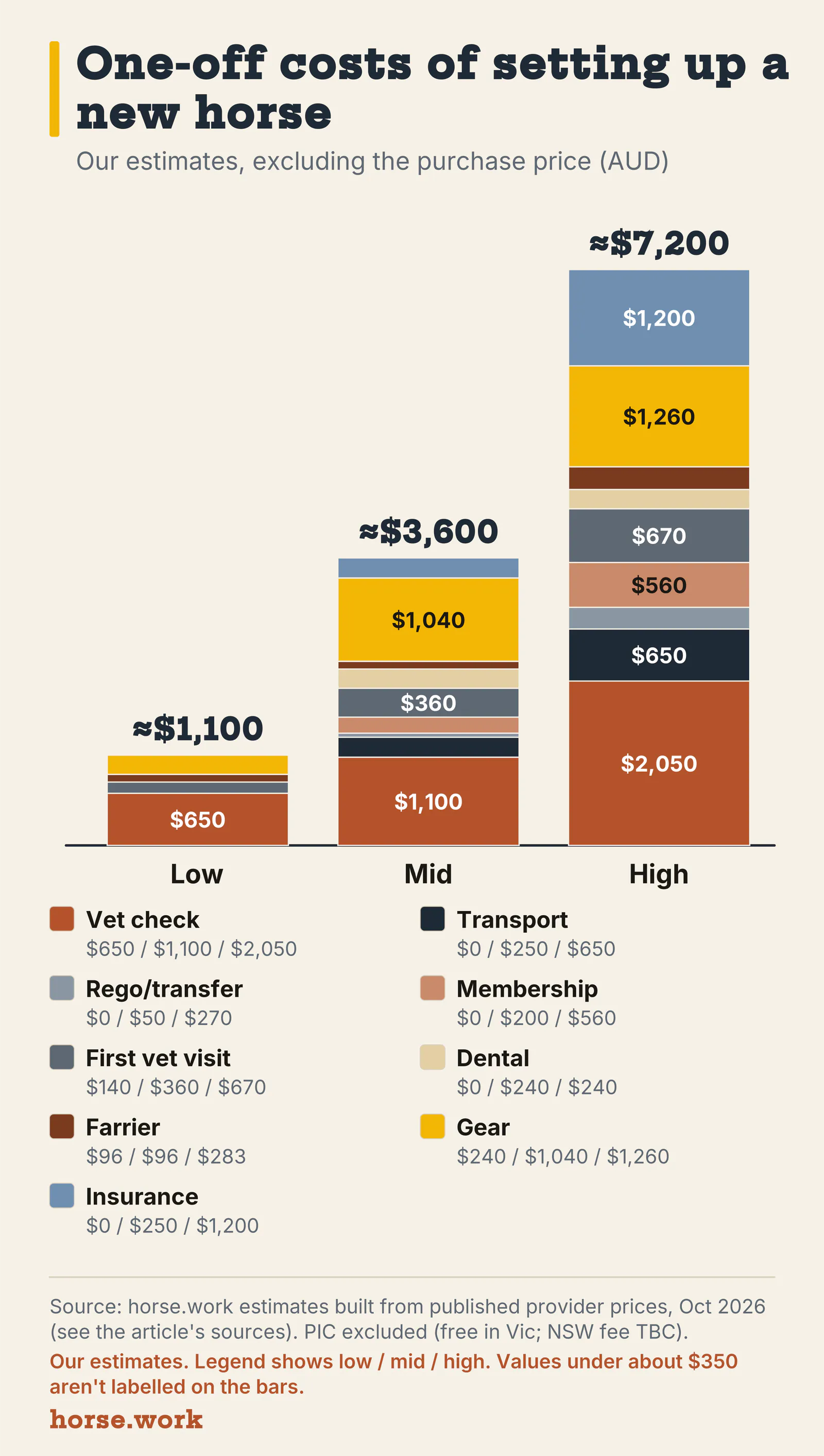
How we built it:
- Low: a horse kept unridden or sold with its saddle. In-clinic exam, tetanus vaccination only, a trim, basic gear.
- Mid: a QLD-rate exam with two joints X-rayed, short local transport, Equestrian Victoria transfer and recreational membership, a full first vet visit, a dental and a new saddle.
- High: a $2,050 exam (on-site exam plus a full sport-horse X-ray set), a longer float trip, full registration and competitor membership, shoes, and the top of Grainshed's insurance range.
Then the running costs start
Buying is the cheap part. Grainshed's 2026 guide says most hobby owners spend $8,000–$12,000 a year once farrier and routine vet care are included. Its "core" costs alone run from about $4,500 to $22,000+ a year [26]. Agistment is usually the biggest single line.
| Ongoing cost | What to read |
|---|---|
| Agistment | Compare agistment quotes and the agistment tool |
| Feed, farrier, dental, vet, worming | How much a horse costs per year |
| Your own total | Horse cost calculator |
Before you commit to a horse, run your numbers through the horse cost calculator. If a share or part-lease is more realistic, the share cost calculator helps you split costs fairly. Our yearly guide shows you how to build a budget line by line, so we won't repeat it here.
Frequently asked questions
How much does a cheap horse cost in Australia? Standardbreds and Brumbies had the lowest Horseyard medians when we checked, at $1,500 and $2,150, and some Thoroughbreds were listed from $500 [1]. A cheap horse still costs the same to vet-check, transport, feed and shoe, so the one-off fees above apply in full.
How much is a good first horse? Quiet, experienced all-rounders and pony club horses had median asking prices of $4,500 and $4,250 [2]. Expect to pay more for a sound, genuinely beginner-safe older horse. It's worth it.
Is a pre-purchase vet check worth it? Yes. Agriculture Victoria recommends one by your own vet [8]. At $510–$675 for the exam itself [9][10], it costs far less than buying a horse that turns out to be lame or unsuitable.
Do I need a PIC before I buy? Generally, yes. The property where the horse will live needs one in Victoria, NSW and Queensland [12][13][14]. Rescue groups can have their own requirements, so confirm them directly with the group before you adopt. For RSPCA NSW, bring photo ID, and its horse listings say you will need a PIC number to adopt [4][28].
Do I pay GST on a horse? It depends on the seller. A private sale between individuals usually doesn't include GST, while a GST-registered business may add it. Check the invoice and ask your accountant if you're buying for a business.
What about New Zealand? Prices and fees in New Zealand differ, and we haven't yet sourced NZ figures for this guide. Use local classifieds and ask NZ vets and transporters for quotes.
Finding providers: use find a provider to locate vets, transporters, farriers and saddlers near where your new horse will live.