"Looking in the mouth" is one of the oldest ways to estimate a horse's age, and it still works reasonably well in young horses. After about five, it becomes much less exact. This guide shows what changes on the lower front teeth (incisors) at each stage, with original illustrations, and is honest about the limits.
Everything here follows the MSD Veterinary Manual, the standard veterinary reference, which was fully reviewed in July 2026 [1].
Not veterinary advice. Teeth give an estimate, not a birth certificate. For a reliable age, check registration or breeding papers, or ask a vet or qualified equine dentist. Only look in a horse's mouth if it's used to being handled and someone experienced is helping.
Why estimate age at all?
MSD lists the reasons vets estimate age from teeth: judging a horse's useful working life, buying and selling, insurance, helping to identify an animal, and working out the likely outcome of a disease [1]. For most owners it comes up when buying a horse with no papers, or when a horse's paperwork and its mouth don't seem to agree.
How it works
Horses have long-crowned teeth that keep erupting through life to make up for wear. MSD puts that wear at about 2.5 mm a year until roughly 17 years of age [1]. As the tooth wears down, different internal structures show up on the biting surface, and the shape of the tooth changes. Ageing uses those changes.
The four things to look at on the lower incisors:
- Eruption: which teeth are in, and whether they're baby (deciduous) or permanent. Baby incisors are smaller and whiter; permanent ones are larger and more rectangular [1].
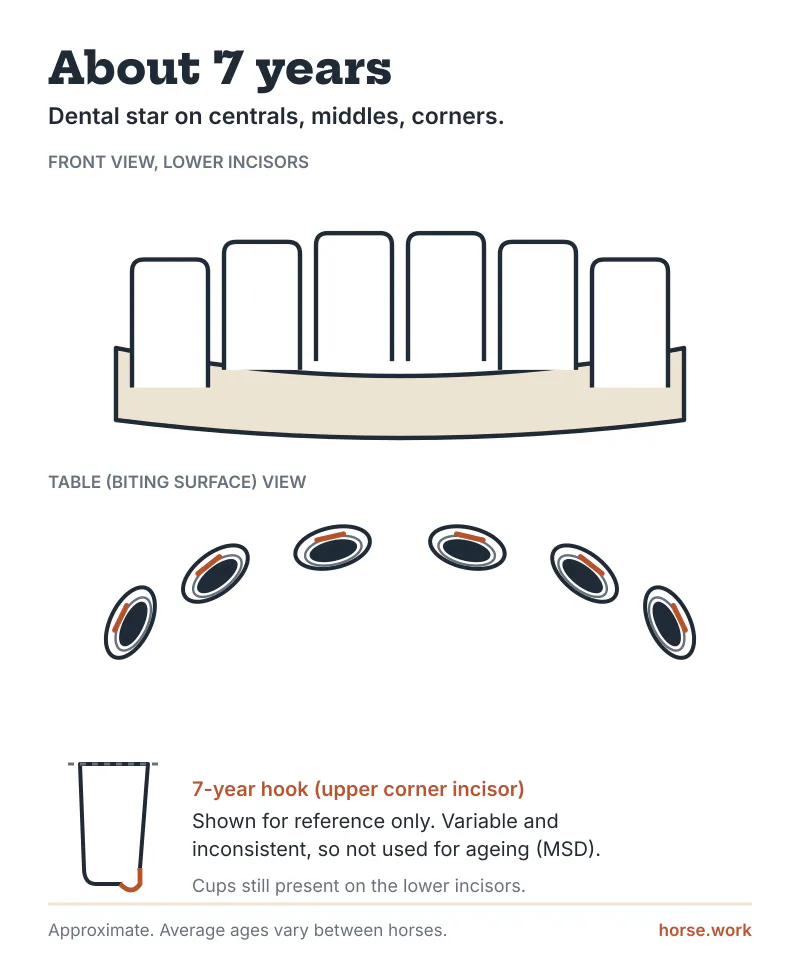
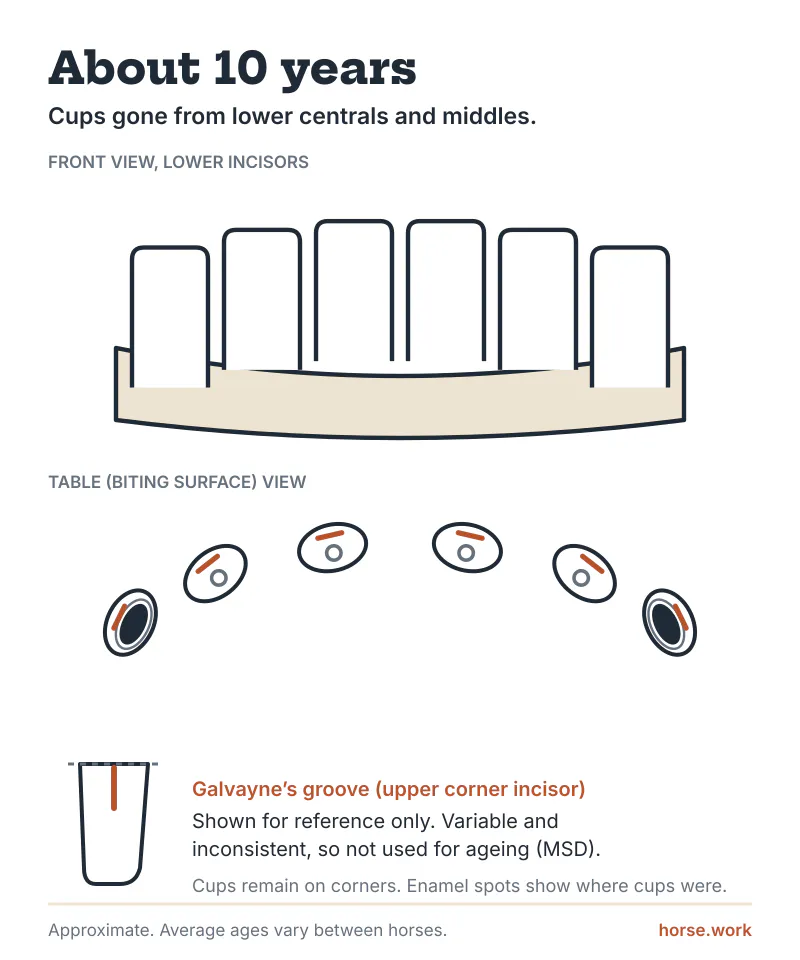
- Cups: the dark, funnel-shaped infoldings on the biting surface (the anatomical name is infundibulum). They get smaller and shallower with wear and eventually disappear [1].
- Dental star: a yellowish-brown mark (the pulp horn) that appears in front of the cup as the tooth wears. Later a white spot appears in its centre [1].
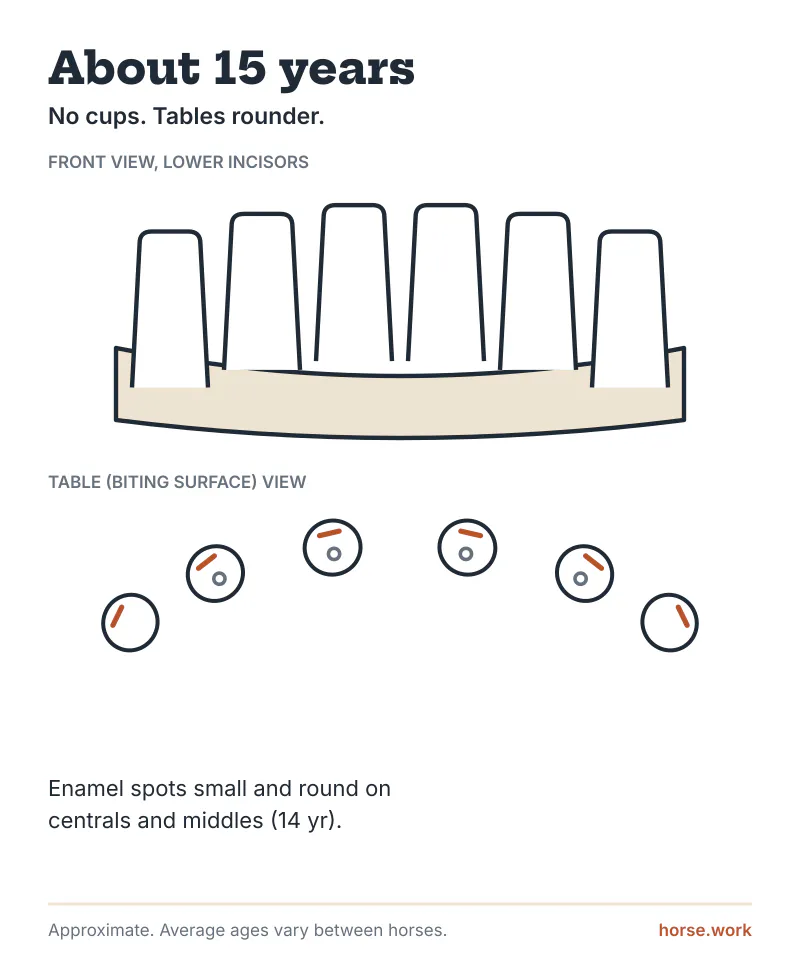
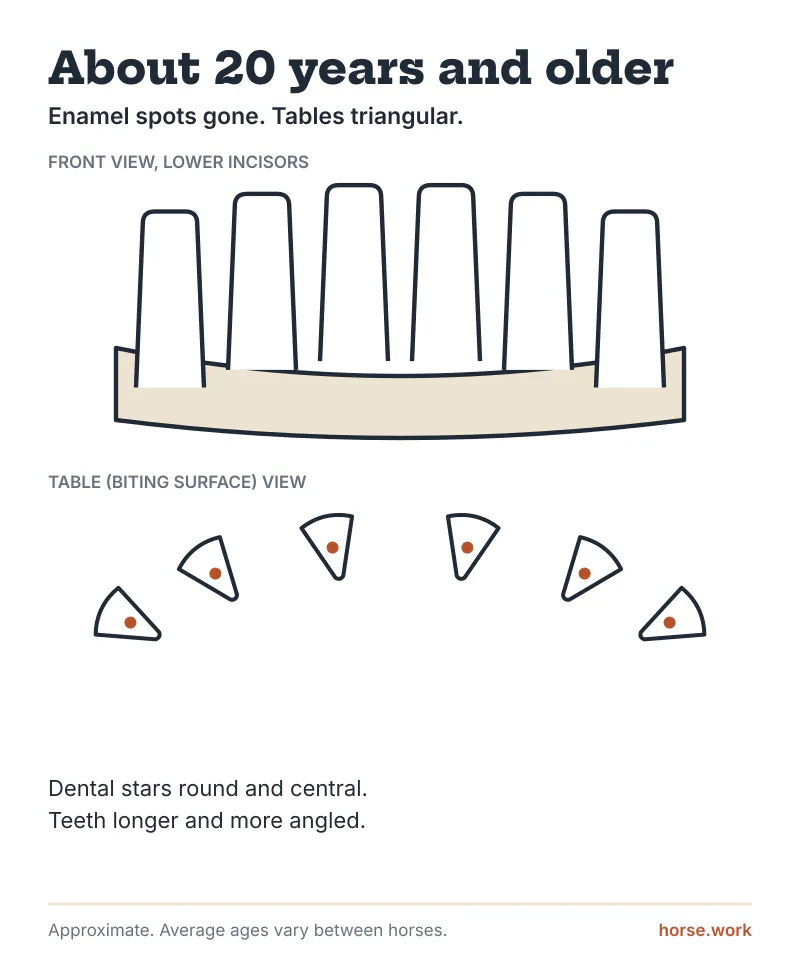
- Shape of the biting surface: oval when young, then trapezoid, round, and finally triangular in older horses [1].
The incisors are named centrals (front middle pair), middles (next pair out) and corners (outermost).
Birth to five: eruption times
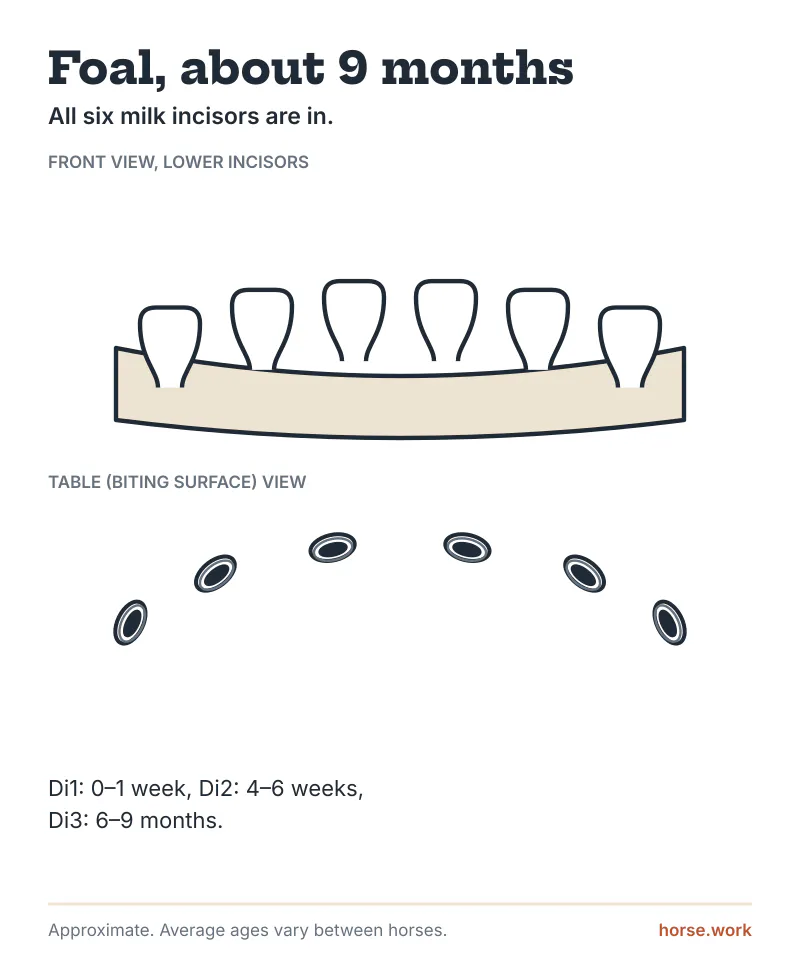
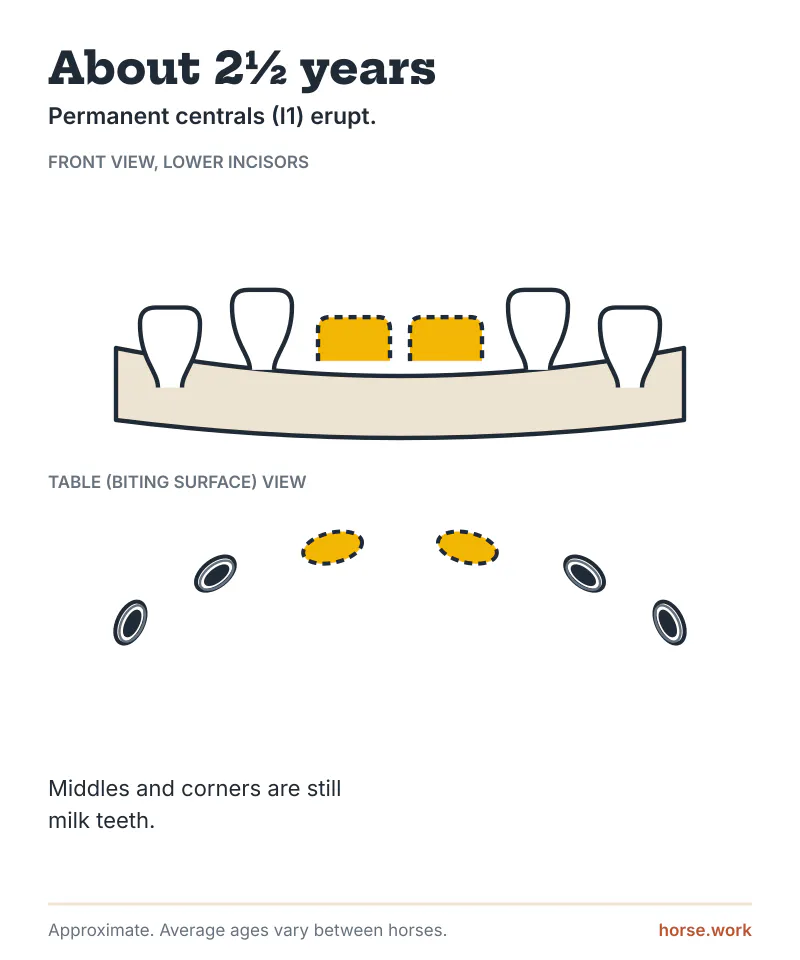
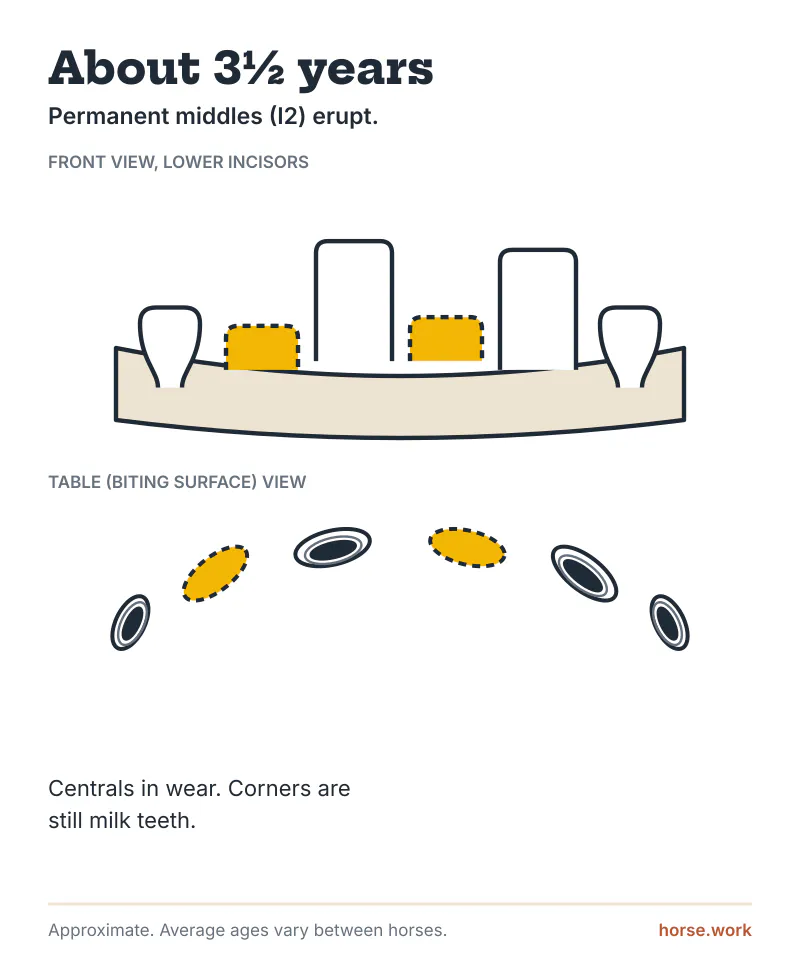
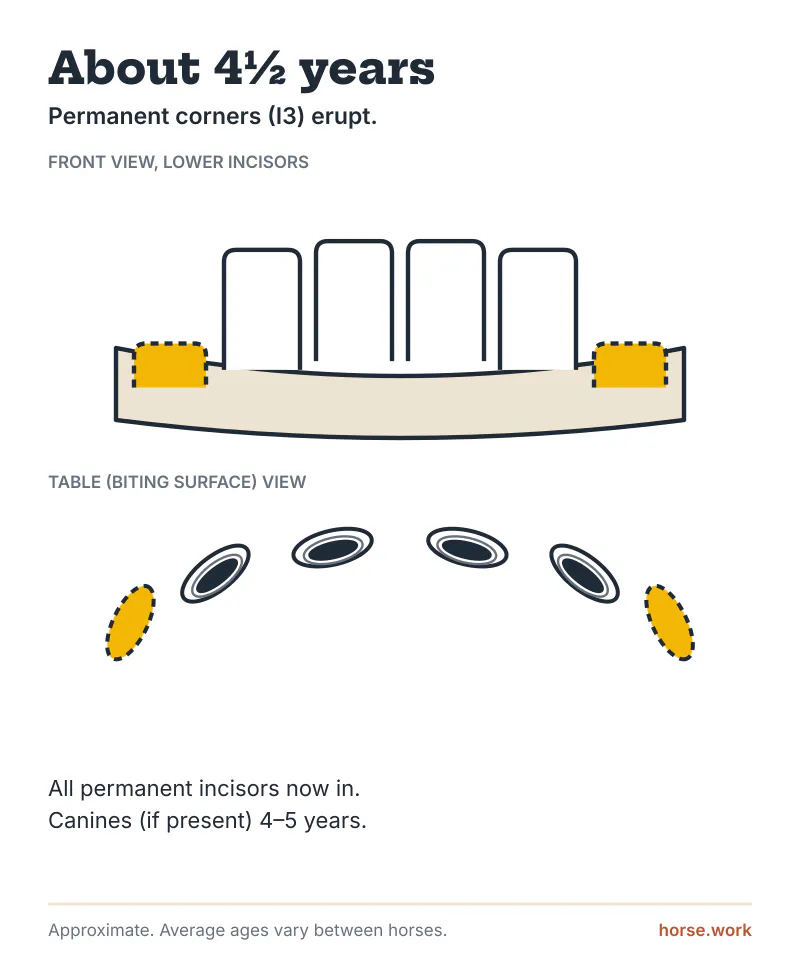
This is the most reliable window. MSD gives these average eruption times [1]:
| Tooth | Average eruption |
|---|---|
| Baby centrals (Di1) | Birth to 1 week |
| Baby middles (Di2) | 4–6 weeks |
| Baby corners (Di3) | 6–9 months |
| Permanent centrals (I1) | 2½ years |
| Permanent middles (I2) | 3½ years |
| Permanent corners (I3) | 4½ years |
| Canines (if present) | 4–5 years |
MSD notes its table is "average data, subject to considerable variation" [1], so give the answer as a range.
After five: the wear chart
Permanent teeth are normally all in by five. After that, MSD warns that ageing by teeth becomes inaccurate because of malocclusion, dental floating (rasping), husbandry and individual or breed differences [1].
With that caution, here is MSD's chronology of the most useful signs [1]:
| Age | What you may see |
|---|---|
| 5 years | Corner incisors erupting. Dental star on the centrals. |
| 6 years | Dental star on the middles. Cups gone from the upper centrals. |
| 7 years | Dental star on the corners. Cups gone from the upper middles. |
| 8 years | Centrals trapezoid in shape, with a white spot in the dental star. Cups gone from the upper corners. |
| 9 years | Middles trapezoid, with a white spot in the dental star. Cups gone from the lower centrals. |
| 10 years | Enamel spots on the centrals oval-triangular. Cups gone from the lower middles. |
| 11 years | White spot in the dental star on the corners. Cups gone from the lower corners. |
| 12 years | Cups gone from all incisors. |
| 14 years | Enamel spots on the centrals and middles small and round. |
| 18 years | Enamel spots gone from the centrals. |
| 20 years | Enamel spots gone from the middles and corners. |
The enamel spot is what's left at the bottom of a cup once the cup has worn away [1].
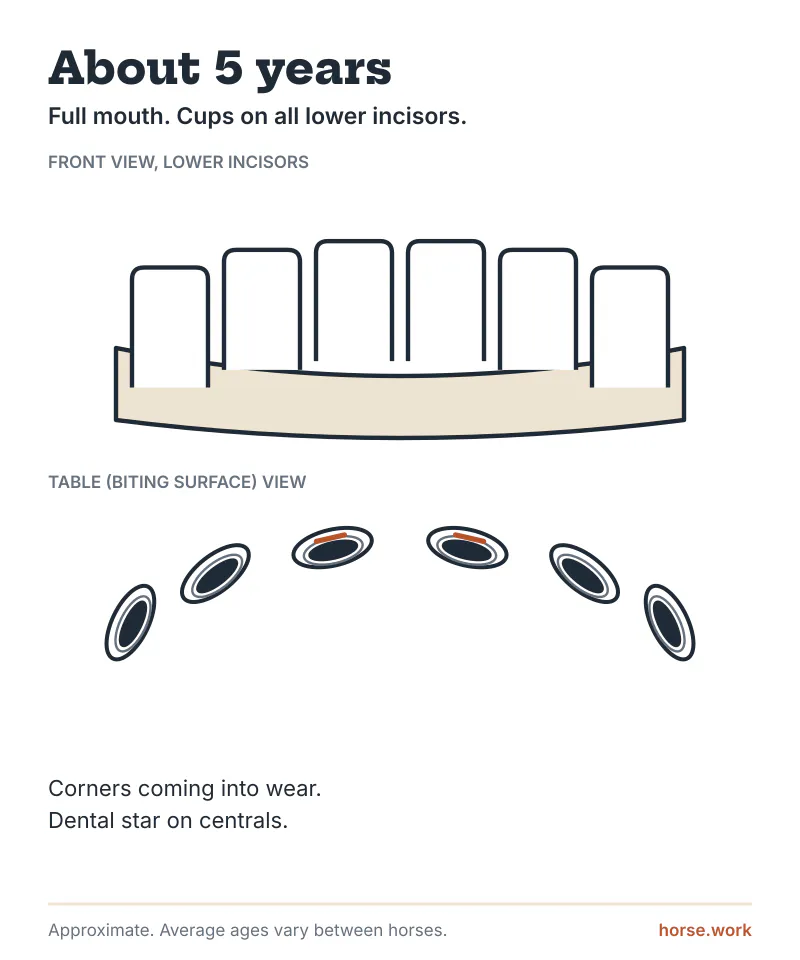
MSD also notes two broader changes with age: the arch formed by the lower incisors goes from a semicircle in young horses to a straight line in older ones, and the angle where the upper and lower incisors meet becomes sharper as the horse ages [1].
What about Galvayne's groove and the 7-year hook?
You'll see both in older books and on plenty of websites. Don't rely on them. MSD calls Galvayne's groove (a groove on the upper corner incisor) and the "7-year hook" "variable, inconsistent, and thus of little value for age determination" [1]. Our illustrations show them only as small insets marked "for reference only, not used for ageing".
X-rays can help in young horses
MSD notes that X-rays of the cheek teeth can also help estimate age in young horses, because the roots mature and close at 5 to 8 years old. In older horses, X-ray signs of age are also inaccurate [1]. This is a job for your vet, not a home check.
Worked example
You look at a horse's lower incisors. All permanent teeth are in, there's a dental star on the centrals and middles but not yet on the corners, and the cups are still present on all the lower incisors.
From the table, that fits about 6 years, so a sensible answer is "about 6, possibly 5–7". If the horse has had a lot of dental work, or has a parrot mouth or other malocclusion, widen the range or don't guess at all.
Our interactive age from teeth guide steps you through the same questions and gives a range.
Tips for looking
- Ask someone experienced to hold the horse.
- Use a torch. Look at the lower incisors from the front with the lips parted, then at the biting surfaces.
- Take photos so you can compare them with the chart without rushing.
- Don't put your fingers between the teeth.
Look after those teeth
While you're looking, check for sharp edges, damage or anything unusual. Agriculture Victoria recommends a dental check by a trained equine dentist at least once a year for paddock horses, and every 3 to 6 months for horses under five and for grain-fed horses [2]. Set a reminder with the care planner and find a qualified practitioner in the equine dentists directory.
Frequently asked questions
Can you tell a horse's age by its teeth? Fairly well up to about five, while teeth are still erupting. After that, only roughly, and the older the horse, the rougher the guess [1].
What are cups and dental stars? Cups are funnel-shaped infoldings in the biting surface that wear away with age. Dental stars are yellowish-brown marks that appear as the tooth wears [1].
Why does my 8-year-old look older (or younger) in the mouth? MSD lists malocclusion, dental floating, husbandry and individual or breed differences as reasons teeth don't match age after five [1]. Diet and grazing on sandy country can also change wear.
Does dental floating change the age estimate? It can. Rasping changes the tooth surfaces, which is one reason MSD warns that ageing after five is inaccurate [1].
How do I prove a horse's age? Registration or breeding papers, or a vet's assessment.
Summary
- Under 5: eruption times give a fairly reliable estimate.
- 5 to about 12: dental stars and disappearing cups give a rough range.
- Over 12: enamel spots and tooth shape give only a broad guess.
- Ignore Galvayne's groove and the 7-year hook.
- For a real answer, check the papers or ask a vet or equine dentist.