
How to tell a horse's age by its teeth
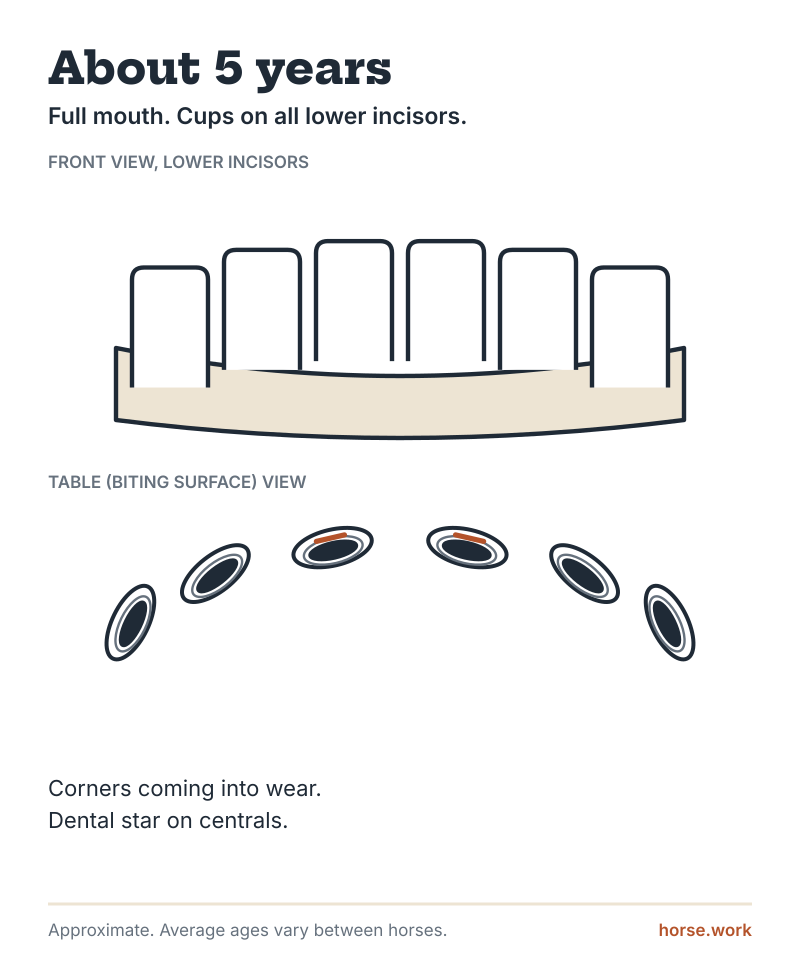
A horse's front teeth (incisors) change in a fairly predictable way as it grows. That's why "looking in the mouth" has long been used to estimate age. This guide steps through what to look for, from baby teeth in foals to permanent teeth, the "cups" and "dental stars" on the biting surface, and the changing shape of the teeth. It's based on the MSD Veterinary Manual. It's most accurate up to about 5 years, while teeth are still erupting. After that, estimates are increasingly approximate. For a reliable age, check registration papers or ask a vet or qualified equine dentist.
Have a vet or equine dentist check. This guide and its illustrations are simplified and are awaiting review by a vet or equine dentist. Use it as a rough guide only, and ask a vet or qualified equine dentist to confirm a horse's age.
Estimated age
5 years
Most reliable while teeth are still erupting.
Privacy: Runs in your browser. Nothing you type is stored or sent to horse.work.
This tool gives an estimate only. It is general information, not veterinary, nutrition, legal or tax advice. Every horse and every situation is different. Check with your vet, equine dentist, farrier or a registered tax agent before you act on the result.
Ready to book?
Find local providers in the horse.work directory.
How to use it
- Look at the lower incisors.
- Pick the description that best matches.
- Read the estimated age range.
How it's worked out
Permanent incisors erupt at about 2½ (centrals), 3½ (middles) and 4½ years (corners). After 5, dental stars appear and cups wear away in sequence. The MSD table is average data, subject to considerable variation, so results are shown as a range. Galvayne's groove and the "7-year hook" are shown for reference only and are not used for ageing.
Questions
- Can you tell a horse's age by its teeth?
- Fairly well until about 5. After that, only roughly.
- What are cups and dental stars?
- Cups are infoldings in the biting surface that wear away. Dental stars are darker marks that appear as the tooth wears.
- What is Galvayne's groove?
- A groove on the upper corner incisor once used for ageing, now considered unreliable.
- Is it safe to look in a horse's mouth?
- Only if the horse is used to it and someone experienced is helping.
- How do I prove a horse's age?
- Registration papers, or ask a vet.
Sources
Sources checked: 17 Oct 2026.