General information only. Not veterinary advice. Heat stress can become life-threatening quickly. If your horse is distressed, staggering, breathing hard or not improving after cooling, call your vet straight away. This guide doesn't cover medicines or doses; those are for your vet to decide.
An Australian summer is hard on horses. They are big animals that make a lot of their own heat, and they rely on sweating, shade, airflow and plenty of water to stay cool. When the temperature stays high for several days, especially if the nights don't cool down, they can run into trouble faster than many owners expect.
This guide covers the everyday summer basics: recognising heat stress, setting up water and shade, using electrolytes, protecting pink skin, managing flies, and travelling in hot weather. Some summer problems have their own articles. For midge allergy, read Queensland itch in horses. For long trips, read our long-distance floating guide.
When does heat become dangerous?
There isn't a single cut-off temperature, but official guides give useful markers.
- Agriculture Victoria tells animal owners to plan ahead for days over 36 °C in dry heat, and lower if it's humid. It suggests watching the apparent temperature, which accounts for humidity and wind, not just the forecast maximum [1].
- Risk rises with several hot days in a row, and with nights that stay above 25 °C, because animals don't get a chance to cool down overnight [1].
- RSPCA Australia says horses are at risk of heat stress once temperatures go above 25 °C, particularly if they're being worked [3].
The practical message is to watch the forecast for runs of hot days and warm nights, not just one hot afternoon, and to change your plans before the heat arrives.
Which horses are most at risk?
The Queensland Racing Integrity Commission (QRIC) lists the factors that raise the risk of heat stress in horses [2]:
| Risk factor | Why it matters |
|---|---|
| Long-distance travel | Horses are confined, can't move into shade or wind, and may not drink well |
| Water withheld | Even short periods without water add to dehydration |
| Excitable or anxious horses | They sweat and burn energy before any work starts |
| Not acclimatised | Horses that have recently moved from a cooler climate cope less well |
| First-up horses (first run after a spell) | They aren't yet fit for hard work in the heat |
| Sweating problems | Horses that sweat too much lose fluid fast; horses that sweat too little ("dry-coated") can't cool themselves |
Agriculture Victoria adds that horses in heat often sweat heavily and eat less [1]. If your horse leaves feed in hot weather, take note.
Signs of heat stress, and what to do
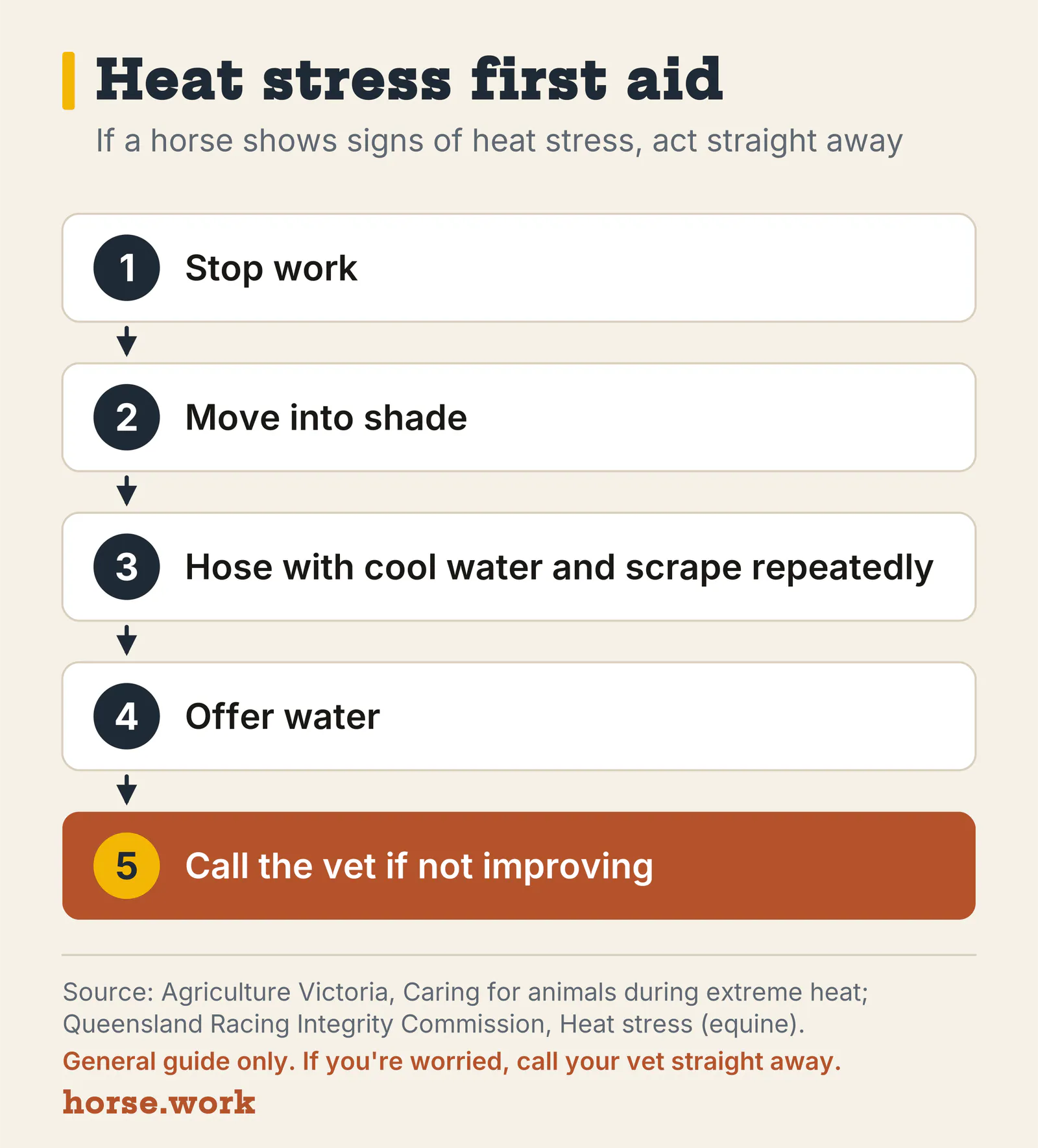
QRIC describes heat stress signs in horses as rapid, shallow breathing with flared nostrils, staggering, agitation, kicking and, in severe cases, collapse [2].
If you see these signs:
- Stop work and get the horse into shade. Walk it quietly in the shade if it can walk safely [2].
- Cool with plenty of water, over and over. QRIC recommends repeatedly applying cool water and scraping it off [2]. Agriculture Victoria suggests hosing from the feet upwards, or using sponges or wet towels, and scraping off excess water unless there's a good breeze [1]. QRIC also mentions towels soaked in iced water [2].
- Offer water to drink.
- Call your vet. Agriculture Victoria says to contact a vet if the horse doesn't improve [1]. Don't wait if the horse is staggering, collapsing or very distressed.
Water: more than you think
Water is the single most important thing you can provide in summer.
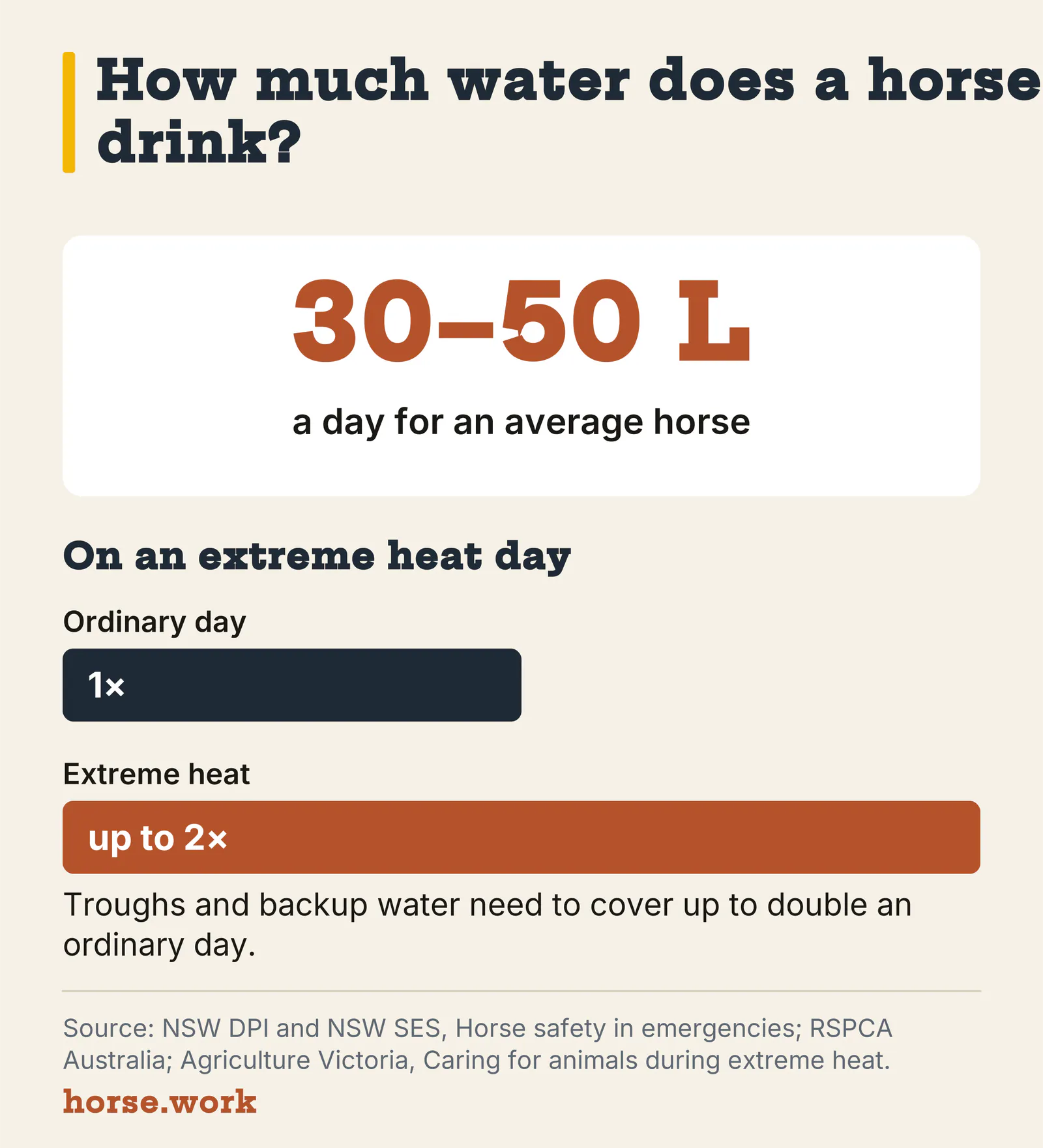
An average horse drinks about 30 to 50 litres a day, according to NSW DPI and NSW SES [5]. The RSPCA gives the same 30 to 50 litre range and notes that horses drink more in warm weather [3]. Agriculture Victoria warns that animals' water consumption may double during extreme heat [1].
Practical set-up tips from Agriculture Victoria [1]:
- Large concrete troughs stay cooler than small or shallow ones.
- Bury supply pipes (it suggests about 15 cm) so the water arriving at the trough isn't hot.
- Check that the supply can keep up with peak demand when every horse drinks at once.
A few more checks that are worth making part of your summer routine:
- Check troughs at least twice a day on hot days, and clean out algae and dead birds or animals.
- Have a backup supply, such as a tank, drums or buckets, in case a float valve sticks, a pump fails or the power goes out.
- If horses share a trough, watch that a dominant horse isn't keeping others away.
The RSPCA also suggests providing a salt block [3].
Electrolytes
Horses lose salts as well as water when they sweat. Agriculture Victoria suggests adding electrolytes to feed for horses in hot weather [1]. Fresh, clean water must always be available as well.
Ask your vet which product suits your horse and how much to give, especially if your horse is in hard work, travelling, older, or has a medical condition. Don't guess doses or combine several products.
Shade and shelter
The RSPCA's advice is that in Australia, shade matters more than shelter from wind and rain [4]. Some points it makes:
- Digesting fibre produces heat, so even a horse standing still in a paddock is making heat of its own [4].
- Horse flies prefer full sun, so shade also gives horses some relief from biting flies [4].
- Stables can get too hot. A stable with an attached shaded yard lets the horse choose [4].
- A shelter needs to be big enough for every horse in the paddock to use it at once, so lower-ranked horses aren't pushed out [4].
Agriculture Victoria recommends shelter that still lets the wind through [1]. Trees are excellent, but on a hot afternoon the shade moves, so check where it falls between about 11 am and 4 pm.
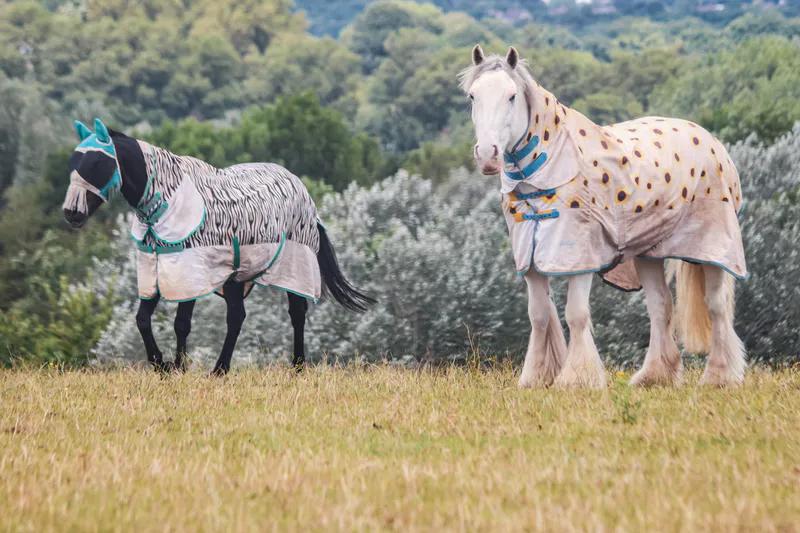
On summer rugs, the RSPCA's advice is that rugs aren't recommended for horses in summer [3]. If you use a fly rug, check it isn't making the horse hot, and look under it daily.
Sunburn and photosensitisation
Horses with white or pink skin, often on the face and muzzle, can get sunburnt [4]. The RSPCA also notes that breeds such as Clydesdales and Appaloosas are more prone to eye cancer [4]. Good shade is the first line of defence. Ask your vet which sun protection products are safe if your horse has pink skin that keeps burning.
Sometimes what looks like bad sunburn is actually photosensitisation. In this condition, something the horse has eaten, or liver damage, makes unpigmented skin react badly to sunlight. AgriFutures Australia reported cases in thoroughbreds at two studs in northern Victoria in 2020 that were linked to cowpea aphid infestations on older lucerne. The advice was to move affected horses off the pasture and involve a vet [6].
Call your vet if pink skin becomes red, swollen, weeping or peeling, especially if several horses in the same paddock are affected or the problem appeared after a change in pasture or hay.
Flies and midges
Summer brings biting flies and midges. Some practical steps:
- Provide shade, because horse flies prefer full sun [4].
- Use fly masks and fly rugs that fit well, and check them daily for rubs and heat build-up.
- Manage manure and wet areas around yards to reduce breeding sites.
If your horse rubs its mane and tail raw every summer, it may have an allergy to biting midges. Read Queensland itch in horses for the full picture. In the north and along the east coast, warm weather is also tick season, so read up on paralysis ticks and horses.
Riding and working in the heat
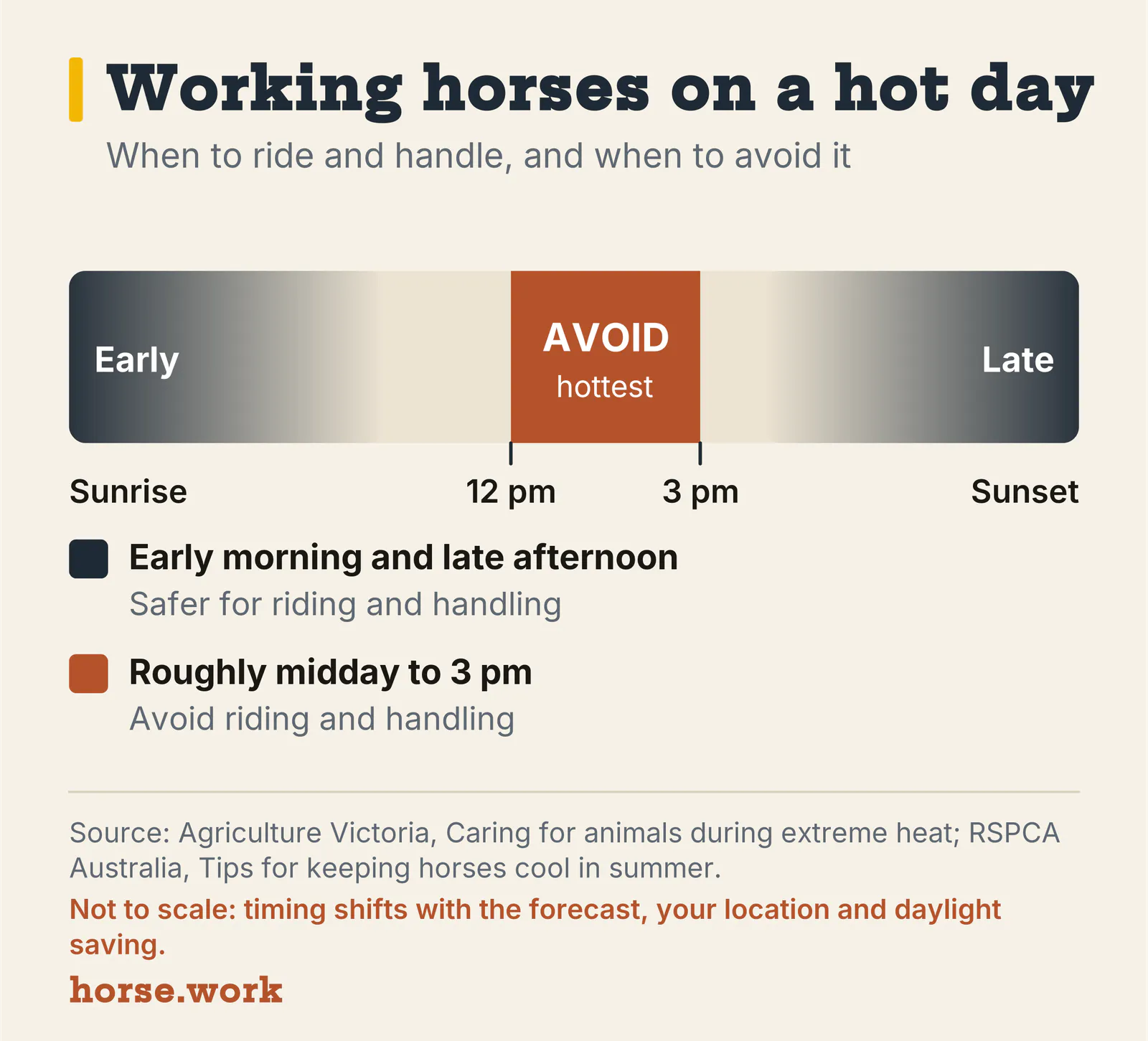
- Ride early in the morning or late in the afternoon. Agriculture Victoria recommends exercising horses at these times in hot weather [1], and the RSPCA suggests avoiding riding in the hottest part of the day, roughly between midday and 3 pm [3].
- Agriculture Victoria advises handling animals early or late in the day as well [1], which also applies to farrier, dentist and vet visits. Book them early on hot days if you can.
- Cool horses down properly after work, and offer water.
- Be careful with horses coming back from a spell. QRIC lists first-up horses as a higher risk [2].
Travelling in hot weather
Long trips are on QRIC's list of heat stress risk factors [2]. Agriculture Victoria's transport advice for hot weather is to travel in the cooler hours, plan stops with shade and water, and when you stop, park the vehicle at right angles to the wind so air flows through [1].
Other tips for summer travel:
- Never leave a horse in a parked float or truck in the sun.
- Offer water at every stop, and carry far more than you think you'll need.
- Check the weather and fire danger rating on the day of travel, and be ready to postpone.
For more on long trips, read the long-distance floating guide. If you're booking a professional, the horse transport directory can help, and the transport cost calculator gives a ballpark for the trip.
Heat, fire and power cuts
Heatwaves often come with high fire danger and power outages. Electric pumps and automatic waterers stop when the power goes out. The NSW DPI and SES factsheet advises owners to be self-sufficient for at least three days in an emergency and to not rely on automatic water systems [5]. For fire-season planning, see our bushfire plan for horses.
When to call the vet
Call your vet promptly if your horse:
- shows signs of heat stress that don't improve quickly with cooling, or staggers, collapses or becomes very agitated [1][2]
- stops sweating or has a dry coat on a hot day [2]
- stops eating or drinking, or shows signs of colic (see horse colic signs)
- has red, weeping or peeling skin on pink areas
- is lame or footsore after standing on hot or hard ground
Keep your vet's number, and an after-hours number, somewhere everyone on the property can find it. You can find equine vets near you in the equine vets directory.
Frequently asked questions
How much water does a horse drink in summer? An average horse drinks about 30 to 50 litres a day [5], and more in warm weather [3]. Agriculture Victoria warns that consumption can double in extreme heat [1].
Should I rug my horse in summer? The RSPCA doesn't recommend rugs for horses in summer [3]. If you use a light fly rug, check daily that it isn't making your horse too hot.
Can I hose my horse down when it's hot? Yes. Hosing with cool water and scraping off the excess is the standard first aid for an overheated horse [1][2]. If there's a breeze, Agriculture Victoria says you can leave the water on [1].
What temperature is too hot to ride? There's no single number. The RSPCA says heat stress risk starts above 25 °C [3], and Agriculture Victoria advises planning for days over 36 °C, or lower when it's humid [1]. On hot days, ride early or late, or not at all.
Summer horse care checklist
- Check troughs at least twice a day on hot days, and keep a backup water supply
- Make sure shade covers every horse through the afternoon
- Ask your vet about electrolytes before the first heatwave
- Protect pink skin, and watch for redness or weeping
- Ride, train and book farrier visits early in the morning or late in the afternoon
- Know the signs of heat stress, and practise hosing and scraping
- Plan summer trips for cooler hours, with water and shade stops
- Keep at least three days of feed and water in case of power cuts or emergencies
- Save your vet's after-hours number, and record any heat-related issues in your horse health record