Not veterinary advice. Tick paralysis can kill, especially in foals. If your horse is wobbly, weak or having trouble breathing or swallowing, call your vet immediately. Don't wait to see if it improves after you remove the tick.
If you keep horses along the east coast, from north Queensland down through coastal NSW, spring means tick season. Most adult horses cope, but foals and small horses can be badly affected, and owners who know the signs get help sooner.
Which ticks affect horses in Australia
The RSPCA lists three main ticks that affect horses here [1]:
- Paralysis tick (Ixodes holocyclus): usually found in coastal areas of eastern Australia in late winter, spring and summer. It can cause paralysis and "can sometimes kill a young foal", while adult horses have some resistance.
- Cattle tick: found in Queensland, north-eastern NSW, the Northern Territory and Western Australia. In NSW, cattle ticks are a notifiable pest: you must report them to the Biosecurity Helpline on 1800 680 244 within one day of becoming aware of them [2].
- Bush tick (New Zealand cattle tick): in Australia, found in coastal south-east Queensland, along the NSW coast and in north-eastern Victoria [1]. It also infests horses, causing irritation and blood loss in large numbers [2].
If you live in a tick-free area and find a tick on your horse, the RSPCA says you must report it to your state agriculture department [1].
When is tick season?
NSW Local Land Services says tick paralysis cases tend to start in late winter, peaking from very early spring through mid-summer, and that tick numbers are usually higher after wet years with thick ground cover, and where there's plenty of wildlife [2]. Paralysis ticks are native and normally live on bandicoots, wallabies, possums and other marsupials [2].
An Australian study of 103 presumed tick cases in horses found cases from North Queensland to the central coast of NSW, more likely in the warmer months [3].
Why foals and small horses are most at risk
Young and small animals are especially vulnerable because of their low body weight and lack of previous exposure [2]. The RSPCA notes paralysis ticks can kill a young foal [1], and a case report in the Australian Veterinary Journal describes tick paralysis in an adult Miniature Horse, which recovered with antiserum and intensive care [4].
One finding from the 103-case horse study is worth knowing: horses over 6 months old and over 100 kg had higher odds of dying than younger, lighter horses in that group [3]. So while foals are at risk of being affected, an adult horse that does go down with tick paralysis is also a serious emergency. Overall, 74% of the horses in the study survived [3].
Signs of tick paralysis
NSW Local Land Services describes signs in livestock appearing 3–5 days after an adult female tick attaches, and says that without treatment death can occur within 1–5 days [2]. Early signs include [2]:
- hind leg weakness and a wobbly, uncoordinated walk
- paralysis that moves forward up the body
- going down and being unable to get up
- increased breathing effort or grunting
- difficulty swallowing.
The MSD Veterinary Manual describes tick paralysis as a progressive, ascending paralysis, and notes that with I. holocyclus signs may not improve straight away after the tick is removed [5]. That's why vets say don't wait.
What to do if you suspect tick paralysis
- Call your vet now. Treatment is tick antiserum, given as early as possible, plus supportive care [5]. In the horse study, horses that got a higher antiserum dose had better odds of survival [3]. The dose is your vet's decision.
- Keep the horse quiet, cool and in the shade. Stress and heat make things worse. Don't force a weak horse to walk.
- Search for more ticks. There's often more than one.
- Don't give food or water by mouth if the horse is having trouble swallowing. Ask your vet first.
The horse study found that horses lying down for more than 120 hours had higher odds of dying, and that complications occurred in 35% of cases [3]. Get help early.
How to check your horse for ticks
In tick areas, the RSPCA says horses must be checked regularly [1]. Make it part of the daily routine in spring and early summer, especially for foals.
NSW Local Land Services notes ticks are often hard to find and hide in places such as between the hooves, in the nostrils, around the anus, vulva and groin, and inside the ears [2]. On horses, also run your hands:
- under the jaw and along the throat
- in the mane and forelock
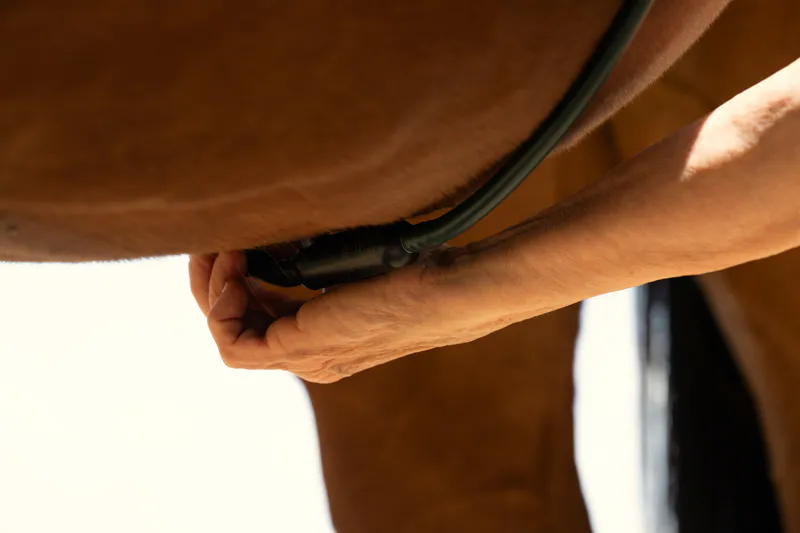
- down the chest, between the front legs and along the belly
- under the tail
- down each leg to the heels.
The RSPCA notes that some horses will rub hard at the spot where a tick has attached [1]. After a tick drops off, you may find a small crater in the skin [2].
Removing ticks
The RSPCA's advice for horses is to spray found ticks with a pyrethrum-based insect repellent (or roll-on), wait about an hour and apply again. The tick should drop off, or can then be removed with tweezers once dead. Don't pull ticks off alive, because the head may be left under the skin [1]. If your horse shows any adverse effects, call a vet [1].
Prevention
There's no perfect prevention. Practical steps:
- Daily checks in tick season, especially foals and minis.
- Keep paddocks short and limit access to bushy, long-grass areas, which provide good tick habitat [2]. Avoid foaling in heavily vegetated paddocks [2].
- Use only products registered for use on horses, and follow the label. Ask your vet which products suit your horses and region.
- Know your vet's after-hours number. NSW Local Land Services also warns there can be national shortages of tick antiserum in high-demand periods [2].
Note tick checks and any treatments in your horse health record, and set seasonal reminders with the care planner.
Moving horses? Ticks travel too
MSD notes that ticks carried on animals, people or plant material can cause isolated cases of tick paralysis far from where the ticks normally live, and that diagnosis may be delayed when an animal travels to an area where tick paralysis isn't usually seen [5]. If your horse has come back from the coast, a show or a new agistment property, check it thoroughly for the next few days, and tell your vet where it has been.
Don't rely on products alone
MSD advises owners not to rely only on chemical control, because no product is totally effective and a single attached tick can cause paralysis [5]. Its prevention advice for pets (daily searching and keeping the coat short to make searching easier) translates well to horses: clipped legs and a pulled mane make ticks easier to find.
MSD also notes that with I. holocyclus, signs usually appear 3–5 days after attachment (rarely up to 18 days), and that removing the tick doesn't immediately stop the disease getting worse [5]. That's why a horse can get worse even after you've found and removed the tick.
Quick reference
- Season: late winter to mid-summer, east coast [1][2]
- Most at risk: foals and small horses [1][2]
- Early signs: hind-leg weakness, wobbliness, laboured breathing, trouble swallowing [2]
- Action: call the vet immediately; antiserum works best early [3][5]