In an emergency, call Triple Zero (000). In Victoria, the VicEmergency Hotline is 1800 226 226 [1]. In NSW, Local Land Services can help with animals in emergencies on 1300 795 299 [3]. Always follow the advice of emergency services.
Looking for the owner checklist? Our bushfire plan for horses covers the steps every horse owner should take: leave early or use a safe area, identification, an emergency kit and caring for horses after a fire. Share it with your clients. This article doesn't repeat it.
This guide is for the business side: agistment centres, livery and stabling yards, riding schools, studs, and spelling and rehab properties. You're responsible for horses you don't own, staff you employ and visitors on site, so you need signed agreements, clear triggers, enough transport and a fast way to reach every owner.
This is general information, not legal or insurance advice. Check the specifics with your fire authority, your state's work health and safety regulator, your insurer and, for agreements, a legal adviser.
Your duty of care: staff, clients and horses
Staff and visitors
As an employer, your work health and safety duties don't stop on a bad fire day. In Victoria, WorkSafe says employers must, so far as is reasonably practicable, "provide and maintain a working environment that is safe and without risks to health" [5]. That includes safe systems of work, and the information, instruction, training and supervision staff need [5]. Employers must also consult employees on health and safety issues, including when identifying hazards and deciding how to control them [5]. Other states and territories have their own regulator and laws, so check yours.
Smoke is a work hazard even when the fire is far away. WorkSafe Victoria says the most effective control is to avoid outdoor work on days when the air quality rating is poor, very poor or hazardous [6]. It describes P2 (N95) masks as the lowest level of control: they only protect if fitted properly, and facial hair stops an air-tight seal [6]. Ordinary paper dust masks, handkerchiefs and bandannas don't filter fine smoke particles [6]. WorkSafe also suggests reviewing first aid arrangements for staff affected by smoke [6].
In practice, your plan should:
- name who makes the call on each trigger, and who stands in if they're away
- never ask staff to stay on site to defend property or horses on a Catastrophic day
- list staff who are more sensitive to smoke, such as those with asthma or heart or lung conditions, and adjust their duties [6]
- cover visitors, contractors, students, parents and residents
Client horses
Agriculture Victoria says everyone who lives, works or agists horses at a property should know and understand its bushfire plan, and that owners who agist should make a plan with the landholder [2]. NSW SES and NSW DPI put it bluntly: "Do not forget agisted horses. Talk with the landholder about risk and establish a plan" [3].
On a fire day, owners may be at work, interstate or cut off by road closures. Without prior agreement, you'll be deciding about their horse under pressure and without consent.
Pre-season agreements with owners
Settle these questions in writing before the fire season, ideally as a bushfire clause or schedule in your agistment or livery agreement. Our agistment agreement checklist covers emergency clauses in general.
| Question | What to agree |
|---|---|
| Who decides to move a horse? | Whether you can move a client's horse without reaching the owner, and from what trigger |
| Owner collection | Whether the owner will collect, by what time, and what happens if they don't arrive |
| Where the horse goes | Your relocation sites, and whether the owner can name their own instead |
| Safe area if not moved | Whether the owner accepts the horse may stay in your on-site safer area |
| Emergency vet authority | Whether you can call a vet and approve treatment if the owner can't be reached, and any limit they set |
| Costs | Who pays for transport, vet care, feed and agistment at the relocation site |
| Insurance | Whether the owner holds their own cover for the horse |
| Contacts | Two phone numbers for the owner, plus a backup person with authority to decide |
Also collect each horse's microchip number, brand or tattoo [2][3], whether it loads and travels easily, any medication, and its regular vet. Agriculture Victoria advises deciding in advance which horses will be evacuated, and training horses to load [2]. Make loading practice part of the agreement for horses that will travel.
Build the owner contact list
Keep one master list: horse, paddock or stable, owner, backup contact, ID, loading notes, medical needs, evacuation priority and relocation site. Store it in the cloud, print copies for the office and vehicles, and update it whenever a horse arrives or leaves. The horse health record can help owners keep their own details current.
Fire Danger Ratings as business triggers
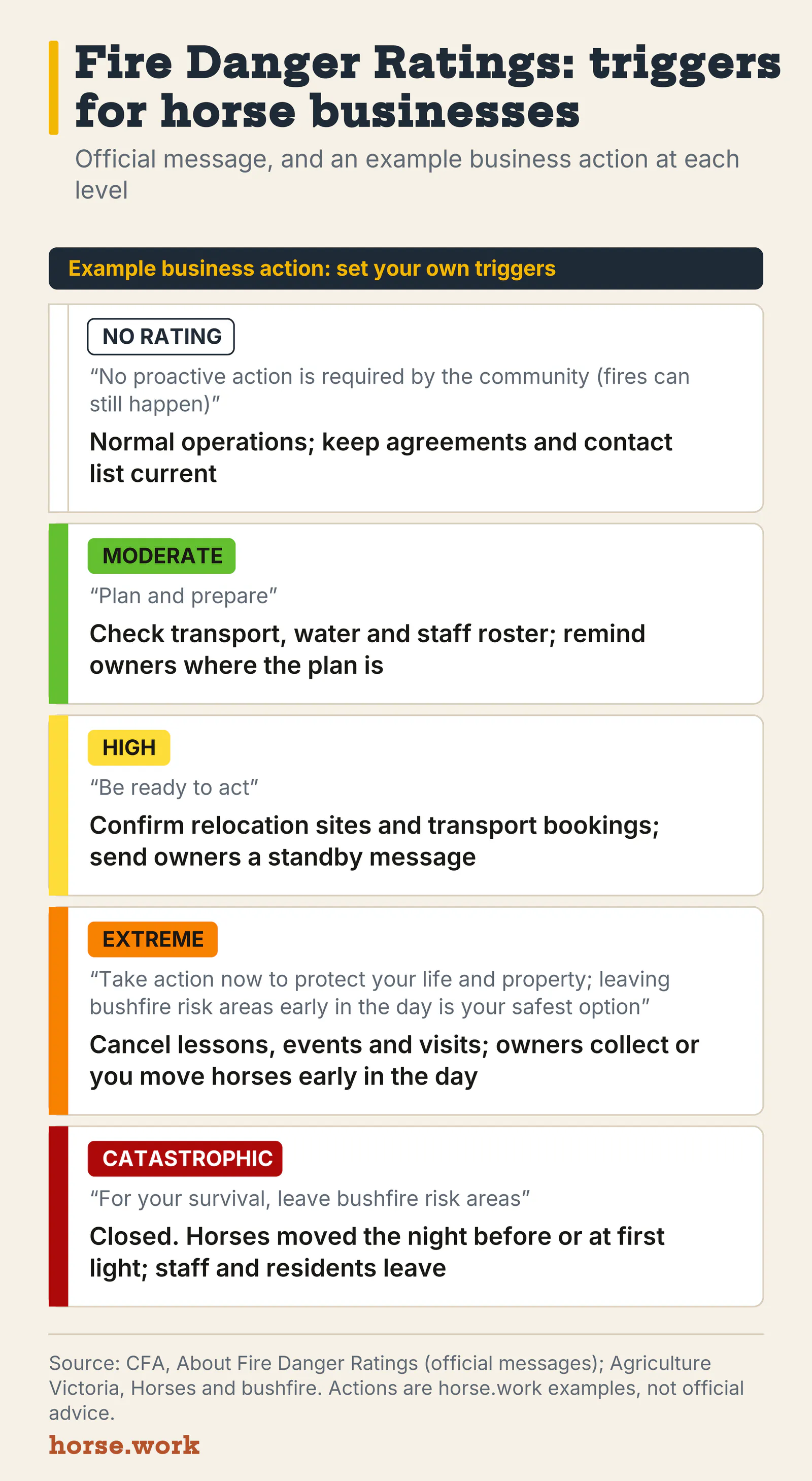
The CFA says "the rating is your trigger to take action", and ratings are forecast up to four days ahead [1]. NSW SES and DPI also recommend setting triggers, such as fire danger ratings, for when you'll act [3]. Agriculture Victoria advises planning "on the basis that you will receive no official warning" [2].
Turn each rating into operating decisions for the business:
| Fire Danger Rating | Official message [1] | Example business action |
|---|---|---|
| No rating | No proactive action is required by the community (fires can still happen) | Normal operations; keep agreements and contact list current |
| Moderate | Plan and prepare | Check transport, water and staff roster; remind owners where the plan is |
| High | Be ready to act | Confirm relocation sites and transport bookings; send owners a standby message |
| Extreme | Take action now to protect your life and property; leaving bushfire risk areas early in the day is your safest option | Cancel lessons, events and visits; owners collect or you move horses early in the day |
| Catastrophic | For your survival, leave bushfire risk areas | Closed. Horses moved the night before or at first light; staff and residents leave |
The "example business action" column is a suggested starting point, not official advice. Write your own triggers based on your site and your local fire authority's advice.
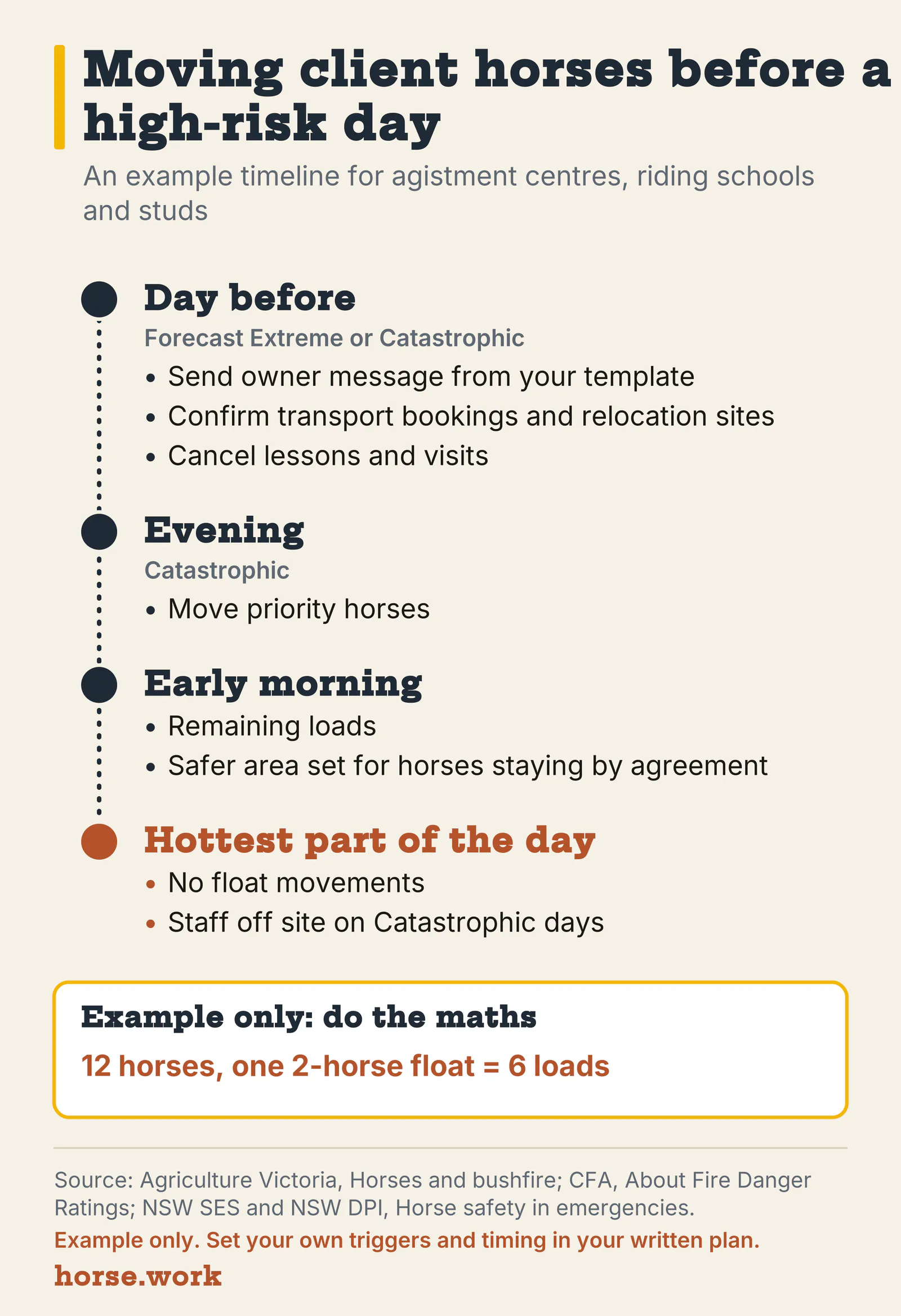
Agriculture Victoria advises that on Extreme or Catastrophic days, horses should be in the safe area, or moved the night before if you plan to leave [2].
Closing for lessons and events
On Extreme and Catastrophic days, the CFA's message is to take action or leave bushfire risk areas [1]. A lesson, clinic or open day brings more people and floats onto your property and roads just when you may need to move horses out. Make cancellation automatic at your chosen rating, not a judgement call on the morning.
Write a cancellation policy now:
- the rating that triggers cancellation, and when you'll confirm it (for example, by 6 pm the day before)
- how bookings are told: SMS, email and a post on your website or social pages
- what happens to fees: rescheduling, credit or refund, as stated in your terms
- the same rule for visiting coaches, farriers and other contractors
Transport capacity for many horses
A business may need to move many horses in a few hours. Work out your real capacity before summer.
- Count horses that will move. Some owners will collect their own horse; some horses may stay in the on-site safer area by agreement.
- Count the float spaces you can rely on: your own, owners who've agreed to bring theirs, and horse transport operators booked in advance, who will also be busy on a bad day.
- Time a round trip to each relocation site, including loading and unloading.
- Do the maths. As an example, 12 horses and one two-horse float means six loads, each with a return trip. If those trips can't be finished well before conditions peak, you need more transport, an earlier trigger, more horses in the safer area, or all three.
Late evacuation can be deadly: roads may be blocked and horses can panic in a float in smoke [2]. Agriculture Victoria lists showgrounds, saleyards, racetracks and pony club grounds as possible relocation sites [2], and NSW SES and DPI advise having more than one site with routes mapped [3]. Confirm before summer how many horses each site will take and what you need to bring.
Our transport cost calculator can help owners budget for a move. If you're deciding whether to own more floats, see hiring vs buying a horse float.
Staff roles
Name a person and a backup for every role, and do a walk-through before the season.
| Role | Responsibilities |
|---|---|
| Plan lead | Watches ratings and warnings, makes the trigger calls, decides when to close and when staff leave |
| Owner communications | Sends all owner messages from the templates, takes calls, updates the master list |
| Transport coordinator | Books and confirms floats, assigns horses to loads, tracks which horse went where |
| Yard team | Catches and loads horses in the agreed order; prepares the safer area for horses that stay |
| Site prep | Pre-season jobs from the NSW RFS Farm Fire Plan, such as slashing, keeping paddocks grazed and having pumps and hoses ready [4] |
| Records | Keeps a written log of decisions, times, horse movements and vet calls for owners and the insurer |
Agriculture Victoria recommends posting your plan where everyone can see it, with the local brigade number, CFA map reference and Property Identification Code [2]. Put the role list next to it.
Owner communication templates
Write these now so whoever is on comms only fills in the blanks. Send by group SMS and email.
Pre-season (start of agreement or before summer)
Our bushfire plan is attached, with an owner checklist. Please confirm your two contact numbers and backup person, and sign the bushfire schedule by [date].
High forecast
[Business] is on bushfire standby for [day], forecast High. No action needed yet. Please keep your phone on and tell us by [time] if you plan to collect [horse].
Extreme forecast
[Day] is forecast Extreme. All lessons and visits are cancelled. Please collect [horse] by [time] or we'll move them to [site] as agreed. Reply YES to confirm.
Catastrophic forecast
[Day] is forecast Catastrophic. We are closed. Horses are being moved tonight and from first light. [Horse] is going to [site] on load [number]. Please don't come to the property on [day].
During a fire
Update [time]: [horse] is at [site / our safer area]. Staff are safe. Next update by [time].
After the fire
[Horse] is at [location]. Vet check: [result / booked for time]. Next steps: [details]. Call [name] on [number].
Insurance questions to ask
Terms vary, so talk to your insurer or an insurance provider before the fire season. Our guide to horse insurance in Australia explains the main types of cover.
- Does my policy cover horses in my care, custody and control that I don't own?
- Am I covered if a client's horse is injured while my staff move it in an emergency?
- Does public liability cover visitors, students and contractors on site?
- Are buildings, fencing, stored hay, floats and equipment covered for fire?
- Do I have cover for business interruption if I have to close or can't operate after a fire?
- What records or photos do I need to make a claim?
- Do my agreements require owners to hold their own cover, and is that consistent with my policy?
Agriculture Victoria advises notifying the insurer as soon as possible if an insured horse has to be destroyed [2].
After the fire: recovery and business continuity
First days
- Account for every horse. Check the master list against where each horse actually is, and message every owner, even if their horse is fine.
- Arrange vet checks. Agriculture Victoria warns that signs of smoke inhalation can appear 3 to 4 hours after a fire, and that hot ground can damage hooves and cause laminitis [2]. Book checks rather than waiting for symptoms. Find a vet in the equine vets directory, and follow the owner-level aftercare in our bushfire plan for horses. If a horse is lost or can't return home, horse rescue services may help.
- Look after staff. Check in with everyone, and keep them off outdoor work if the air quality is still poor [6].
- Start the claim. Contact your insurer early, and photograph damage to fencing, buildings, feed and equipment before clearing it.
Getting back to business
- Keep records. Your decision log, messages, vet reports and receipts support claims and answer owner questions.
- Tell clients when and how you'll reopen. Explain which paddocks, stables or arenas are usable, and what's still being repaired.
- Reopen in stages. Check fences, water and gates before horses return, and lessons and visitors only when the site is safe.
- Review the plan. Debrief staff and owners: what worked, what didn't, and what to change before next season.
Bushfire plan checklist for horse businesses
- Written plan with business triggers for each Fire Danger Rating, posted with brigade number, map reference and PIC
- Bushfire schedule signed by every owner: authority to move, collection, relocation site, emergency vet authority, costs
- Master contact list current, in the cloud and printed
- Lesson, event and visitor cancellation policy published
- Transport capacity counted, operators booked, relocation sites confirmed
- Staff roles and backups named, and staff consulted on the plan
- Owner message templates ready
- Insurance questions answered by your insurer
- Recovery steps and records process agreed